Neural Networks or Traditional Models
Swipe to show menu
In machine learning, there are many model types. Two major groups are traditional models (linear regression, decision trees, SVMs) and neural networks (deep learning). They differ in complexity, data needs, and interpretability.
Differences
Limitations
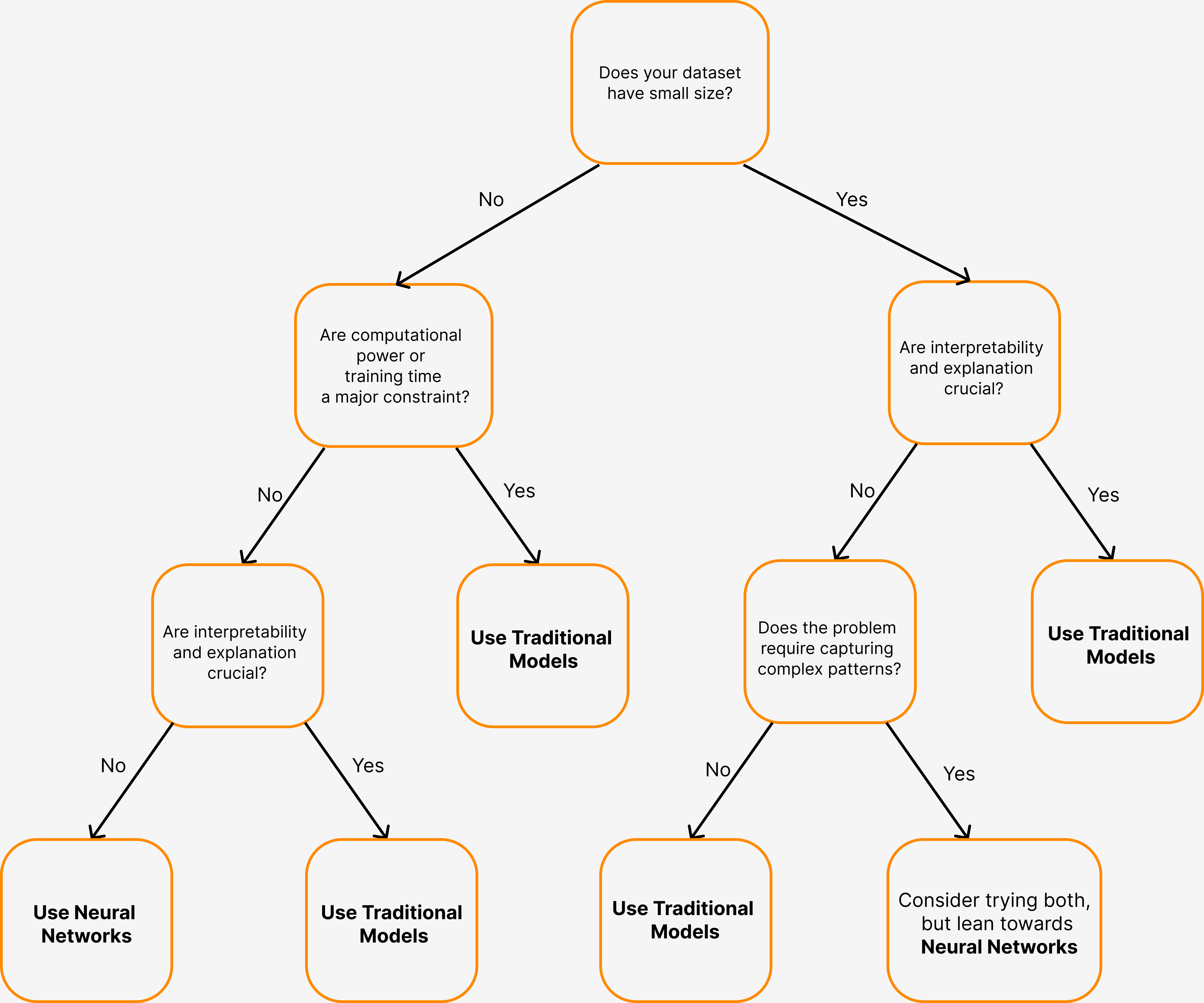
How to Choose Between Them
- Dataset size: small datasets → traditional models; large datasets → neural networks.
- Problem complexity: simple patterns → traditional; complex tasks (e.g., images) → neural networks.
- Interpretability: traditional models are easier to explain.
- Resources: traditional models require less computation and train faster.
Conclusion
There is no universal best choice. Understanding each model type’s strengths and limits helps you select what fits your problem, data, and resources. Experimentation remains the most reliable way to find the right approach.
1. Which model type is more interpretable by design?
2. For a large dataset with complex, non-linear patterns, which model type might be more suitable?
3. In which scenario might you prioritize using a traditional model over a neural network?
Everything was clear?
Thanks for your feedback!
Section 1. Chapter 3
Ask AI

Ask AI

Ask anything or try one of the suggested questions to begin our chat
