Notice: This page requires JavaScript to function properly.
Please enable JavaScript in your browser settings or update your browser.
Lernen The Basics of Ansible Playbooks | Section
Infrastructure as Code

bookThe Basics of Ansible Playbooks

Ansible is an automation tool that helps you manage servers without having to configure each one manually. Instead of logging into every server and typing commands, you write instructions in a file, and Ansible takes care of running them on the target machines. These instruction files are called playbooks.

Playbooks are written in YAML, which is a simple, human-readable format. They describe what should be done, step by step, in a structured way.

What an Ansible Playbook

Note
Definition

An Ansible playbook is essentially a YAML file that defines the automation process. It tells Ansible which hosts to connect to, what tasks to perform, and in what order. Playbooks are the core of how Ansible works, because they contain all the instructions needed to configure a system or deploy an application.

A playbook usually includes:
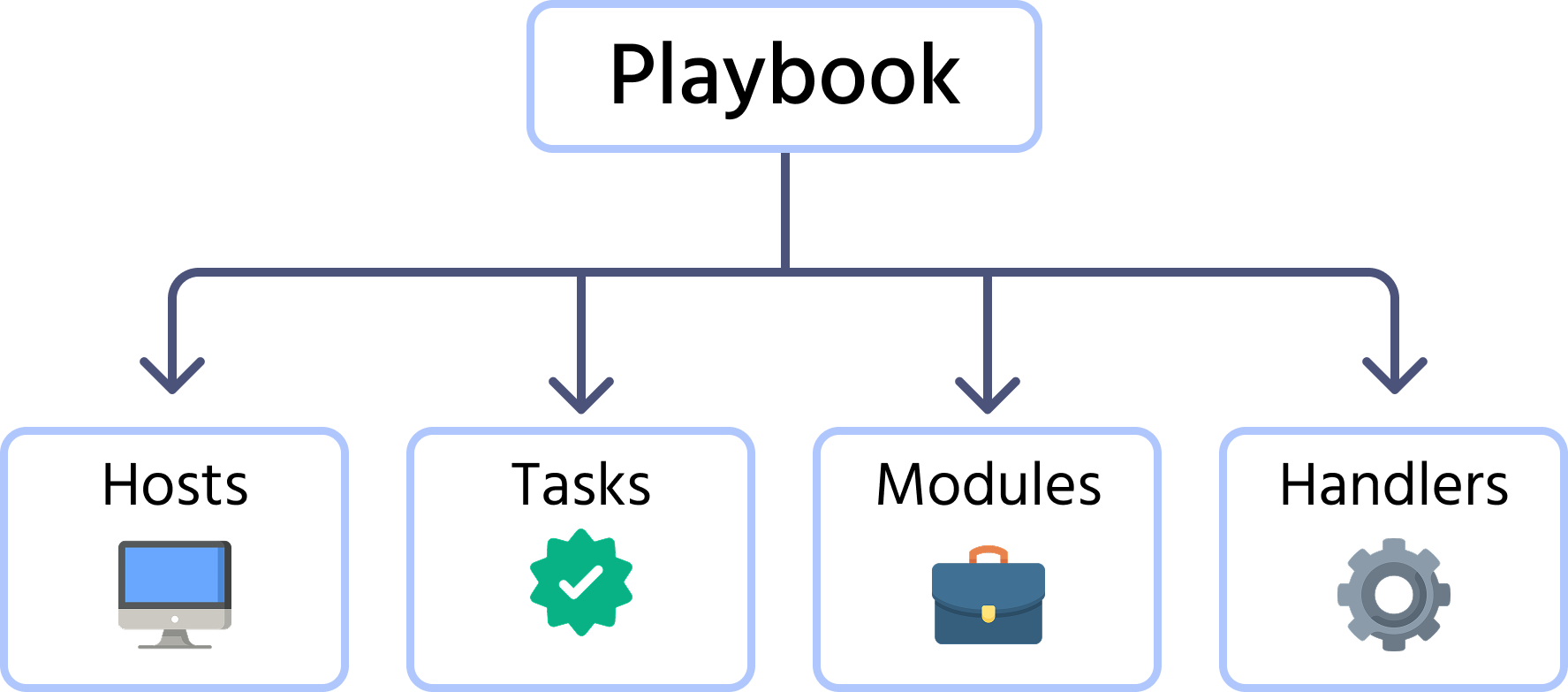
In other words, playbooks bring together hosts, tasks, and modules into one structured file to describe a complete automation workflow.

Example Playbook

Let's look at a very simple example. Imagine you want to create a file on a server and run a handler if something changes. Your playbook might look like this:

example

example

copy

The playbook runs on the server defined by hosts: myserver. Inside the tasks block, the copy module creates a file /tmp/hello.txt with the text "Hello, Ansible!" and notifies a handler if the file is created or changed.

The handlers block contains the Print a message handler, which uses the debug module to show a message. Handlers only run when a task triggers them, which is useful for actions like restarting services or sending notifications after updates.

So, with just a few lines of YAML, you've automated the process of creating a file on a server and triggering a handler when it changes.

question mark

Which Ansible component defines the actions to perform on servers?

Select the correct answer

War alles klar?

Wie können wir es verbessern?

Danke für Ihr Feedback!

Abschnitt 1. Kapitel 5

Fragen Sie AI

expand

Fragen Sie AI

ChatGPT

Fragen Sie alles oder probieren Sie eine der vorgeschlagenen Fragen, um unser Gespräch zu beginnen

bookThe Basics of Ansible Playbooks

Swipe um das Menü anzuzeigen

Ansible is an automation tool that helps you manage servers without having to configure each one manually. Instead of logging into every server and typing commands, you write instructions in a file, and Ansible takes care of running them on the target machines. These instruction files are called playbooks.

Playbooks are written in YAML, which is a simple, human-readable format. They describe what should be done, step by step, in a structured way.

What an Ansible Playbook

Note
Definition

An Ansible playbook is essentially a YAML file that defines the automation process. It tells Ansible which hosts to connect to, what tasks to perform, and in what order. Playbooks are the core of how Ansible works, because they contain all the instructions needed to configure a system or deploy an application.

A playbook usually includes:

In other words, playbooks bring together hosts, tasks, and modules into one structured file to describe a complete automation workflow.

Example Playbook

Let's look at a very simple example. Imagine you want to create a file on a server and run a handler if something changes. Your playbook might look like this:

example

example

copy

The playbook runs on the server defined by hosts: myserver. Inside the tasks block, the copy module creates a file /tmp/hello.txt with the text "Hello, Ansible!" and notifies a handler if the file is created or changed.

The handlers block contains the Print a message handler, which uses the debug module to show a message. Handlers only run when a task triggers them, which is useful for actions like restarting services or sending notifications after updates.

So, with just a few lines of YAML, you've automated the process of creating a file on a server and triggering a handler when it changes.

question mark

Which Ansible component defines the actions to perform on servers?

Select the correct answer

War alles klar?

Wie können wir es verbessern?

Danke für Ihr Feedback!

Abschnitt 1. Kapitel 5
some-alt