Define The Enemy AI
Swipe um das Menü anzuzeigen
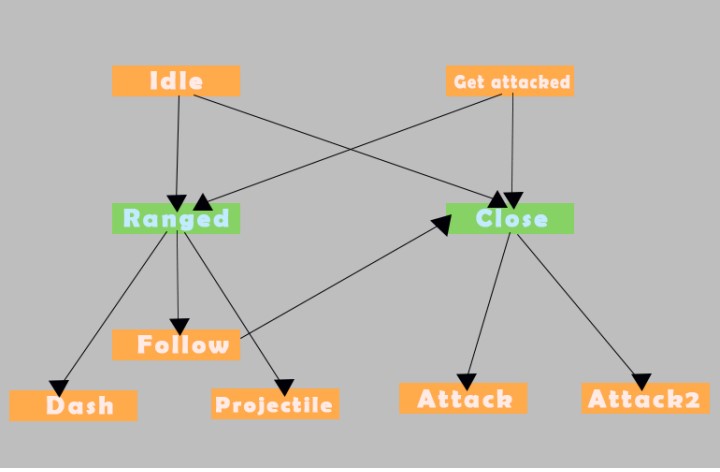
- Idle: This is the default state where the enemy is not engaged in any specific action. From this state, the enemy can transition to other states based on certain conditions;
- Get Attacked: This state represents the enemy being attacked by the player. It triggers animations in response to taking damage;
- Follow: If the player is within range but not too close, the enemy will follow the player, maintaining a certain distance to engage in ranged combat;
- Dash: This action involves the enemy quickly moving in a specific direction;
- Projectile: If the enemy decides to engage in ranged combat, it may launch projectiles towards the player;
- Attack: This represents a generic attack action that the enemy can perform while in close proximity to the player;
- Attack2: Similar to the "Attack" state, this is another type of attack action that the enemy can execute during close combat;
- Idle After Finishing: After performing any action (whether it's attacking, dashing, or launching projectiles), the enemy will return to the idle state to await further commands or player interactions.
Conditions
- Ranged: This condition checks if the player is within a ranged distance from the enemy. If so, the enemy will enter the ranged combat mode, which includes actions like running, dashing, or launching projectiles at the player;
- Close: If the player is within close proximity to the enemy, it will enter close combat mode. In this state, the enemy will primarily focus on attacking the player with close-range attacks, such as attack1 or attack2.
War alles klar?
Danke für Ihr Feedback!
Abschnitt 1. Kapitel 13
Fragen Sie AI

Fragen Sie AI

Fragen Sie alles oder probieren Sie eine der vorgeschlagenen Fragen, um unser Gespräch zu beginnen
