Power of Attorney
Swipe um das Menü anzuzeigen

Wills and trusts deal with what happens after you die. Power of attorney and healthcare directives deal with something equally important and far more likely to affect you in the near term: what happens if you are alive but unable to make decisions for yourself.
A serious accident, a sudden illness, a surgery with complications, or the gradual onset of cognitive decline — any of these can leave you temporarily or permanently unable to manage your finances, communicate your medical wishes, or direct your own care. Without the right documents in place, the people who love you most are legally powerless to act on your behalf. Courts must get involved. Families fight. Decisions get made by strangers.
These documents cost almost nothing to create. The cost of not having them is measured in family trauma, legal fees, and outcomes you would never have chosen.
The Two Documents
Document 1 — Durable Power of Attorney
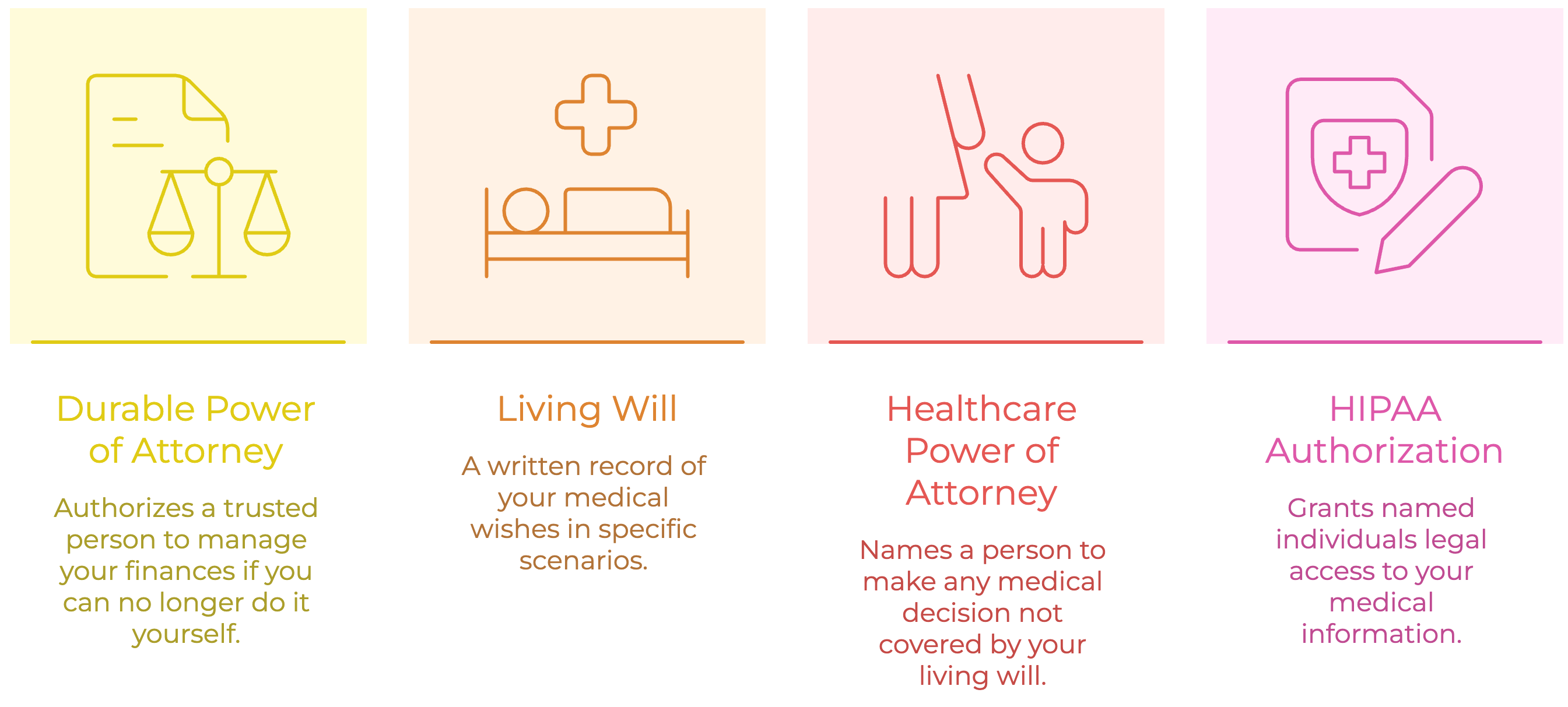
A durable power of attorney (DPOA) is a legal document authorizing a person you choose — your agent or attorney-in-fact — to manage your financial affairs on your behalf.
What it Covers:
- Managing bank accounts and investments;
- Paying bills and filing taxes;
- Managing real estate transactions;
- Operating a business;
- Applying for government benefits;
- Making gifts on your behalf within specified limits.
Why "Durable" Matters: A standard power of attorney becomes void if you become incapacitated — the exact moment you need it most. A durable power of attorney remains valid through incapacity. This is not a minor distinction. Always ensure the document explicitly states it is durable.
Springing vs. Immediate: A springing DPOA only activates upon incapacity — typically requiring a physician's certification that you can no longer manage your affairs. An immediate DPOA is active from the moment you sign it.
Most estate planning attorneys recommend immediate DPOAs for simplicity — activating a springing DPOA during a medical crisis requires paperwork at exactly the wrong moment. The risk of misuse by your agent is managed by choosing someone trustworthy, not by adding activation complexity.
Document 2 — Healthcare Directive
A healthcare directive is an umbrella term covering two related but distinct documents:
Component A — Living Will
A written statement of your medical wishes in specific scenarios — particularly end-of-life situations. It answers questions like:
- Do you want life-sustaining treatment if you are in a permanent vegetative state?
- Do you want artificial nutrition and hydration if you cannot eat on your own?
- What are your wishes regarding resuscitation (DNR/DNI orders)?
- How do you feel about organ donation?
- What matters most to you in terms of quality vs. length of life?
A living will speaks for you when you cannot speak for yourself. Without it, medical teams default to maximum intervention — which may not align with your wishes — and family members are left making agonizing decisions without guidance.
Component B — Healthcare Power of Attorney
While a living will covers specific scenarios, it cannot anticipate every medical situation. A healthcare power of attorney names a person — your healthcare proxy or healthcare agent — to make medical decisions on your behalf in any situation your living will does not explicitly address.
Your healthcare proxy should be someone who:
- Knows your values and wishes deeply;
- Can make difficult decisions under pressure without being paralyzed by grief;
- Will advocate for what you actually want, not what they want for you;
- Is geographically accessible or reachable quickly in an emergency;
- Is willing to have frank conversations with medical professionals.
This does not need to be your closest family member. It needs to be the right person for the role. Sometimes those are the same person. Often they are not.
Why These Documents Are Urgent at Every Age
Most people associate incapacity planning with old age. This is a dangerous misconception.
Consider the statistics:
- The leading cause of long-term disability in working-age adults is not cancer or heart disease — it is accidents and musculoskeletal conditions;
- Approximately 795,000 Americans suffer a stroke each year — many under the age of 65;
- Traumatic brain injuries affect 1.5 million Americans annually, with the highest rates among people aged 15–44.
A 32-year-old in a serious car accident may be unconscious for days or weeks. Without a DPOA, their partner — even a long-term partner or spouse in some states — may be unable to access bank accounts to pay rent, manage investments, or handle basic financial affairs. Without a healthcare directive, the medical team turns to next of kin, whose decisions may not reflect what the patient would have wanted.
These documents are not about being old. They are about being human.
Choosing Your Agents
The choice of agent — both financial and healthcare — is more important than the document itself. A well-drafted power of attorney in the hands of the wrong person is worse than no document at all.
For Your Financial Agent:
- Choose someone financially literate and organized;
- Avoid choosing someone with their own financial difficulties or conflicts of interest;
- Consider whether a professional fiduciary is more appropriate than a family member;
- Name a successor agent in case your primary agent is unavailable, unwilling, or predeceases you.
For Your Healthcare Agent:
- Have an explicit, detailed conversation with this person about your wishes before finalizing the document;
- Do not assume they know what you want — walk them through specific scenarios;
- Make sure they understand that their job is to represent your wishes, not their own;
- Consider naming a different person than your financial agent — the skill sets and emotional requirements are different.
The Overlap Problem:
Naming the same person as both financial and healthcare agent is common and often fine — but consider whether that person can realistically manage both roles simultaneously during a medical crisis. Sometimes dividing responsibilities between two trusted people produces better outcomes.
HIPAA Authorization
The Health Insurance Portability and Accountability Act (HIPAA) restricts who can access your medical information. Even with a healthcare proxy named, medical providers may refuse to share information with family members not explicitly authorized under HIPAA.
A HIPAA authorization form — often a single page — names the individuals permitted to receive your medical information. Without it, your healthcare agent may be making decisions without access to the full medical picture.
This document is free, takes minutes to complete, and is frequently overlooked. Add it to your estate planning checklist.
State-Specific Requirements
Powers of attorney and healthcare directives are governed by state law, and requirements vary:
- Some states require notarization;
- Some require two witnesses who are not beneficiaries;
- Some have specific statutory forms that carry automatic legal recognition across healthcare providers;
- Healthcare directives from one state may not be automatically honored in another.
If you split time between states — a common situation for early retirees pursuing geographic flexibility — consider executing documents that comply with the requirements of both states, or use documents drafted to be as broadly recognized as possible.
Storing and Communicating These Documents
A power of attorney locked in a safe deposit box that only you can access is functionally useless in an emergency.
Best Practices:
- Give your financial agent a copy of the DPOA and tell them where the original is stored;
- Give your healthcare agent a copy of both healthcare documents and ensure they can access them quickly;
- Provide copies to your primary care physician and any specialists for inclusion in your medical file;
- Store digital copies in a secure, shared location — a password manager with emergency access, a shared cloud folder, or a document storage service;
- Tell at least one other trusted person where all documents are located.
Review these documents every 3–5 years or after any major life change — marriage, divorce, death of a named agent, significant health diagnosis, or move to a new state.
The Complete Incapacity Plan
A complete plan for managing incapacity covers:
- Durable Power of Attorney — financial decisions during incapacity;
- Living Will — specific medical wishes in defined scenarios;
- Healthcare Power of Attorney — medical decisions in all other scenarios;
- HIPAA Authorization — access to medical information for named individuals;
- Living Trust (if applicable) — financial management during incapacity without court involvement.
Together these documents ensure that if something happens to you, the right people have the legal authority to act, the medical team has clear guidance, and no court needs to get involved in your personal affairs.
Key Takeaways
- A durable power of attorney authorizes a trusted person to manage your financial affairs during incapacity — without it, even a spouse may be legally unable to access accounts or pay bills during a medical crisis;
- A healthcare directive has two components — a living will specifying your medical wishes in defined scenarios, and a healthcare proxy authorizing a person to make decisions in all other situations;
- Incapacity planning is urgent at every age — accidents, strokes, and traumatic injuries affect working-age adults in significant numbers, and the absence of these documents creates legal and emotional crises at the worst possible moment;
- Choosing the right agents matters more than the documents themselves — have explicit conversations with both agents about your wishes, name successors, and consider whether one person should hold both roles;
- Accessibility is as important as existence — documents stored where no one can find them in an emergency are worthless; share copies with agents, physicians, and at least one other trusted person.
1. Which statements accurately describe the differences and legal implications between springing and immediate durable power of attorney (DPOA)?
2. Which statements accurately describe the distinction between a living will and a healthcare power of attorney?
3. Which statements accurately reflect why incapacity planning is urgent at every age?
4. Which statements are true when choosing agents for financial and healthcare powers of attorney
Danke für Ihr Feedback!
Fragen Sie AI

Fragen Sie AI

Fragen Sie alles oder probieren Sie eine der vorgeschlagenen Fragen, um unser Gespräch zu beginnen
