 Gated Recurrent Units (GRU)
Swipe um das Menü anzuzeigen

Definition
Gated recurrent units (GRU) are introduced as a simplified version of LSTMs. GRUs address the same issues as traditional RNNs, such as vanishing gradients, but with fewer parameters, making them faster and more computationally efficient.
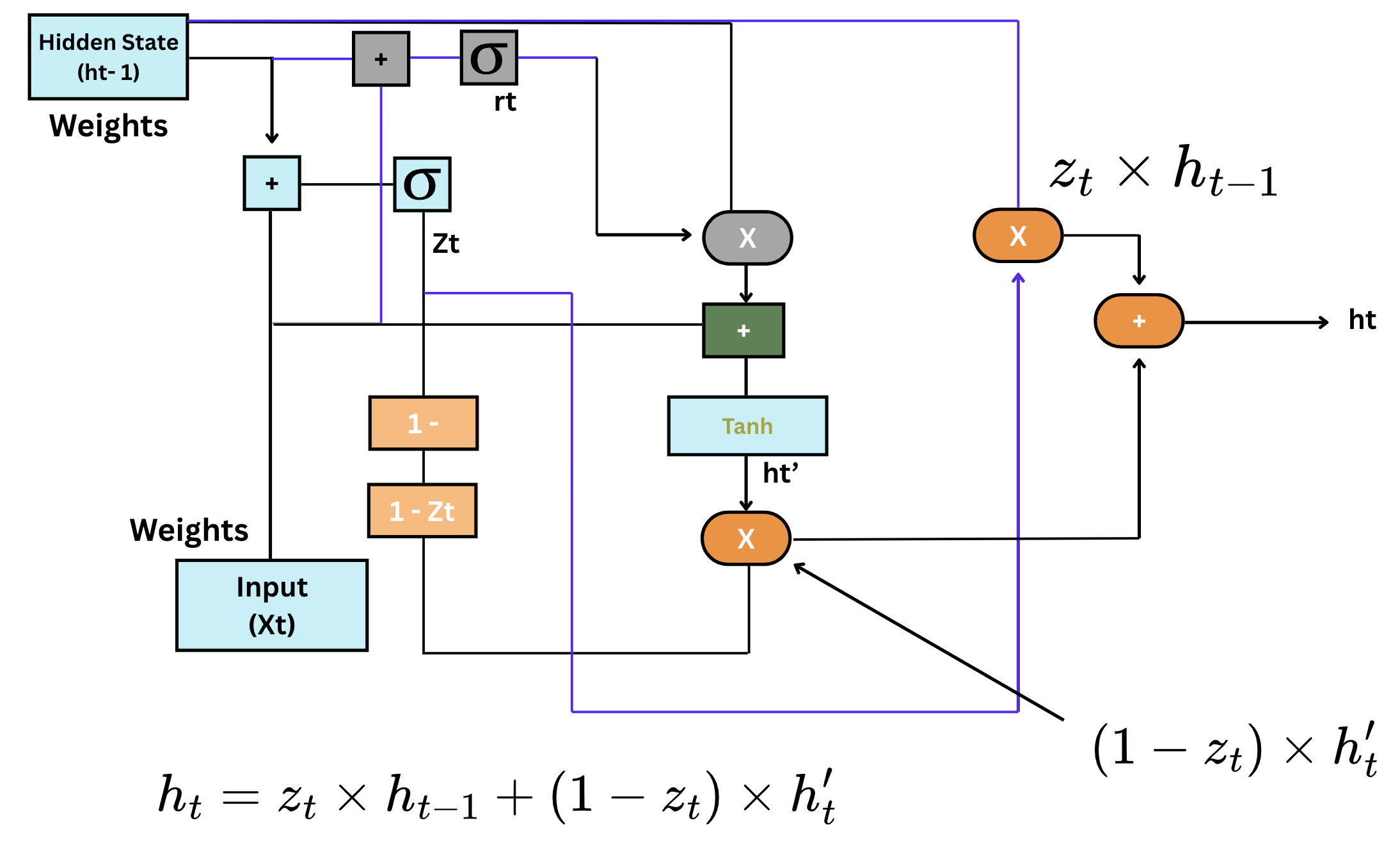
- GRU structure: a GRU has two main components—reset gate and update gate. These gates control the flow of information in and out of the network, similar to LSTM gates but with fewer operations;
- Reset gate: the reset gate determines how much of the previous memory to forget. It outputs a value between 0 and 1, where 0 means "forget" and 1 means "retain";
- Update gate: the update gate decides how much of the new information should be incorporated into the current memory. It helps regulate the model's learning process;
- Advantages of GRUs: GRUs have fewer gates than LSTMs, making them simpler and computationally less expensive. Despite their simpler structure, they often perform just as well as LSTMs on many tasks;
- Applications of GRUs: GRUs are commonly used in applications like speech recognition, language modeling, and machine translation, where the task requires capturing long-term dependencies but without the computational cost of LSTMs.
In summary, GRUs are a more efficient alternative to LSTMs, providing similar performance with a simpler architecture, making them suitable for tasks with large datasets or real-time applications.
War alles klar?
Danke für Ihr Feedback!
Abschnitt 1. Kapitel 10
Fragen Sie AI

Fragen Sie AI

Fragen Sie alles oder probieren Sie eine der vorgeschlagenen Fragen, um unser Gespräch zu beginnen
Abschnitt 1. Kapitel 10
