The Four Levels of Financial Independence
Desliza para mostrar el menú

Financial independence is not a light switch. Most people imagine it as binary — you're either dependent on a paycheck or you're free. In reality, it's a spectrum with distinct stages, each one meaningful, each one worth pursuing in its own right.
Understanding the levels matters for two reasons. First, it makes the journey feel achievable — you're not climbing one enormous cliff, you're ascending a staircase. Second, it gives you language for where you actually are, which is the prerequisite for figuring out what to do next.
Level 1 — Financial Stability
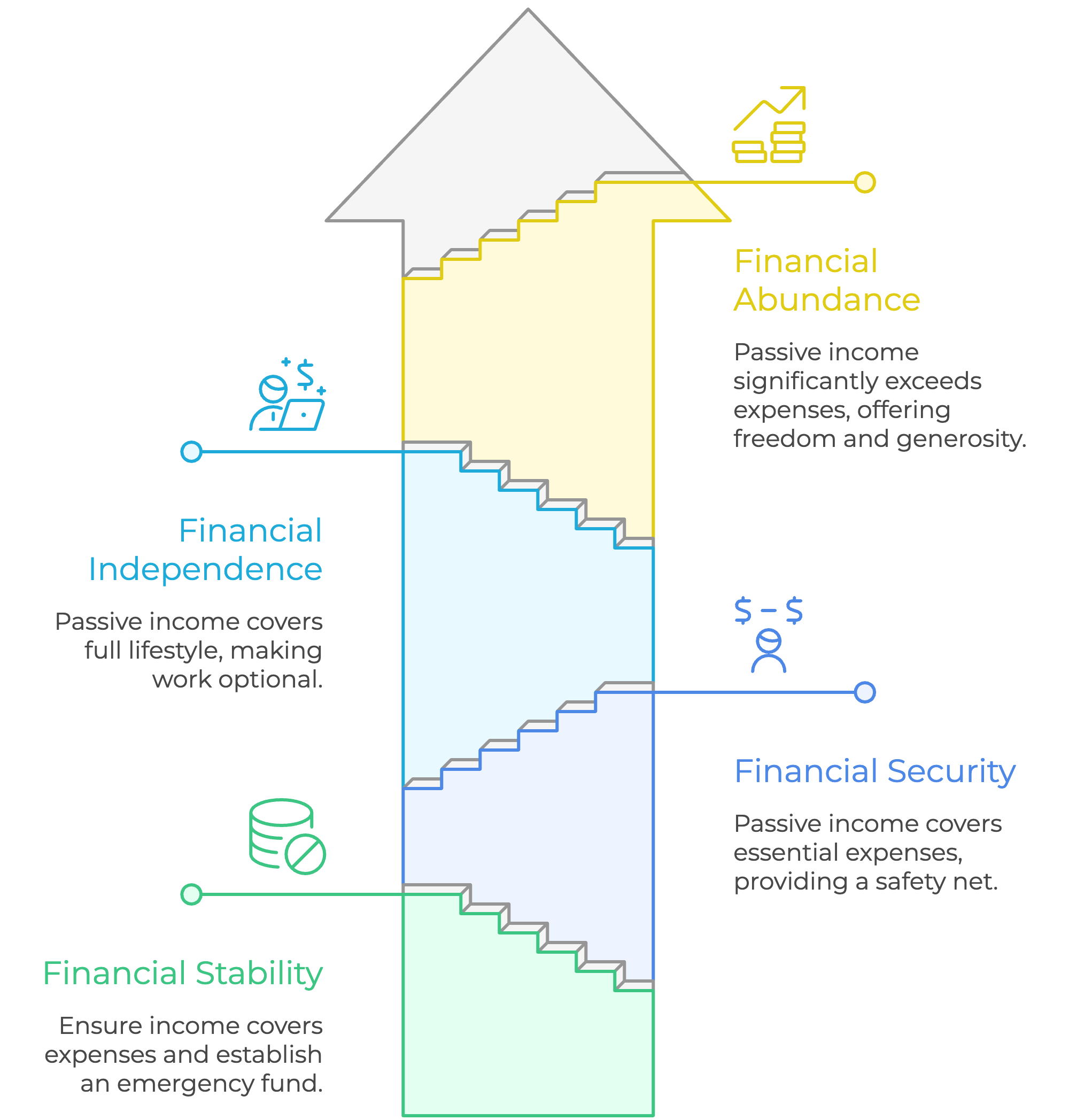
Definition: Your income reliably covers your expenses, you have no high-interest debt, and you have a basic emergency fund (3–6 months of expenses in cash).
What it feels like: You're no longer in survival mode. A car repair or medical bill doesn't send you into a spiral. You're not getting ahead yet, but you're also not falling behind.
The milestone: $0 in consumer debt + emergency fund fully funded.
Why it matters: Everything above this level assumes a stable foundation. Without it, investment returns get wiped out by interest charges and emergency borrowing. This is the floor — and for a significant portion of the population, it's not yet reached.
Level 2 — Financial Security
Definition: Your passive income (from investments, rental income, or other non-labor sources) covers your bare minimum essential expenses — housing, food, utilities, basic transport.
What it feels like: If you lost your job tomorrow, you wouldn't lose your home. Your most basic needs are covered by money that doesn't require you to show up anywhere.
The milestone: Investment portfolio generating enough to cover your essential floor.
The math: If your bare minimum monthly expenses are $2,500, you need a portfolio of roughly $750,000 generating $30,000/year at a 4% withdrawal rate.
Why it matters: This is the first taste of real freedom. Most people never reach it because they confuse it with full financial independence. You don't need to cover your full lifestyle — just the floor. That's a much closer target than most people realize.
Level 3 — Financial Independence
Definition: Your passive income covers your current full lifestyle — not just essentials, but the actual life you're living now, including discretionary spending.
What it feels like: Work is fully optional. You could stop tomorrow and nothing about your life would materially change. This is the FU number from Chapter 1.
The milestone: Investment portfolio = annual current expenses × 25.
The distinction from Level 2: Level 2 covers survival. Level 3 covers your actual life. The gap between them is everything above bare necessities — dining out, travel, hobbies, giving, leisure. For most people this gap is $1,000–$3,000/month, which translates to $300,000–$900,000 more required in the portfolio.
Why it matters: This is the number most people mean when they say "financial independence." It's the complete exit ramp — the point at which your labor is genuinely optional, permanently.
Level 4 — Financial Abundance
Definition: Your passive income significantly exceeds your lifestyle costs. You have more than enough — the margin is large enough that market fluctuations, lifestyle inflation, or generosity don't threaten your security.
What it feels like: Money is no longer a constraint on any decision you'd reasonably want to make. You give freely, you upgrade when you want to, and market downturns are an inconvenience rather than a threat.
The milestone: Portfolio generates 2× or more of your annual expenses. Some people define this as Fat FIRE — covered in Chapter 5.
Why it matters: This level is not the goal for everyone — and it doesn't need to be. But understanding it clarifies something important: financial independence and financial abundance are different things. Conflating them is one of the main reasons people keep moving the goalposts after reaching Level 3.
Why Most People Stall Between Levels
Between Level 1 and 2: Lifestyle inflation. Income rises but spending rises in parallel, leaving no surplus to invest. The gap between expenses and income — the investable margin — never grows.
Between Level 2 and 3: Scope confusion. People hit Level 2 without realizing it because they're measuring against their full lifestyle rather than their essential floor. Naming the levels separately helps you recognize progress you've already made.
Between Level 3 and 4: Goalposts shifting. This is the classic "enough problem" — each time a level is reached, the definition of enough expands. Awareness of the pattern is the first defense against it.
The Levels and the FU Number
The FU number from Chapter 1 corresponds specifically to Level 3. But it's worth building a table of all four numbers for your own situation, because each one is a real milestone worth tracking.
Fill in your own numbers. The gap between Level 2 and Level 3 is often smaller than people expect. The gap between Level 3 and Level 4 is often larger — and less necessary.

Progress through the levels is not always linear. Life events — job loss, divorce, health crises, having children — can move someone from Level 2 back to Level 1 temporarily. This is not failure. The framework is descriptive, not a scoreboard.
What matters is direction over time and the ability to identify where you are clearly enough to make good decisions about what comes next.
Key Takeaways
- Financial independence is a spectrum, not a binary. There are four distinct and meaningful levels between financial dependency and financial abundance;
- Level 2 is closer than most people think. Covering your essential floor requires a significantly smaller portfolio than covering your full lifestyle;
- Naming where you are is the prerequisite for knowing what to do next. Vague progress toward a vague goal produces vague results;
- The goalposts problem is real. Deciding in advance what Level 3 looks like for you — and committing to calling it "enough" when you get there — is one of the most important financial decisions you'll make.
1. Which statements accurately describe the milestones for Level 3 and Level 4 in the four levels of financial independence?
2. Which statements accurately describe the milestone for each level of financial independence?
3. Which of the following are common misconceptions or pitfalls that can stall your progress through the financial independence levels?
¡Gracias por tus comentarios!
Pregunte a AI

Pregunte a AI

Pregunte lo que quiera o pruebe una de las preguntas sugeridas para comenzar nuestra charla
