NoSQL
Desliza para mostrar el menú
NoSQL, which stands for "Not Only SQL", refers to a broad category of database management systems that are designed to handle a wide variety of data models, particularly non-relational or semi-structured data.
Unlike traditional relational databases, which use structured query language (SQL) to define and manipulate data, NoSQL databases offer a more flexible schema design and are optimized for large-scale data storage and retrieval.
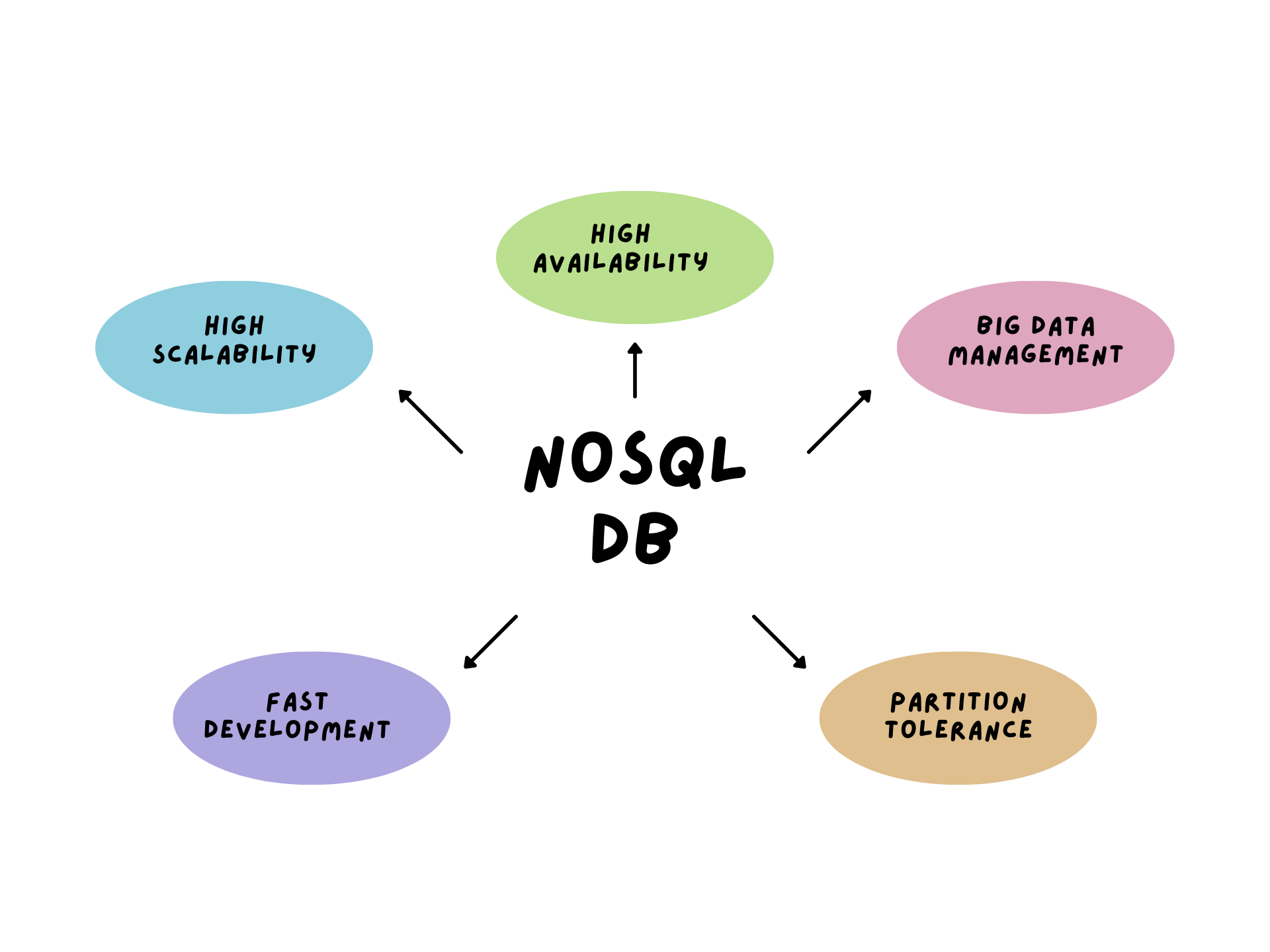
Why NoSQL?
NoSQL databases are designed to handle:
- Unstructured or Semi-structured Data: data that does not fit neatly into tables, rows, and columns, such as JSON documents, key-value pairs, graphs, and wide-column stores;
- High Scalability: horizontal scaling, where databases can distribute data across many servers, making it easier to handle large volumes of data and high transaction loads;
- Flexibility: dynamic schemas that allow for the addition of new fields without the need for database downtime or complex schema migrations.
NoSQL database types
¿Todo estuvo claro?
¡Gracias por tus comentarios!
Sección 1. Capítulo 21
Pregunte a AI

Pregunte a AI

Pregunte lo que quiera o pruebe una de las preguntas sugeridas para comenzar nuestra charla
