Why Digital Literacy Is Now a Core Job Skill
Desliza para mostrar el menú
In 2019, a mid-sized logistics company in Ohio posted a job for an operations coordinator. The role had nothing to do with technology — it involved scheduling, vendor communication, and process documentation. By 2025, that same job posting required proficiency in a cloud-based ERP system, familiarity with shared document workflows, and the ability to manage digital communications across three platforms.
The job didn't become a tech job. The world it operates in became a digital one.
The Numbers Behind the Shift
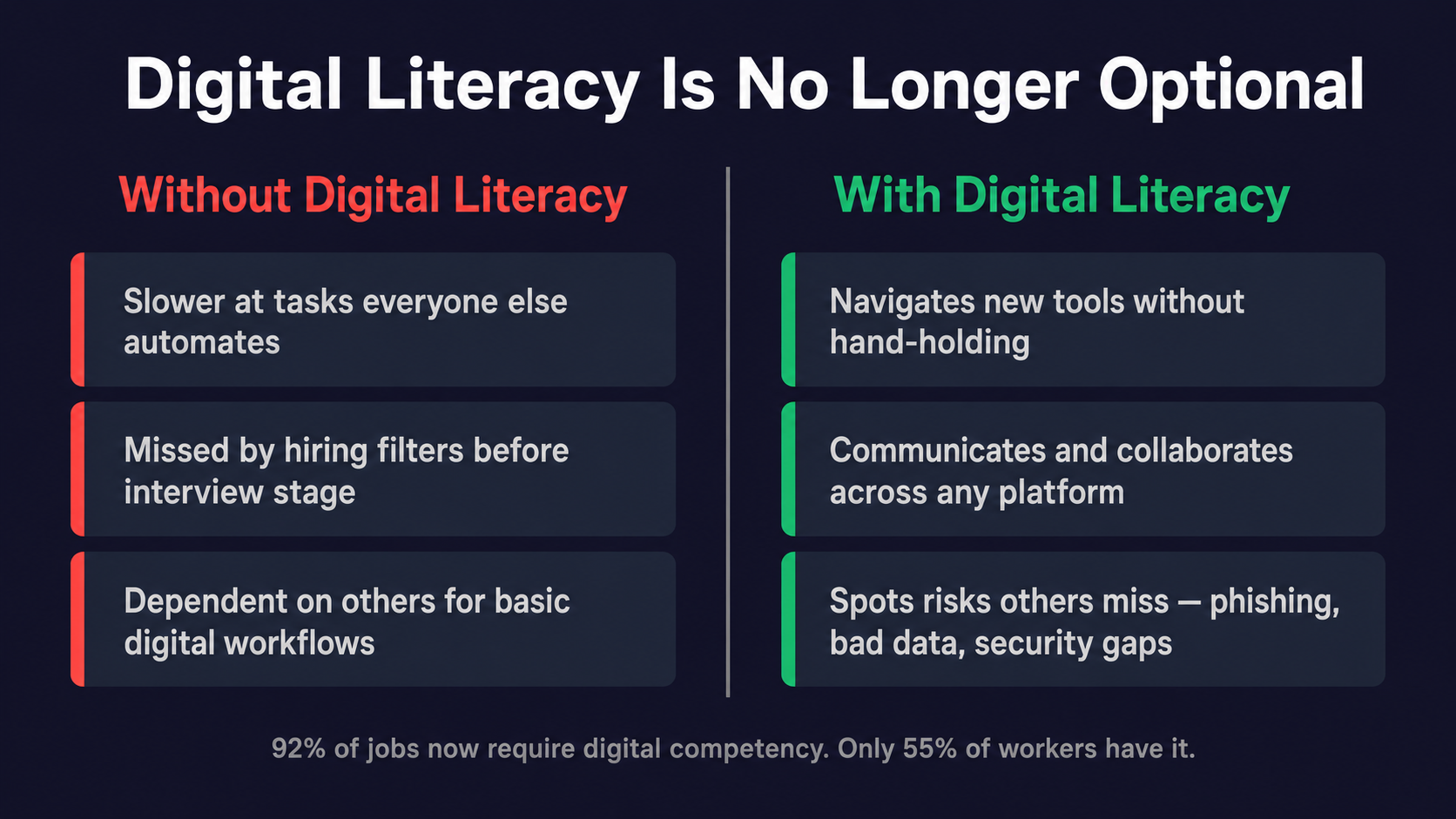
Digital literacy is now a requirement for 92% of jobs across all industries — not just technology. According to the World Economic Forum's Future of Jobs Report 2025, 60% of employers identified broadening digital access and skills as the single most transformative trend reshaping the labor market.
The gap is significant. A 2026 EDUCAUSE report found that nearly a third of the US workforce has "little to no" digital literacy skills. Globally, 90% of jobs require digital competence, but fewer than 55% of workers currently possess it.
This isn't a crisis waiting to happen. It's one that's already affecting hiring decisions, team productivity, and individual career trajectories right now.
What Digital Literacy Actually Means
Here's what digital literacy is not: it is not knowing how to code. It is not being a "tech person." It is not having grown up with smartphones.
Digital literacy is the ability to find, evaluate, create, and communicate information using digital tools — and to do so safely, effectively, and appropriately in a professional context.
That definition covers a wide range of practical skills: knowing which communication tool to use for which type of message, understanding why your company's data lives where it does, recognizing a phishing attempt before you click it, navigating a shared document without creating chaos, and understanding enough about how digital systems work to use them confidently and ask the right questions when something goes wrong.
None of those require a technical degree. All of them are learnable.
The Fluency Framing
Think of digital literacy the way you think about language fluency. A fluent speaker doesn't think about grammar rules — they just communicate. The rules are internalized, and the cognitive load drops to near zero.
Digital fluency works the same way. Once you understand how the underlying systems work — what the cloud actually is, how data flows through an organization, why security protocols exist — individual tools become much easier to learn. You stop being surprised by new platforms and start recognizing familiar patterns in unfamiliar interfaces.
That's the goal of this course: not to teach you every tool you'll ever use, but to give you the underlying framework that makes every tool easier to understand and every digital situation easier to navigate.
What This Course Covers
This course has three sections. Section 1 builds the foundation — how the digital environment actually works, what your digital footprint is, what data and the cloud really mean in practice, and how your devices and networks connect.
Section 2 is the practical layer — communication tools, information management, collaboration, cybersecurity habits, AI tools, and automation. Section 3 focuses on judgment: misinformation, privacy, professional presence, ethics, and staying current in a landscape that keeps moving.
By the end, you won't just be more comfortable with digital tools. You'll understand the environment they operate in — and that understanding is what makes the difference between someone who follows instructions and someone who solves problems.
¡Gracias por tus comentarios!
Pregunte a AI

Pregunte a AI

Pregunte lo que quiera o pruebe una de las preguntas sugeridas para comenzar nuestra charla
