 Types of RNNs
Desliza para mostrar el menú
RNNs come in various architectures depending on the nature of the data and the task at hand. Understanding the different types can help you choose the right RNN for a given application.
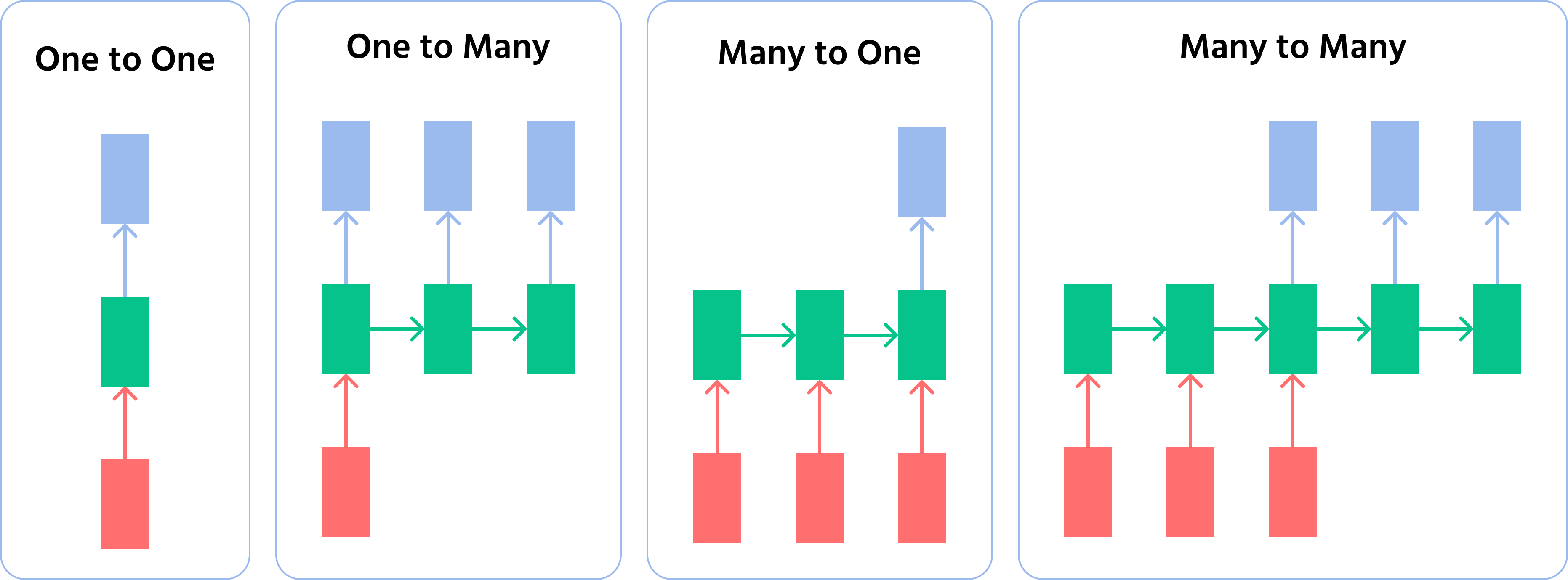
- One to one: in this architecture, each input is mapped to a single output. This is typically used in simple classification tasks where the input size and output size are fixed;
- One to many: in this architecture, a single input generates multiple outputs. This is useful in tasks like image captioning, where an image (single input) generates a sequence of words (multiple outputs);
- Many to one: this type processes multiple inputs and generates a single output. Sentiment analysis is an example, where a sequence of words (input) is analyzed to produce a single sentiment score (output);
- Many to many: here, multiple inputs produce multiple outputs. This architecture is used in tasks like machine translation, where a sequence of words in one language (input) is mapped to a sequence of words in another language (output).
Each type of RNN architecture has its specific use case, and selecting the appropriate one is crucial for solving the task efficiently.
¿Todo estuvo claro?
¡Gracias por tus comentarios!
Sección 1. Capítulo 3
Pregunte a AI

Pregunte a AI

Pregunte lo que quiera o pruebe una de las preguntas sugeridas para comenzar nuestra charla
Sección 1. Capítulo 3
