Generating Creative Angles with AI
Pyyhkäise näyttääksesi valikon
A creative angle is the specific lens through which you present your product to your audience. It is not the product itself, and it is not the offer — it is the perspective, emotion, or narrative frame that makes someone stop, pay attention, and feel like the ad was made for them.
The same product can be sold through dozens of different angles. A project management tool could be positioned through:
- The angle of chaos — "your team is losing hours every week to disorganization";
- The angle of ambition — "the tool that fast-growing teams use to stay ahead";
- The angle of simplicity — "one place for everything, no training required";
- The angle of social proof — "50,000 teams switched from spreadsheets in the last year";
- The angle of fear — "one missed deadline can cost you the client."
None of these is wrong. Each speaks to a different segment of the audience, at a different stage of awareness, through a different emotional mechanism. The job of a performance creative designer is to identify which angles are most likely to resonate — and then generate enough of them to test.
This is where AI becomes genuinely transformative.
Why AI Is Exceptionally Good at Angle Generation
Generating creative angles is a task that requires breadth — the ability to rapidly explore many different framings, emotional registers, and narrative approaches without getting stuck in a single point of view. This is exactly what large language models excel at.
A skilled human strategist might generate five to eight strong angles in a focused session. With the right AI prompting, you can generate thirty to fifty angles in the same time — and then apply your human judgment to select, refine, and prioritize the best ones.
AI does not replace creative judgment. It expands the surface area of your thinking so that your judgment has more to work with.
Your AI Toolkit for Angle Generation
ChatGPT
ChatGPT is the most widely used AI tool for creative ideation, and for good reason. Its ability to rapidly reframe a product from multiple perspectives makes it the go-to starting point for angle generation sessions.
Best use cases:
- Generating large volumes of angle variations from a single brief;
- Reframing the same core benefit through different emotional lenses;
- Exploring angles for different audience segments simultaneously;
- Iterating quickly on angles that are almost right but need refinement.
Claude
Claude tends to produce more nuanced, strategically grounded angle suggestions than ChatGPT, particularly when you give it rich context about the audience and product. It is especially strong at identifying the psychological mechanism behind each angle — not just what the angle says, but why it would work.
Best use cases:
- Deep strategic angle development with full brief context;
- Identifying the emotional and psychological logic behind each angle;
- Pressure-testing angles — asking Claude to argue why an angle might fail;
- Writing the strategic rationale for a chosen angle.
Perplexity AI
Perplexity AI combines AI reasoning with real-time web search, making it uniquely useful for grounding your angle generation in current audience behavior and language.
Best use cases:
- Researching how your target audience talks about their problems in forums, reviews, and social media;
- Finding current language patterns that can be borrowed for hooks and angles;
- Validating whether an angle you've identified is already being widely used.
Gemini
Google's Gemini integrates with Google's wider data ecosystem, giving it strong awareness of search trends and audience intent signals.
Best use cases:
- Angle generation informed by search intent data;
- Connecting product benefits to rising audience search behaviors;
- Generating angles for products where Google search is a primary acquisition channel.
Notion AI
Notion AI works inside your existing workflow documents, making it excellent for iterating on angles within the context of a live brief.
Best use cases:
- Expanding a rough angle into a full creative brief;
- Generating variations on an angle directly within your project documentation;
- Summarizing research notes into a condensed set of angle opportunities.
The Angle Generation Framework
Having the right tools is only part of the equation. The quality of your output depends almost entirely on the quality of your input. Here is a structured framework for running an AI angle generation session.
Step 1 — Build Your Context Document
Before prompting any AI tool, compile a context document containing:
- Product description — what it does and how it works;
- Core benefit — the single most important thing it does for the customer;
- Secondary benefits — supporting advantages worth highlighting;
- Target audience — who they are, what they want, what they fear, what they believe;
- Awareness level — are they problem-aware, solution-aware, or product-aware?;
- Competitive context — how does this product differ from alternatives?;
- Existing angles — what angles have already been tested and what were the results?
The more complete this document, the better your angle output will be. AI angle generation is only as good as the brief you give it.
Step 2 — Generate a Wide Angle List
Paste your context document into ChatGPT or Claude and use a prompt like:
"Based on this product brief, generate 30 distinct creative angles for performance ads. For each angle, write one sentence describing the core idea and one sentence explaining the emotional mechanism it uses. Organize them by the primary emotion they target: fear, desire, curiosity, relief, pride, and belonging."
This will give you a broad landscape of options to work from. At this stage, volume matters more than quality — you want to see the full possibility space before narrowing down.
Step 3 — Filter and Prioritize
Review the generated list and mark each angle as:
- Strong — emotionally resonant, differentiated, and executable;
- Interesting — worth developing further but not immediately obvious;
- Weak — generic, already saturated, or misaligned with the audience.
Aim to keep five to ten strong or interesting angles for further development.
Step 4 — Develop Each Angle into a Hook
For each shortlisted angle, return to the AI tool and prompt it to generate hook variations:
"For the angle '[angle description]', write ten different hooks — five for video ads (spoken opening line) and five for static ads (headline copy). Each hook should be under fifteen words."
This is where angles become executable creative material.
Step 5 — Pressure-Test Your Best Angles
Before committing to production, use Claude to stress-test your top three to five angles:
"Here are my top five angles for this product. For each one, argue the strongest case for why it might underperform — consider audience fit, competitive saturation, and emotional resonance."
This step surfaces weaknesses before you invest production resources, and often generates insights that improve the angle itself.
Audience Awareness Levels and Why They Change Everything
One of the most important variables in angle selection is where your target audience sits on the awareness spectrum. An angle that works for a problem-aware audience will fall completely flat for a solution-aware one, and vice versa.
- Unaware — the audience does not yet know they have the problem your product solves. Angles must educate and surface the problem before presenting the solution;
- Problem-aware — the audience knows the problem but has not yet discovered your category of solution. Angles should connect their known pain to your solution category;
- Solution-aware — the audience knows solutions like yours exist but has not yet chosen one. Angles should differentiate your product from alternatives;
- Product-aware — the audience knows your product but has not yet bought. Angles should address objections, reinforce social proof, and create urgency;
- Most aware — existing customers or highly engaged prospects. Angles should focus on loyalty, upsell, or re-engagement.
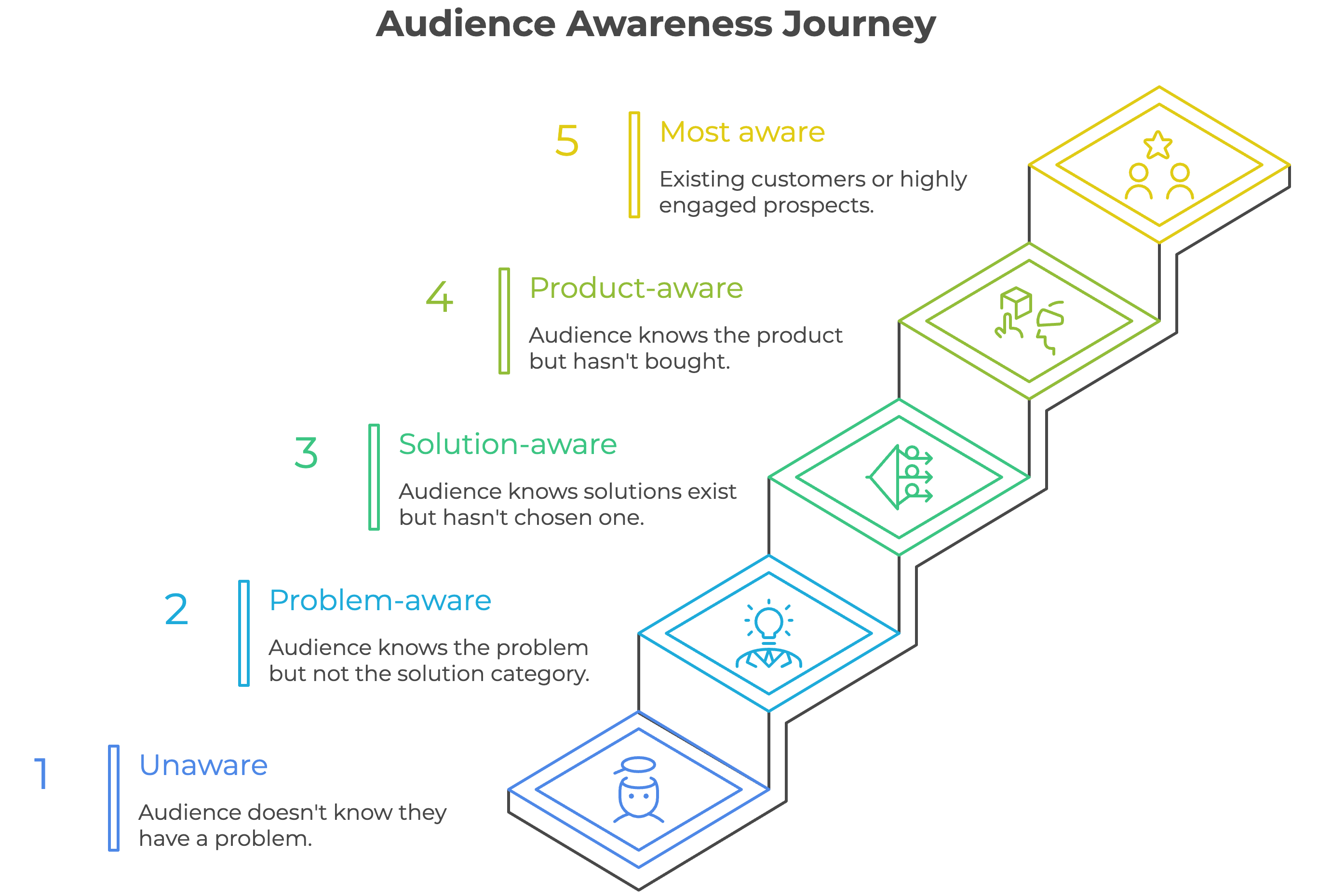
When prompting AI for angle generation, always specify the awareness level. A prompt that includes "this audience is solution-aware and has likely tried at least one competitor" will generate dramatically more relevant angles than one that omits this context.
Prompting Principles for Better Angle Output
The difference between mediocre and exceptional AI angle output almost always comes down to how the prompt is written. Apply these principles consistently:
- Be specific about the audience. Don't write "target audience: women 25–45." Write "target audience: women in their early thirties who are building a freelance career alongside raising young children, who feel chronically behind and are skeptical of productivity tools because they've tried many and abandoned them."
- Specify the emotional register. Tell the AI whether you want angles that are empathetic, provocative, aspirational, humorous, or urgent. Without this direction, you'll get a generic mix;
- Give examples of what you don't want. Stating "avoid angles that focus on price or discounts" or "avoid generic productivity messaging" steers the AI away from the most obvious, saturated territory;
- Ask for the mechanism, not just the idea. Prompting for "the psychological reason this angle would work" forces the AI to produce strategically grounded angles, not just creative slogans;
- Iterate in conversation, not in single prompts. The best angle generation sessions are dialogues — you respond to what the AI generates, push back on what's weak, and ask it to go deeper on what's promising.
From Angles to a Creative Testing Matrix
Once you have a set of validated angles, organize them into a creative testing matrix — a structured plan for which angles you will test, in which formats, against which audiences.
A simple matrix might look like this:
This matrix becomes your production roadmap. It ensures that your creative testing is systematic — covering multiple angles, formats, and audience segments — rather than random.
Kiitos palautteestasi!
Kysy tekoälyä

Kysy tekoälyä

Kysy mitä tahansa tai kokeile jotakin ehdotetuista kysymyksistä aloittaaksesi keskustelumme
