Building an AI-Ready Team
Pyyhkäise näyttääksesi valikon
Implementing AI tools is the easy part. Getting your team to actually use them consistently is where most implementations stall. The technology is rarely the obstacle – the people side almost always is. This chapter covers what it takes to bring a team along with an AI implementation rather than pushing it on them.
Why Teams Resist AI
Resistance to AI tools in the workplace tends to come from one of three places.
Fear of replacement is the most common and least often stated openly. Team members worry that if AI can do their job faster, there will be less need for them. Left unaddressed, this fear translates into passive non-adoption – people who technically have access to the tools but find reasons not to use them.
Loss of expertise identity is subtler. People who have spent years developing skills in a particular area can feel threatened by a tool that produces comparable output in minutes. A skilled writer asked to use AI for drafting may feel their expertise is being devalued rather than augmented.
Distrust of the output is the most rational resistance and the easiest to address. Team members who have seen AI tools produce errors are right to be cautious. The answer is not to tell them to trust it – it is to show them how to verify it.

The single most effective thing a manager can do to reduce AI resistance is to be visibly using the tools themselves. Teams adopt what their managers model. If you are using Claude and Zapier in your own workflow and talking about it openly, your team is far more likely to engage than if adoption is presented as a requirement handed down from above.
The Right Adoption Sequence
Forcing AI adoption across an entire team simultaneously rarely works. The more effective pattern is to start with willing early adopters, build visible wins, and let the results do the persuading.
A practical three-phase approach:
Phase 1 – Identify your early adopters. Find one or two team members who are naturally curious about new tools and give them dedicated time to experiment. Their role is not to implement anything formally – it is to explore and report back on what works.
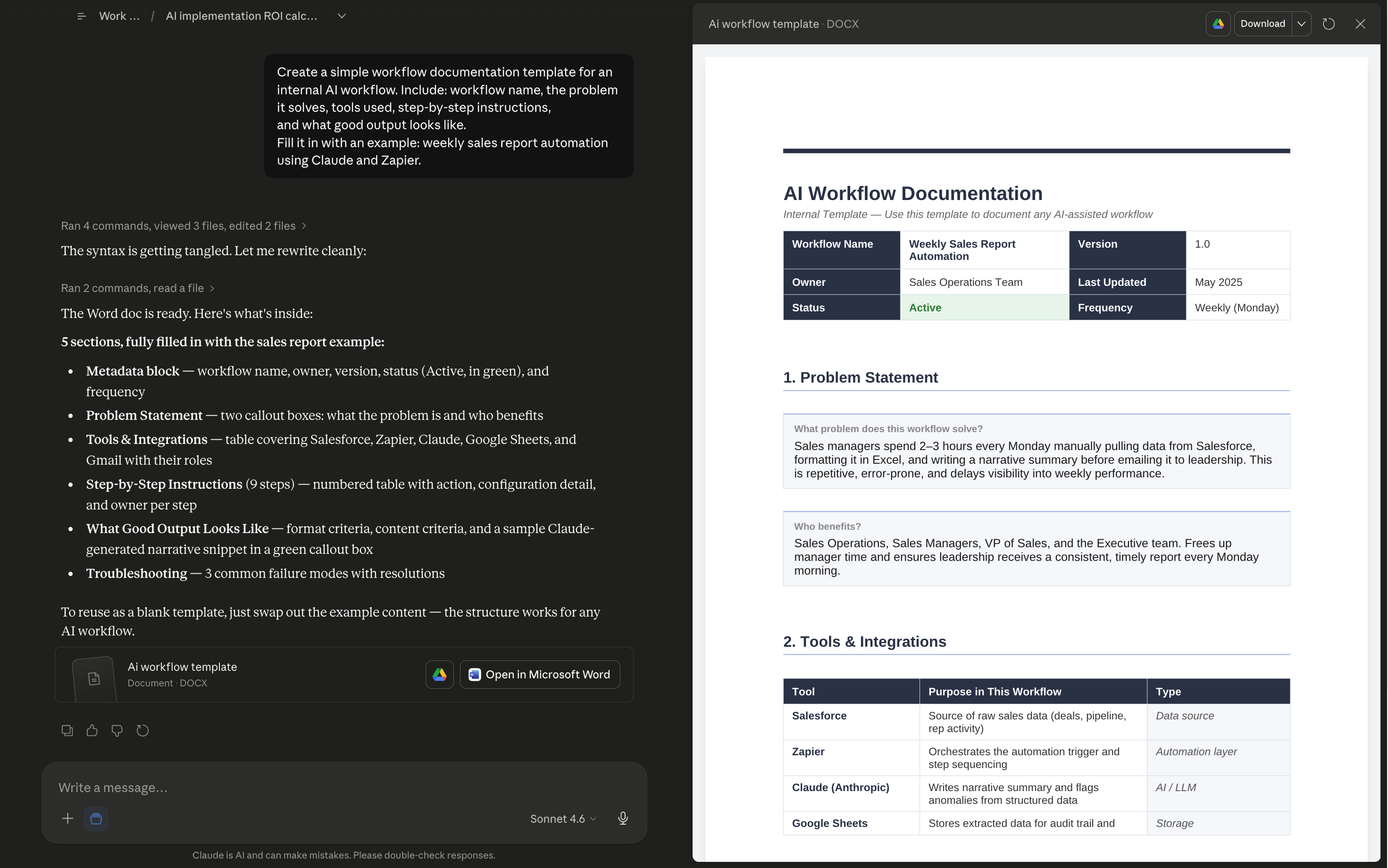
Phase 2 – Build a reference workflow. Take the most successful finding from Phase 1 and implement it properly for the whole team. Document it clearly: what the workflow does, how to run it, what good output looks like. This becomes the reference point for everything that follows.
Phase 3 – Expand systematically. Use the reference workflow as proof of concept. Add one new workflow at a time, always starting from a clear operational problem rather than a tool you want to deploy.
Upskilling Without Overwhelming
Most AI tools have a learning curve measured in hours, not weeks. The mistake many organizations make is treating AI upskilling as a formal training program – multiple sessions, structured curriculum, assessments. This creates overhead that slows adoption and signals that the tools are more complex than they are.
A more effective approach: identify the two or three workflows most relevant to each team member's role, give them 90 minutes of uninterrupted time to experiment with those specific workflows, and follow up with a 30-minute group session to share what worked. Repeat monthly as new workflows are added.
How to Handle Team Members Who Remain Resistant after Adoption Efforts?
Some team members will not adopt AI tools regardless of how well the implementation is managed. This is normal and should not be treated as a failure of the implementation.
The practical approach is to distinguish between active resistance – where someone is undermining adoption for others – and personal non-adoption – where someone simply prefers not to use the tools themselves. The former requires a direct conversation about expectations. The latter is generally acceptable provided it does not create workflow inconsistencies that affect the rest of the team.
As AI becomes more embedded in standard business processes, the line between optional and expected will shift. Managing that transition thoughtfully – giving people time and support to adapt rather than demanding immediate compliance – produces better long-term outcomes than forcing adoption on a timeline.
Kiitos palautteestasi!
Kysy tekoälyä

Kysy tekoälyä

Kysy mitä tahansa tai kokeile jotakin ehdotetuista kysymyksistä aloittaaksesi keskustelumme
