Creating an AI Usage Policy
Glissez pour afficher le menu
Most companies using AI tools in 2026 fall into one of two categories: those with a clear internal policy that guides how AI is used, and those operating in a gray area where individual employees make their own decisions about what is appropriate. The second category carries significantly more risk – legal, reputational and operational.
Creating an AI usage policy does not require a legal team or a lengthy approval process. A practical, one-page document that answers the most common questions is enough to get most organizations out of the gray area and into a defensible position.
What an AI Usage Policy Needs to Cover
A functional AI usage policy addresses five questions:
- Which tools are approved? A specific list of approved tools removes ambiguity and prevents employees from using consumer AI tools with company data without realizing the risk;
- What data can be shared with AI tools? The most critical section. Clear categories – public information, internal operational data, client data, financial data, personal data – with explicit guidance on what can and cannot be shared with which tools;
- Who is responsible for AI outputs? Establishes that the employee using the AI tool is accountable for reviewing and standing behind the output, not the tool itself;
- What requires human review before distribution? Any AI-generated content going to clients, senior stakeholders or external audiences should have a named review requirement;
- How do we handle errors or policy violations? A clear, non-punitive process for reporting issues encourages transparency rather than concealment.

AI usage policy – an internal document that defines which AI tools employees are authorized to use, what data they may share with those tools, and the standards expected for reviewing and taking responsibility for AI-generated outputs.
Using Claude to Draft Your Policy
The fastest way to produce a first draft is to use Claude itself. Give it the context of your organization – size, industry, the tools you are using, and the main data categories you handle – and ask it to produce a draft policy covering the five sections above.
The draft will not be final. It will need review by whoever owns legal and compliance in your organization, and adaptation to your specific context. But it will give you a structured starting point in 10 minutes rather than a blank page.
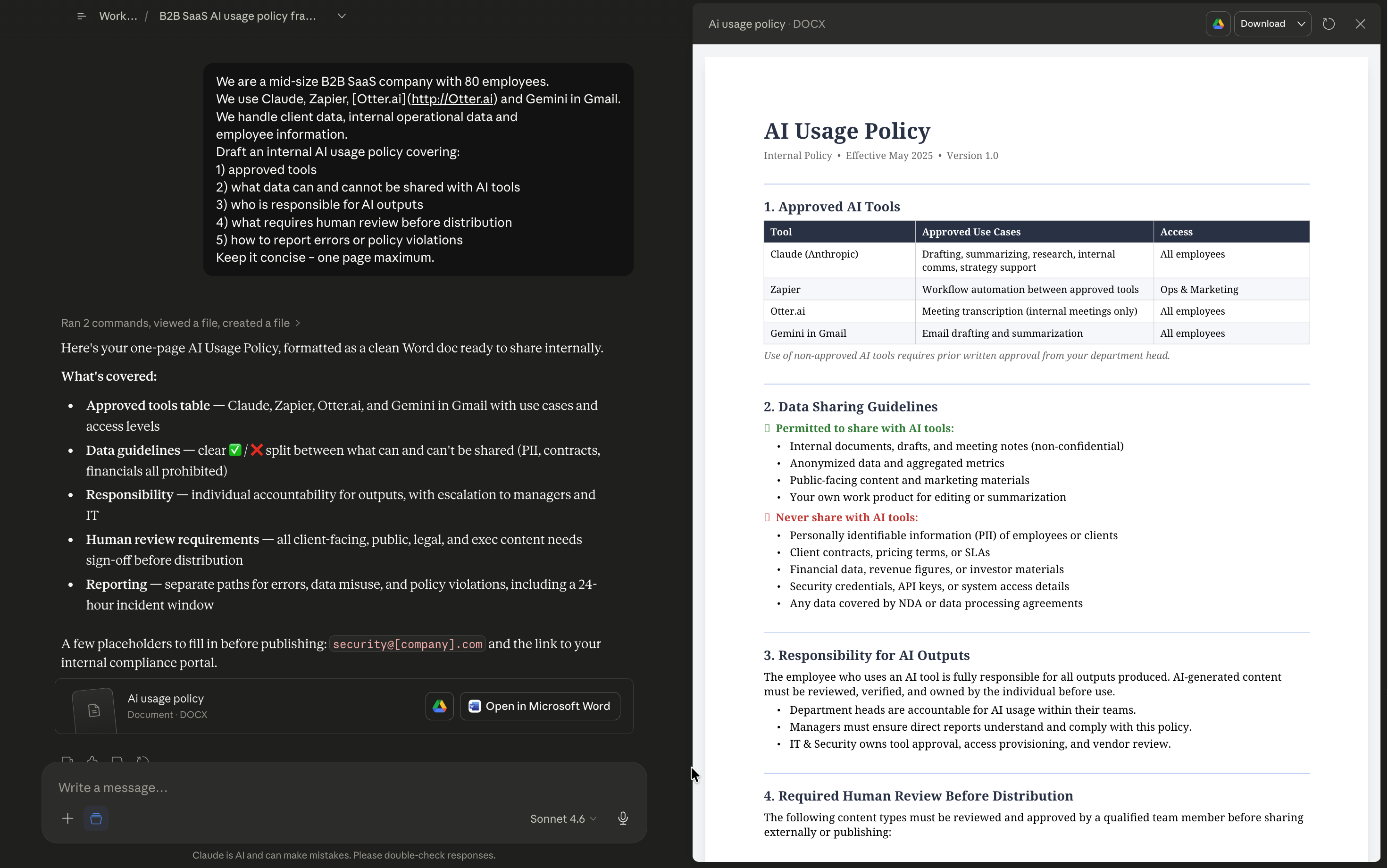

An AI usage policy is most effective when it is short, clear and accessible – not when it is comprehensive and unread. A one-page document that employees actually refer to is more valuable than a 20-page policy that lives in a folder no one opens. Prioritize clarity over completeness.
Getting the Policy Adopted
A policy that exists but is not communicated is not a policy – it is a document. Effective adoption requires three things.
Visibility – the policy should be easy to find, ideally linked from the tools themselves or posted in the primary internal communication channel.
A single owner – one person should be responsible for maintaining the policy, answering questions about it, and updating it as tools and practices evolve. Without a named owner, policies drift out of date.
A regular review cycle – AI tools and best practices are evolving fast enough that a policy written today may need meaningful updates in six months. Build a review into the calendar rather than waiting for an incident to prompt it.
What to Do if Employees Are Already Using Unapproved Tools?
Shadow AI – the use of AI tools outside officially approved channels – is widespread in most organizations. Responding to it punitively tends to drive it further underground rather than eliminating it.
The more effective response is to acknowledge that it is happening, understand which tools are being used and why, and use that information to inform your approved toolstack. If a significant portion of your team has independently started using the same tool, that is a signal that it is addressing a real need – and it is probably worth evaluating for official approval rather than banning.
The goal of an AI usage policy is not to restrict what people use. It is to ensure that when AI is used, it is used in a way that protects the organization and the people in it.
Merci pour vos commentaires !
Demandez à l'IA

Demandez à l'IA

Posez n'importe quelle question ou essayez l'une des questions suggérées pour commencer notre discussion
Creating an AI Usage Policy
Most companies using AI tools in 2026 fall into one of two categories: those with a clear internal policy that guides how AI is used, and those operating in a gray area where individual employees make their own decisions about what is appropriate. The second category carries significantly more risk – legal, reputational and operational.
Creating an AI usage policy does not require a legal team or a lengthy approval process. A practical, one-page document that answers the most common questions is enough to get most organizations out of the gray area and into a defensible position.
What an AI Usage Policy Needs to Cover
A functional AI usage policy addresses five questions:
- Which tools are approved? A specific list of approved tools removes ambiguity and prevents employees from using consumer AI tools with company data without realizing the risk;
- What data can be shared with AI tools? The most critical section. Clear categories – public information, internal operational data, client data, financial data, personal data – with explicit guidance on what can and cannot be shared with which tools;
- Who is responsible for AI outputs? Establishes that the employee using the AI tool is accountable for reviewing and standing behind the output, not the tool itself;
- What requires human review before distribution? Any AI-generated content going to clients, senior stakeholders or external audiences should have a named review requirement;
- How do we handle errors or policy violations? A clear, non-punitive process for reporting issues encourages transparency rather than concealment.
AI usage policy – an internal document that defines which AI tools employees are authorized to use, what data they may share with those tools, and the standards expected for reviewing and taking responsibility for AI-generated outputs.
Using Claude to Draft Your Policy
The fastest way to produce a first draft is to use Claude itself. Give it the context of your organization – size, industry, the tools you are using, and the main data categories you handle – and ask it to produce a draft policy covering the five sections above.
The draft will not be final. It will need review by whoever owns legal and compliance in your organization, and adaptation to your specific context. But it will give you a structured starting point in 10 minutes rather than a blank page.
An AI usage policy is most effective when it is short, clear and accessible – not when it is comprehensive and unread. A one-page document that employees actually refer to is more valuable than a 20-page policy that lives in a folder no one opens. Prioritize clarity over completeness.
Getting the Policy Adopted
A policy that exists but is not communicated is not a policy – it is a document. Effective adoption requires three things.
Visibility – the policy should be easy to find, ideally linked from the tools themselves or posted in the primary internal communication channel.
A single owner – one person should be responsible for maintaining the policy, answering questions about it, and updating it as tools and practices evolve. Without a named owner, policies drift out of date.
A regular review cycle – AI tools and best practices are evolving fast enough that a policy written today may need meaningful updates in six months. Build a review into the calendar rather than waiting for an incident to prompt it.
What to Do if Employees Are Already Using Unapproved Tools?
Shadow AI – the use of AI tools outside officially approved channels – is widespread in most organizations. Responding to it punitively tends to drive it further underground rather than eliminating it.
The more effective response is to acknowledge that it is happening, understand which tools are being used and why, and use that information to inform your approved toolstack. If a significant portion of your team has independently started using the same tool, that is a signal that it is addressing a real need – and it is probably worth evaluating for official approval rather than banning.
The goal of an AI usage policy is not to restrict what people use. It is to ensure that when AI is used, it is used in a way that protects the organization and the people in it.
Merci pour vos commentaires !
