Finding Trends Before They Peak
Scorri per mostrare il menu
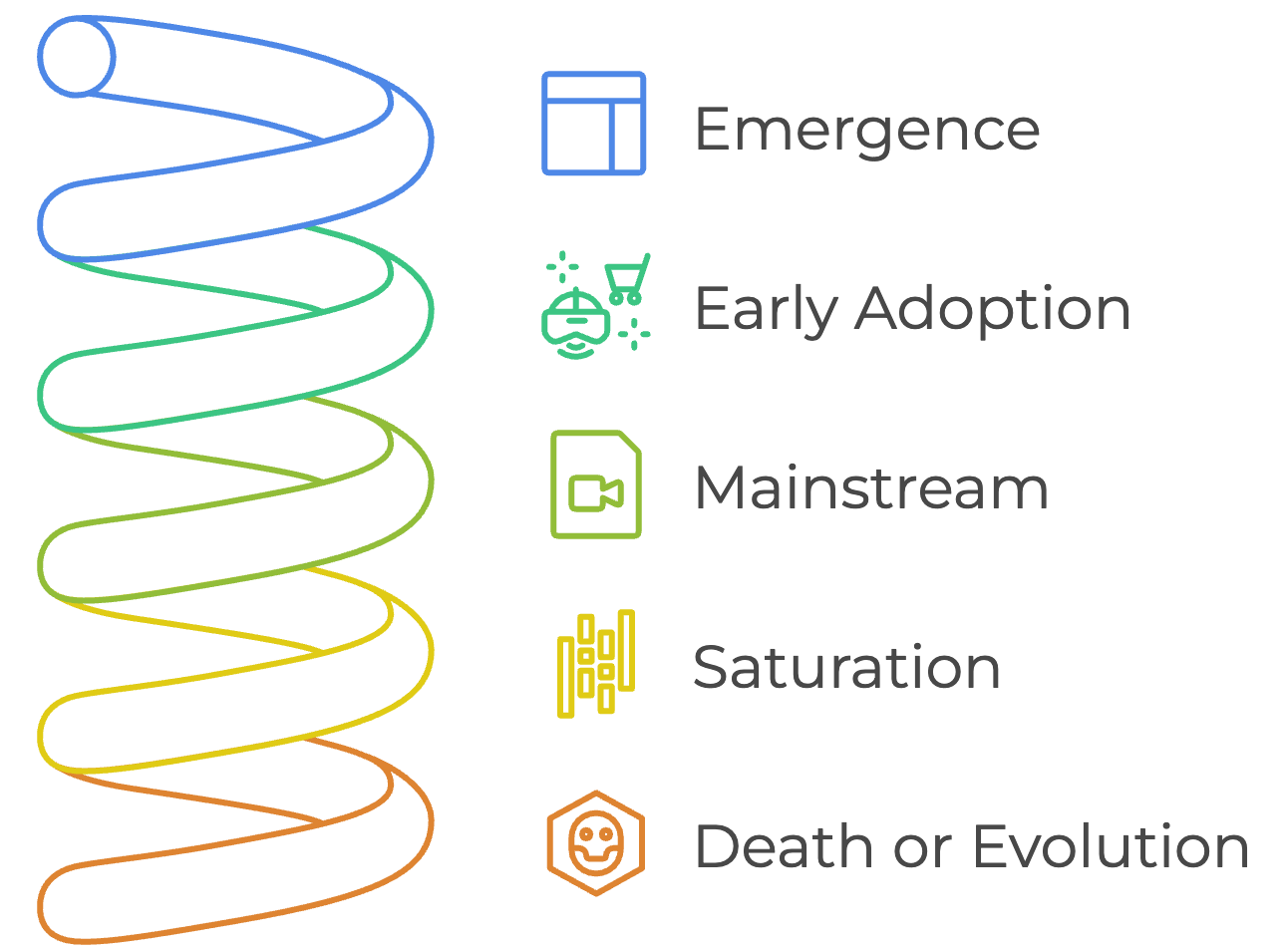
There is a lifecycle to every creative trend. A format emerges, early adopters use it and see outsized results, the mainstream catches on, it saturates, and then it dies. The performance creative designers who consistently win are the ones who identify trends in the emergence phase — not after every brand in their niche is already running the same format.
Getting in early on a trend means less competition for attention, higher novelty for the viewer, and significantly better performance metrics before audiences become desensitized. Getting in late means fighting for scraps in a saturated format where CPMs are higher and CTRs are declining.
The Trend Lifecycle
Understanding where a trend sits in its lifecycle determines how you should respond to it.
-
Stage 1 — Emergence
A format or hook style appears in a small number of ads, usually pioneered by one or two brands. Performance is exceptionally strong because the audience hasn't seen it before. Most designers miss this stage entirely;
-
Stage 2 — Early adoption
A handful of performance-aware brands notice the format working and begin testing it. Still strong performance, still relatively low competition. This is the ideal entry window;
-
Stage 3 — Mainstream
The format is now widely recognized. Industry publications write about it. Most brands in the niche are testing it. Performance begins declining as audience fatigue sets in;
-
Stage 4 — Saturation
Every brand is running the format. Viewers recognize and skip it reflexively. CTRs drop, CPMs rise, and the format loses its novelty premium entirely;
-
Stage 5 — Death or evolution
The format either disappears or mutates into something new. Occasionally a brand will revive it with a fresh twist, briefly resurrecting its performance before the cycle repeats.
Your goal is to consistently operate in Stages 1 and 2.
Your Trend Research Stack
TikTok Creative Center
TikTok is where most performance creative trends are born before migrating to Instagram Reels, YouTube Shorts, and Meta ads. The TikTok Creative Center gives you a direct window into what is gaining traction right now.
How to Use It for Trend Detection
- Navigate to the Trending section, not just Top Ads;
- Filter by your industry and look at the week-on-week growth in ad volume for specific formats;
- Watch the trending sounds — audio trends on TikTok frequently predict visual and format trends in ads;
- Study the top hashtags — rising hashtags in your niche often signal audience interests before they become ad creative conventions;
- Look at the creative insights tab for data on which creative elements — hook length, pacing, visual style — are currently driving the strongest performance.
The key discipline here is visiting consistently. A weekly 15-minute session in Creative Center, with notes, will give you a running picture of what is accelerating and what is plateauing.
Google Trends
Google Trends is one of the most underused tools in the performance creative toolkit. It shows you the search volume trajectory of any keyword over time — which tells you whether audience interest in a topic, product, or idea is growing, stable, or declining.
How to Use It for Creative Trend Research
- Search a product category, pain point, or topic relevant to your niche;
- Set the time range to past 12 months to see the full trajectory;
- Use the compare function to measure two competing topics side by side;
- Check related queries — the rising queries section often reveals emerging audience interests before they appear in ad creative;
- Use the geographic breakdown to understand whether a trend is local or global — useful for deciding how broadly to apply a creative insight.

If searches for "cortisol face" or "nervous system regulation" are rising steeply in the health and wellness space, that's a signal to start building creative angles around those concepts before every supplement brand has already done it.
Exploding Topics
Exploding Topics is specifically designed to surface trends in their early stages — before they go mainstream. It uses data analysis to identify topics, products, and behaviors that are growing significantly faster than baseline.
What It Gives You
- A curated feed of emerging topics across dozens of categories;
- A trajectory score showing how quickly each topic is accelerating;
- Trend reports organized by industry, including DTC, health, tech, and finance;
- The ability to search any topic and see its growth curve over time.
For performance creative designers, Exploding Topics is most useful for content and hook ideation — identifying the conversations, anxieties, desires, and behaviors that are entering mainstream consciousness but haven't yet been saturated by advertising.
If Exploding Topics shows a topic trending strongly but your Foreplay swipe file shows few ads addressing it, that is a whitespace opportunity.
AnswerThePublic
AnswerThePublic visualizes the questions, comparisons, and statements that real people are typing into search engines around any topic. It is a direct window into audience psychology — what they are confused about, what they are afraid of, what they want to understand.
How to use it for creative trend research:
- Enter a product category or pain point;
- Study the questions section — these are the exact anxieties and curiosities your audience has;
- Look at the comparisons section — "X vs Y" searches reveal the decision frameworks your audience is using;
- Use the rising filter to see which questions are growing in search volume.
This is particularly powerful for hook writing. A hook that mirrors the exact question someone is already typing into Google is a hook that will stop them mid-scroll — because it feels like the ad was made specifically for them.
Motion App
Motion App is a creative analytics platform that connects directly to your Meta and TikTok ad accounts to show you which of your own creatives are performing and why. But for trend research, its value is in the aggregated insights it surfaces across its user base.
For trend detection:
- Monitor which creative formats in your account are showing accelerating performance — these often mirror broader platform trends;
- Use the creative scoring features to identify patterns in your winning ads;
- Watch the benchmark data — when your winning formats start regressing toward average benchmarks, it often signals that a format is entering saturation.
Motion is less about discovering external trends and more about detecting when your current creative approach is aging — which is equally important information.
Organic Content as a Trend Signal
One of the most reliable early warning systems for ad creative trends is organic content performance on TikTok and Instagram Reels. Organic viral formats almost always migrate into paid creative within four to eight weeks.
Build a habit of monitoring organic content signals:
On TikTok:
- Follow ten to fifteen creators in your niche who produce high-volume content;
- Watch what format structures go viral for them — not just what topics;
- Pay attention to editing styles, hook structures, and audio choices that are getting unusually high view counts.
On Instagram Reels:
- Track the explore page in your niche regularly;
- Note which Reels are being reshared heavily — resharing behavior predicts ad adoption;
- Watch how brands with strong organic presences are experimenting with new formats before putting spend behind them.
The principle: if a format is generating millions of organic views, it means the audience is receptive to it. Performance creative is the process of taking that receptivity and attaching a commercial message to it.
Building a Trend Tracking System
Spotting trends is only useful if you capture and act on them. Here is a simple system for turning trend signals into creative output.
The Weekly Trend Log
Keep a running document — in Notion or a simple notes app — with the following structure:
Week of [date]
- Rising formats: new creative structures or visual approaches I'm seeing across multiple sources;
- Rising topics: audience interests, anxieties, or conversations gaining momentum;
- Dying formats: approaches I'm seeing less of, or that are performing noticeably worse;
- Action items: specific creative tests I want to run based on this week's observations.
After three months, this log becomes an invaluable reference — you can look back and see exactly when you first spotted a trend, how quickly it moved, and whether you acted on it in time.
Trend-to-Brief Pipeline
When you identify a trend worth acting on, move quickly. The window between emergence and saturation can be as short as six to eight weeks on fast-moving platforms like TikTok.
- Log the trend — document it with examples and the source where you spotted it;
- Validate it — check it across at least two to three independent sources before investing production resources;
- Brief it — write a creative brief specifically designed to test the trend format;
- Produce fast — in the emergence phase, speed matters more than polish;
- Measure it — track whether it performs above your baseline benchmarks;
- Scale or move on — if it outperforms, scale it; if it doesn't validate, document why and move on.
What Not to Chase
Not every trend is worth acting on. Develop the judgment to filter signal from noise.
Skip a trend if:
- It is already appearing in every major brand's ad account in your niche — you've missed the window;
- It requires significant production investment and the lifecycle looks short;
- It doesn't fit your brand's voice, product, or audience — trend-chasing that feels inauthentic almost always underperforms;
- It is driven by a single viral moment rather than a sustained shift in audience behavior.
Prioritize a trend if:
- You are seeing it independently across multiple platforms and sources;
- It maps directly onto an audience pain point or desire that is relevant to your product;
- Early examples are still relatively rare but performance signals are strong;
- It can be produced quickly with your existing resources.
The best performance creative designers are selective trend adopters, not compulsive ones.
Grazie per i tuoi commenti!
Chieda ad AI

Chieda ad AI

Chieda pure quello che desidera o provi una delle domande suggerite per iniziare la nostra conversazione
Finding Trends Before They Peak
There is a lifecycle to every creative trend. A format emerges, early adopters use it and see outsized results, the mainstream catches on, it saturates, and then it dies. The performance creative designers who consistently win are the ones who identify trends in the emergence phase — not after every brand in their niche is already running the same format.
Getting in early on a trend means less competition for attention, higher novelty for the viewer, and significantly better performance metrics before audiences become desensitized. Getting in late means fighting for scraps in a saturated format where CPMs are higher and CTRs are declining.
The Trend Lifecycle
Understanding where a trend sits in its lifecycle determines how you should respond to it.
-
Stage 1 — Emergence
A format or hook style appears in a small number of ads, usually pioneered by one or two brands. Performance is exceptionally strong because the audience hasn't seen it before. Most designers miss this stage entirely;
-
Stage 2 — Early adoption
A handful of performance-aware brands notice the format working and begin testing it. Still strong performance, still relatively low competition. This is the ideal entry window;
-
Stage 3 — Mainstream
The format is now widely recognized. Industry publications write about it. Most brands in the niche are testing it. Performance begins declining as audience fatigue sets in;
-
Stage 4 — Saturation
Every brand is running the format. Viewers recognize and skip it reflexively. CTRs drop, CPMs rise, and the format loses its novelty premium entirely;
-
Stage 5 — Death or evolution
The format either disappears or mutates into something new. Occasionally a brand will revive it with a fresh twist, briefly resurrecting its performance before the cycle repeats.
Your goal is to consistently operate in Stages 1 and 2.
Your Trend Research Stack
TikTok Creative Center
TikTok is where most performance creative trends are born before migrating to Instagram Reels, YouTube Shorts, and Meta ads. The TikTok Creative Center gives you a direct window into what is gaining traction right now.
How to Use It for Trend Detection
- Navigate to the Trending section, not just Top Ads;
- Filter by your industry and look at the week-on-week growth in ad volume for specific formats;
- Watch the trending sounds — audio trends on TikTok frequently predict visual and format trends in ads;
- Study the top hashtags — rising hashtags in your niche often signal audience interests before they become ad creative conventions;
- Look at the creative insights tab for data on which creative elements — hook length, pacing, visual style — are currently driving the strongest performance.
The key discipline here is visiting consistently. A weekly 15-minute session in Creative Center, with notes, will give you a running picture of what is accelerating and what is plateauing.
Google Trends
Google Trends is one of the most underused tools in the performance creative toolkit. It shows you the search volume trajectory of any keyword over time — which tells you whether audience interest in a topic, product, or idea is growing, stable, or declining.
How to Use It for Creative Trend Research
- Search a product category, pain point, or topic relevant to your niche;
- Set the time range to past 12 months to see the full trajectory;
- Use the compare function to measure two competing topics side by side;
- Check related queries — the rising queries section often reveals emerging audience interests before they appear in ad creative;
- Use the geographic breakdown to understand whether a trend is local or global — useful for deciding how broadly to apply a creative insight.
If searches for "cortisol face" or "nervous system regulation" are rising steeply in the health and wellness space, that's a signal to start building creative angles around those concepts before every supplement brand has already done it.
Exploding Topics
Exploding Topics is specifically designed to surface trends in their early stages — before they go mainstream. It uses data analysis to identify topics, products, and behaviors that are growing significantly faster than baseline.
What It Gives You
- A curated feed of emerging topics across dozens of categories;
- A trajectory score showing how quickly each topic is accelerating;
- Trend reports organized by industry, including DTC, health, tech, and finance;
- The ability to search any topic and see its growth curve over time.
For performance creative designers, Exploding Topics is most useful for content and hook ideation — identifying the conversations, anxieties, desires, and behaviors that are entering mainstream consciousness but haven't yet been saturated by advertising.
If Exploding Topics shows a topic trending strongly but your Foreplay swipe file shows few ads addressing it, that is a whitespace opportunity.
AnswerThePublic
AnswerThePublic visualizes the questions, comparisons, and statements that real people are typing into search engines around any topic. It is a direct window into audience psychology — what they are confused about, what they are afraid of, what they want to understand.
How to use it for creative trend research:
- Enter a product category or pain point;
- Study the questions section — these are the exact anxieties and curiosities your audience has;
- Look at the comparisons section — "X vs Y" searches reveal the decision frameworks your audience is using;
- Use the rising filter to see which questions are growing in search volume.
This is particularly powerful for hook writing. A hook that mirrors the exact question someone is already typing into Google is a hook that will stop them mid-scroll — because it feels like the ad was made specifically for them.
Motion App
Motion App is a creative analytics platform that connects directly to your Meta and TikTok ad accounts to show you which of your own creatives are performing and why. But for trend research, its value is in the aggregated insights it surfaces across its user base.
For trend detection:
- Monitor which creative formats in your account are showing accelerating performance — these often mirror broader platform trends;
- Use the creative scoring features to identify patterns in your winning ads;
- Watch the benchmark data — when your winning formats start regressing toward average benchmarks, it often signals that a format is entering saturation.
Motion is less about discovering external trends and more about detecting when your current creative approach is aging — which is equally important information.
Organic Content as a Trend Signal
One of the most reliable early warning systems for ad creative trends is organic content performance on TikTok and Instagram Reels. Organic viral formats almost always migrate into paid creative within four to eight weeks.
Build a habit of monitoring organic content signals:
On TikTok:
- Follow ten to fifteen creators in your niche who produce high-volume content;
- Watch what format structures go viral for them — not just what topics;
- Pay attention to editing styles, hook structures, and audio choices that are getting unusually high view counts.
On Instagram Reels:
- Track the explore page in your niche regularly;
- Note which Reels are being reshared heavily — resharing behavior predicts ad adoption;
- Watch how brands with strong organic presences are experimenting with new formats before putting spend behind them.
The principle: if a format is generating millions of organic views, it means the audience is receptive to it. Performance creative is the process of taking that receptivity and attaching a commercial message to it.
Building a Trend Tracking System
Spotting trends is only useful if you capture and act on them. Here is a simple system for turning trend signals into creative output.
The Weekly Trend Log
Keep a running document — in Notion or a simple notes app — with the following structure:
Week of [date]
- Rising formats: new creative structures or visual approaches I'm seeing across multiple sources;
- Rising topics: audience interests, anxieties, or conversations gaining momentum;
- Dying formats: approaches I'm seeing less of, or that are performing noticeably worse;
- Action items: specific creative tests I want to run based on this week's observations.
After three months, this log becomes an invaluable reference — you can look back and see exactly when you first spotted a trend, how quickly it moved, and whether you acted on it in time.
Trend-to-Brief Pipeline
When you identify a trend worth acting on, move quickly. The window between emergence and saturation can be as short as six to eight weeks on fast-moving platforms like TikTok.
- Log the trend — document it with examples and the source where you spotted it;
- Validate it — check it across at least two to three independent sources before investing production resources;
- Brief it — write a creative brief specifically designed to test the trend format;
- Produce fast — in the emergence phase, speed matters more than polish;
- Measure it — track whether it performs above your baseline benchmarks;
- Scale or move on — if it outperforms, scale it; if it doesn't validate, document why and move on.
What Not to Chase
Not every trend is worth acting on. Develop the judgment to filter signal from noise.
Skip a trend if:
- It is already appearing in every major brand's ad account in your niche — you've missed the window;
- It requires significant production investment and the lifecycle looks short;
- It doesn't fit your brand's voice, product, or audience — trend-chasing that feels inauthentic almost always underperforms;
- It is driven by a single viral moment rather than a sustained shift in audience behavior.
Prioritize a trend if:
- You are seeing it independently across multiple platforms and sources;
- It maps directly onto an audience pain point or desire that is relevant to your product;
- Early examples are still relatively rare but performance signals are strong;
- It can be produced quickly with your existing resources.
The best performance creative designers are selective trend adopters, not compulsive ones.
Grazie per i tuoi commenti!
