Define "Enough"
Scorri per mostrare il menu

Most people spend their entire careers chasing "more" without ever stopping to define enough. The FU number forces a different question entirely — not "how do I get rich?" but "what would it take to be free?"
Freedom here means something specific: the ability to cover your essential expenses from investment returns, without depending on a paycheck. At that point, work becomes optional. You can keep working — or not. That optionality is the point.
The FU number is not a fantasy number. It's a math problem. And math problems have answers.
The Formula
Your FU number comes from the 4% rule — a principle rooted in decades of retirement research. The finding: a well-diversified portfolio can safely sustain annual withdrawals of 4% of its value indefinitely (or for at least 30 years).
The formula:
Annual essential expenses ÷ 0.04
or equivalently
Annual essential expenses × 25
Examples:

Lowering your annual expenses has a double effect. You save more each year and you need a smaller portfolio. Every $1,000 cut from monthly spending removes $300,000 from your FU number.
Essential Expenses — Not Current Spending
The FU number is calculated from your essential baseline — not your current lifestyle. This distinction matters enormously.
Include in your baseline:
- Housing (rent or mortgage);
- Food and groceries;
- Utilities;
- Basic transportation;
- Health insurance;
- Minimum debt payments.
Exclude for now:
- Dining out;
- Vacations and travel;
- Subscriptions and hobbies;
- Clothing beyond basics;
- Any discretionary extras.
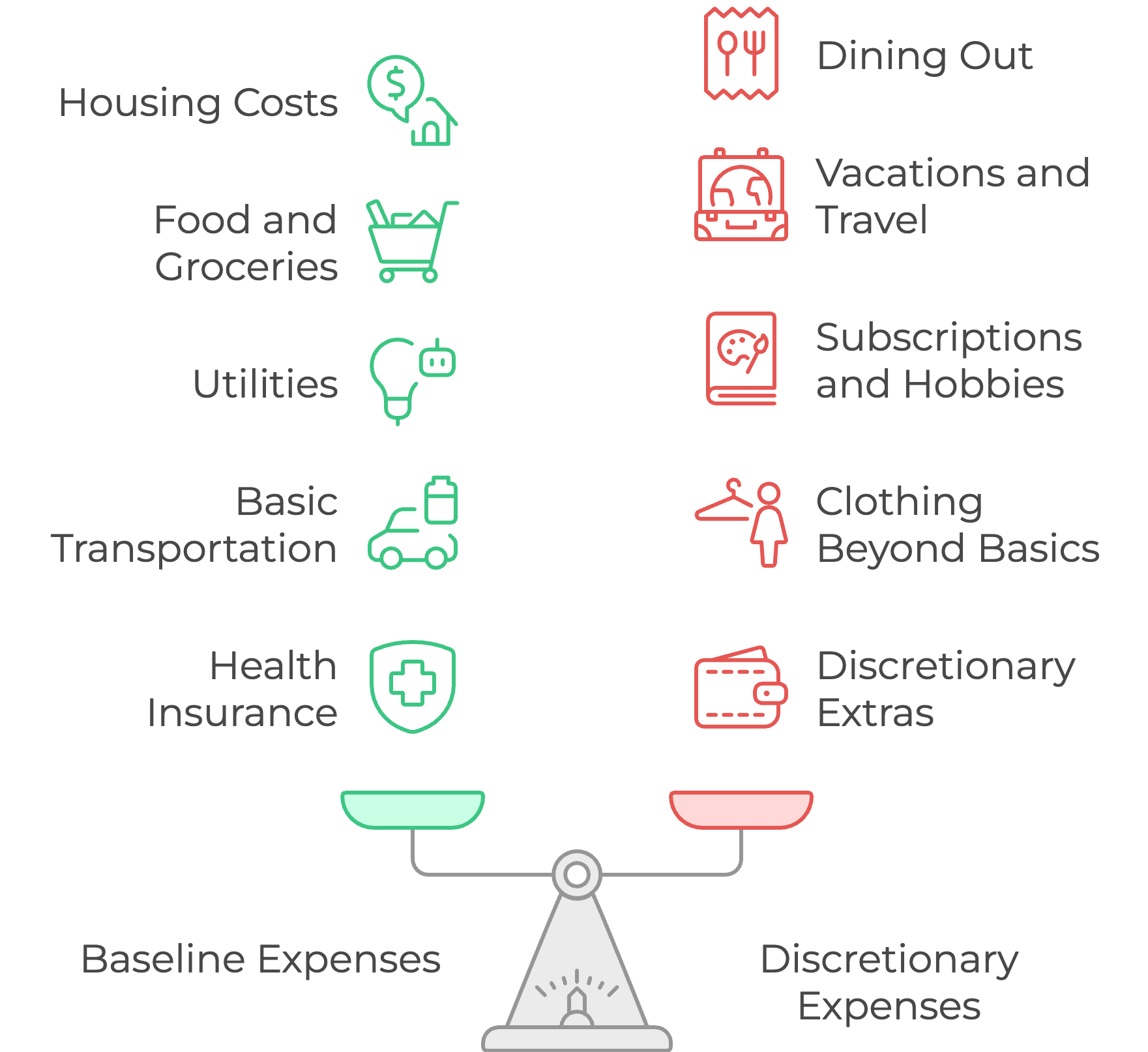
Your FU number is a floor, not a ceiling. Once free, you can still earn income — from work you choose, consulting, part-time projects. That income covers your extras. The baseline number is simply the exit ramp: the point at which continuing to work is a choice, not a requirement.
The reframe most people need:
Most people calculate how much they'd need to sustain their exact current lifestyle forever. That number is usually huge and discouraging. Your FU number is smaller — it's the number you need to never have to work again.
How to Calculate Yours
- Add up your monthly essential expenses (housing, food, utilities, transport, insurance, minimum debt payments);
- Multiply by 12 to get your annual essential expenses;
- Multiply that number by 25.
That's your FU number.
Want to adjust for inflation or a more conservative withdrawal rate? Use a lower rate — 3.5% or 3% — which means multiplying by 28.5 or 33 instead of 25. This builds in extra margin for a longer retirement horizon or a rougher market sequence.
The Psychological Shift
Knowing your FU number changes how you make decisions — even years before you reach it.
You stop lifestyle creep. When you know every $500 added to monthly spending adds $150,000 to your FU number, discretionary purchases look different. It's not about deprivation. It's about trade-offs being visible.
Progress becomes concrete. Instead of "saving for retirement someday," you have a specific number and a specific gap. Watching that gap close is motivating in a way that vague goals never are.
You negotiate differently. Knowing you could walk away — even years before you would — changes how you show up at work. You stop tolerating bad situations out of financial fear.
You define success yourself. Society's definition of success is "earn more, spend more." Defining your own number quietly opts you out of that treadmill.
Common Objections
"My expenses will change, so how can I know?" You don't need precision. A rough FU number is infinitely more useful than no number. Recalculate it once a year as your life changes.
"What about healthcare, kids, unexpected costs?" Add a buffer — typically 10–20% on top of your essential baseline. Some people use 3.5% instead of 4% for exactly this reason.
"The 4% rule is outdated." It's a starting point, not a guarantee. Later chapters cover sequence-of-returns risk and how to adjust for early retirement. For now, it gives you a useful, well-researched benchmark.
"My number feels impossibly large." That's why this course has 25 chapters. The number is the target. The rest is the system for reaching it.
Key Takeaways
- The FU number is a math problem, not a fantasy — annual essential expenses × 25 gives you the portfolio size that makes work optional;
- Base it on essential expenses, not current spending. The gap between those two numbers is usually significant;
- Every $1 cut from monthly spending is worth $300 off the target — spending decisions and saving decisions are both levers on the same number;
- You don't have to be free yet to think like someone with a plan. Knowing the number changes your decisions starting today.
1. Which statements accurately reflect the FU number and its calculation using the 4% rule? (Select two)
2. Which statements best reflect the psychological shifts and common objections that come from defining your FU number? (Select two)
Grazie per i tuoi commenti!
Chieda ad AI

Chieda ad AI

Chieda pure quello che desidera o provi una delle domande suggerite per iniziare la nostra conversazione
