Measuring and Communicating ROI
Scorri per mostrare il menu
Implementing AI tools is straightforward. Proving that they are working – in a way that justifies continued investment and earns organizational support for expanding them – requires a different discipline. ROI measurement does not need to be complicated, but it does need to be deliberate.
What to Measure
The metrics that matter for AI implementation ROI fall into two categories: time-based and quality-based.
Time-based metrics are the most straightforward and the most credible with leadership. They answer the question: how long did this take before, and how long does it take now?
Useful time-based metrics include:
- Hours per week spent on a specific task before and after implementation;
- Time from data availability to report distribution;
- Time from meeting end to summary distribution;
- Number of emails handled per hour before and after AI assistance.
Quality-based metrics are harder to quantify but often more significant. They answer the question: is the output better?
Useful quality-based metrics include:
- Error rate in reports before and after AI review steps;
- Client response rate to AI-assisted versus manually written outreach;
- Employee satisfaction with the process, measured through a simple monthly survey.
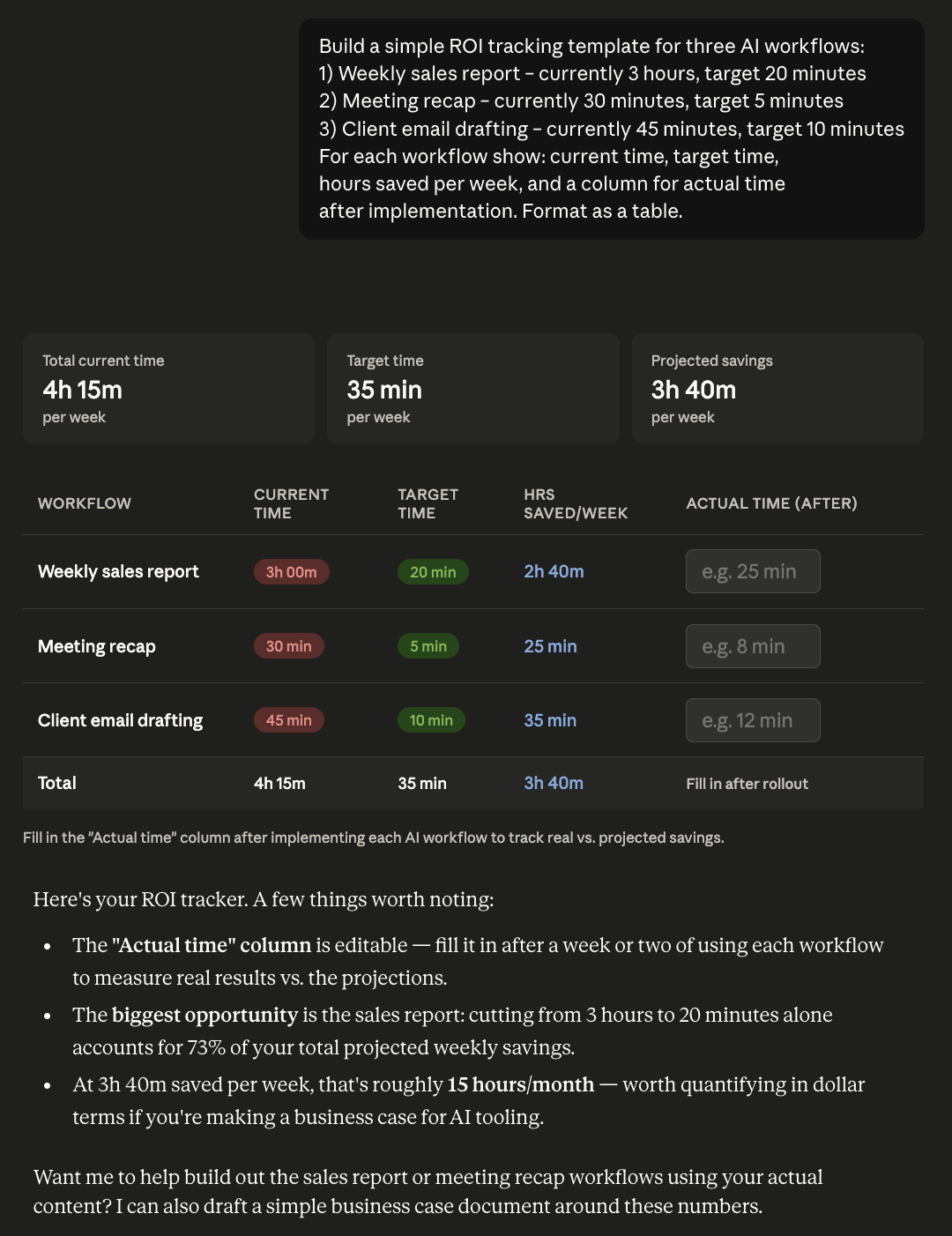

Baseline measurement – the data you collect about a process before implementing AI, which becomes the comparison point for measuring improvement. Without a baseline, ROI claims are anecdotal. With one, they are defensible.
Setting Up Your Baseline
The most common ROI measurement mistake is failing to capture baseline data before implementation. Once a workflow has changed, it is very difficult to accurately reconstruct how long it used to take.
Before implementing any new AI workflow, spend 30 minutes documenting the current state:
- The specific task being targeted;
- How often it occurs per week;
- How long it currently takes, measured over at least two cycles;
- Who is involved and at what fully-loaded hourly cost;
- What the output currently looks like and any known quality issues.
This takes less than an hour and makes every subsequent measurement meaningful.

Precise measurement is less important than consistent measurement. A rough time estimate tracked consistently over 12 weeks is more valuable than a precise measurement taken once. Build measurement into the workflow rather than treating it as a separate task.
Communicating Results to Leadership
Leadership conversations about AI ROI work best when they follow a specific structure: problem, intervention, result, implication.
Problem – what was the operational pain before the implementation? Quantify it if possible.
Intervention – what did you implement, at what cost, and how long did it take to set up?
Result – what changed? Lead with the most compelling metric, usually time recovered or error rate reduction.
Implication – what does this mean for the next investment decision? What should be done next and why?
A realistic example of this structure in practice:

Our weekly operations report was taking 3.5 hours to compile manually. We implemented a Claude workflow that reduced this to 25 minutes of review and distribution. The tool costs $20 per month. At our fully-loaded hourly rate, we are recovering $7,200 in capacity per year against a $240 annual tool cost. We recommend applying the same approach to our monthly client reports, which currently take a similar amount of time.
This is one paragraph. It answers every question a reasonable decision-maker would ask, and it ends with a clear recommendation.
What if the ROI is harder to demonstrate?
Some AI implementations produce real value that does not show up cleanly in time or error rate metrics. Better decision quality, improved team morale, faster onboarding of new staff – these are genuine but difficult to quantify.
For these cases, the most credible approach is a combination of qualitative feedback and proxy metrics. Ask the team members involved whether the AI assistance is genuinely useful and why. Track proxy indicators – for example, if AI-assisted meeting summaries are being distributed faster, measure distribution time as a proxy for meeting follow-up quality.
Be honest with leadership about what you can and cannot measure directly. A credible "we believe this is working for these reasons, and here is the qualitative evidence" is more persuasive than a strained quantitative case built on shaky assumptions.
Grazie per i tuoi commenti!
Chieda ad AI

Chieda ad AI

Chieda pure quello che desidera o provi una delle domande suggerite per iniziare la nostra conversazione
Measuring and Communicating ROI
Implementing AI tools is straightforward. Proving that they are working – in a way that justifies continued investment and earns organizational support for expanding them – requires a different discipline. ROI measurement does not need to be complicated, but it does need to be deliberate.
What to Measure
The metrics that matter for AI implementation ROI fall into two categories: time-based and quality-based.
Time-based metrics are the most straightforward and the most credible with leadership. They answer the question: how long did this take before, and how long does it take now?
Useful time-based metrics include:
- Hours per week spent on a specific task before and after implementation;
- Time from data availability to report distribution;
- Time from meeting end to summary distribution;
- Number of emails handled per hour before and after AI assistance.
Quality-based metrics are harder to quantify but often more significant. They answer the question: is the output better?
Useful quality-based metrics include:
- Error rate in reports before and after AI review steps;
- Client response rate to AI-assisted versus manually written outreach;
- Employee satisfaction with the process, measured through a simple monthly survey.
Baseline measurement – the data you collect about a process before implementing AI, which becomes the comparison point for measuring improvement. Without a baseline, ROI claims are anecdotal. With one, they are defensible.
Setting Up Your Baseline
The most common ROI measurement mistake is failing to capture baseline data before implementation. Once a workflow has changed, it is very difficult to accurately reconstruct how long it used to take.
Before implementing any new AI workflow, spend 30 minutes documenting the current state:
- The specific task being targeted;
- How often it occurs per week;
- How long it currently takes, measured over at least two cycles;
- Who is involved and at what fully-loaded hourly cost;
- What the output currently looks like and any known quality issues.
This takes less than an hour and makes every subsequent measurement meaningful.
Precise measurement is less important than consistent measurement. A rough time estimate tracked consistently over 12 weeks is more valuable than a precise measurement taken once. Build measurement into the workflow rather than treating it as a separate task.
Communicating Results to Leadership
Leadership conversations about AI ROI work best when they follow a specific structure: problem, intervention, result, implication.
Problem – what was the operational pain before the implementation? Quantify it if possible.
Intervention – what did you implement, at what cost, and how long did it take to set up?
Result – what changed? Lead with the most compelling metric, usually time recovered or error rate reduction.
Implication – what does this mean for the next investment decision? What should be done next and why?
A realistic example of this structure in practice:
Our weekly operations report was taking 3.5 hours to compile manually. We implemented a Claude workflow that reduced this to 25 minutes of review and distribution. The tool costs $20 per month. At our fully-loaded hourly rate, we are recovering $7,200 in capacity per year against a $240 annual tool cost. We recommend applying the same approach to our monthly client reports, which currently take a similar amount of time.
This is one paragraph. It answers every question a reasonable decision-maker would ask, and it ends with a clear recommendation.
What if the ROI is harder to demonstrate?
Some AI implementations produce real value that does not show up cleanly in time or error rate metrics. Better decision quality, improved team morale, faster onboarding of new staff – these are genuine but difficult to quantify.
For these cases, the most credible approach is a combination of qualitative feedback and proxy metrics. Ask the team members involved whether the AI assistance is genuinely useful and why. Track proxy indicators – for example, if AI-assisted meeting summaries are being distributed faster, measure distribution time as a proxy for meeting follow-up quality.
Be honest with leadership about what you can and cannot measure directly. A credible "we believe this is working for these reasons, and here is the qualitative evidence" is more persuasive than a strained quantitative case built on shaky assumptions.
Grazie per i tuoi commenti!
