Tax-Advantaged Accounts Ranked
Scorri per mostrare il menu
The Order That Saves You The Most Money
You have a paycheck. You want to invest some of it. There are five or six different accounts you could use — and the order you fill them matters a lot.
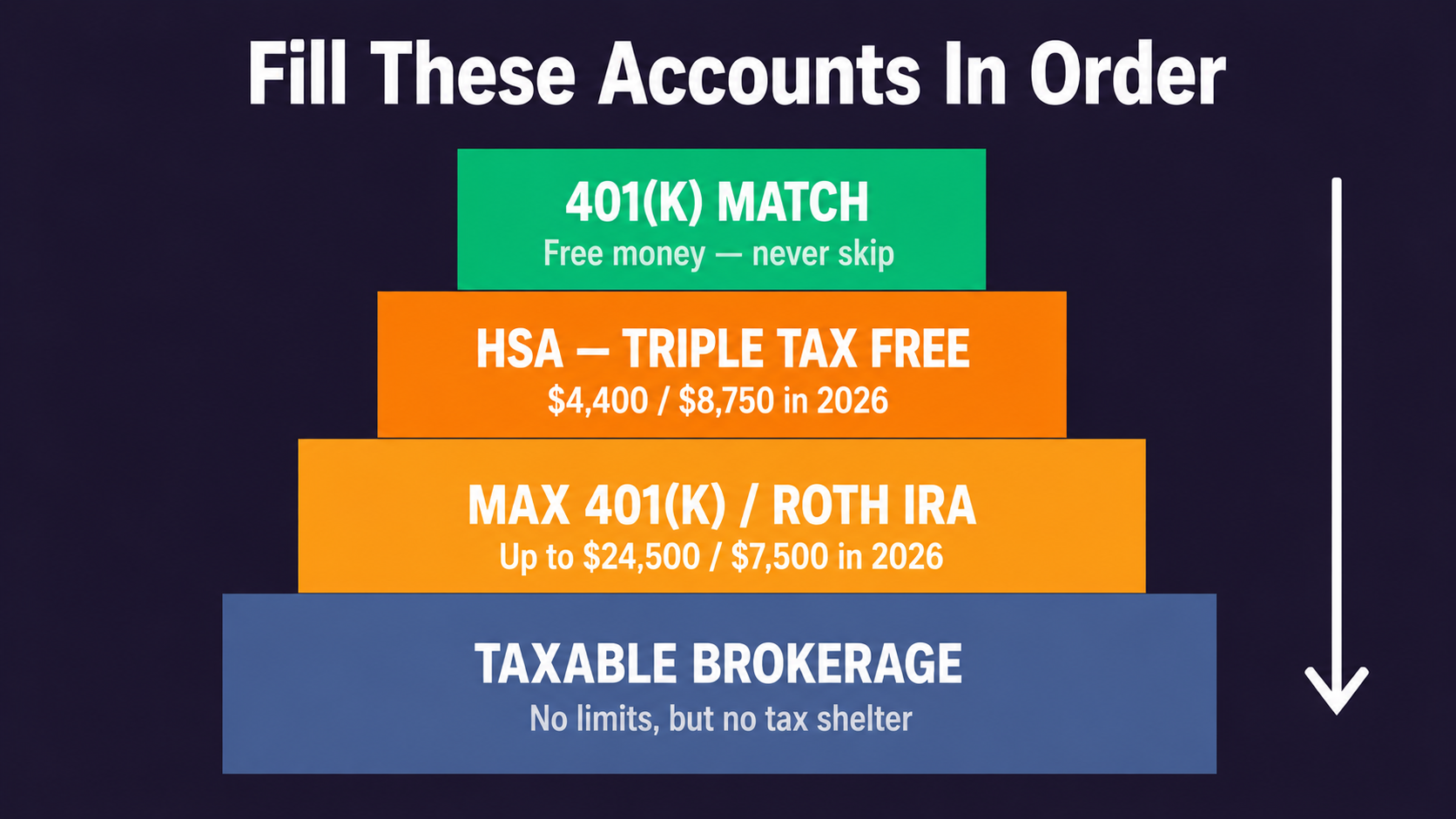
Here's the ranking most financial planners agree on. Follow it from top to bottom.
1. 401(k) Up To The Employer Match
If your employer matches your 401(k) contributions, that's free money — typically a 50% to 100% instant return. Nothing else in finance comes close.
Fill this first. Even if you don't max it out, get every dollar of the match.
2. HSA (If You're Eligible) — The Quiet King
The Health Savings Account is the only triple-tax-advantaged account in the entire U.S. tax code:
- Contributions are tax-deductible (just like a 401(k));
- Growth is tax-free (just like a Roth);
- Withdrawals for medical expenses are tax-free (no other account does this).
It's basically a 401(k), Roth IRA, and FSA combined into one. And after age 65, you can use the money for anything — you just pay ordinary income tax on non-medical withdrawals (same treatment as a Traditional IRA).
2026 HSA contribution limits:
- Self-only coverage → $4,400;
- Family coverage → $8,750;
- Age 55+ catch-up → +$1,000.
The catch: you need to be enrolled in a High-Deductible Health Plan (HDHP) to contribute.
3. Max Out Your 401(k) Or Roth IRA
After the match and HSA, push toward maxing out a 401(k) or contributing to a Roth IRA, depending on your income and tax-bracket situation:
- 2026 401(k) limit → $24,500 (+$8,000 catch-up at 50+, +$11,250 super catch-up at 60–63);
- 2026 IRA/Roth IRA limit → $7,500 (+$1,100 catch-up at 50+).
Roth IRA income limits (2026): phase-out at $153,000–$168,000 single, $242,000–$252,000 joint.
4. Taxable Brokerage
After all tax-advantaged accounts are filled, anything extra goes into a regular brokerage. Less tax efficiency, but no contribution caps and no withdrawal rules.
Why The HSA Wins Long-Term
Here's the move advanced investors make:
- Contribute the max to the HSA every year;
- Don't spend it on current medical bills — pay those out of pocket;
- Invest the HSA in index funds;
- Save every medical receipt;
- Decades later, withdraw tax-free using the old receipts — or just use it as a stealth retirement account.
A $4,400 contribution invested at 7% for 30 years grows to about $33,500 — completely tax-free if used for medical expenses (and you'll have those in retirement, guaranteed).
Most people use their HSA like a debit card. They're leaving the best account in the U.S. tax code on the table.
Grazie per i tuoi commenti!
Chieda ad AI

Chieda ad AI

Chieda pure quello che desidera o provi una delle domande suggerite per iniziare la nostra conversazione
Tax-Advantaged Accounts Ranked
The Order That Saves You The Most Money
You have a paycheck. You want to invest some of it. There are five or six different accounts you could use — and the order you fill them matters a lot.
Here's the ranking most financial planners agree on. Follow it from top to bottom.
1. 401(k) Up To The Employer Match
If your employer matches your 401(k) contributions, that's free money — typically a 50% to 100% instant return. Nothing else in finance comes close.
Fill this first. Even if you don't max it out, get every dollar of the match.
2. HSA (If You're Eligible) — The Quiet King
The Health Savings Account is the only triple-tax-advantaged account in the entire U.S. tax code:
- Contributions are tax-deductible (just like a 401(k));
- Growth is tax-free (just like a Roth);
- Withdrawals for medical expenses are tax-free (no other account does this).
It's basically a 401(k), Roth IRA, and FSA combined into one. And after age 65, you can use the money for anything — you just pay ordinary income tax on non-medical withdrawals (same treatment as a Traditional IRA).
2026 HSA contribution limits:
- Self-only coverage → $4,400;
- Family coverage → $8,750;
- Age 55+ catch-up → +$1,000.
The catch: you need to be enrolled in a High-Deductible Health Plan (HDHP) to contribute.
3. Max Out Your 401(k) Or Roth IRA
After the match and HSA, push toward maxing out a 401(k) or contributing to a Roth IRA, depending on your income and tax-bracket situation:
- 2026 401(k) limit → $24,500 (+$8,000 catch-up at 50+, +$11,250 super catch-up at 60–63);
- 2026 IRA/Roth IRA limit → $7,500 (+$1,100 catch-up at 50+).
Roth IRA income limits (2026): phase-out at $153,000–$168,000 single, $242,000–$252,000 joint.
4. Taxable Brokerage
After all tax-advantaged accounts are filled, anything extra goes into a regular brokerage. Less tax efficiency, but no contribution caps and no withdrawal rules.
Why The HSA Wins Long-Term
Here's the move advanced investors make:
- Contribute the max to the HSA every year;
- Don't spend it on current medical bills — pay those out of pocket;
- Invest the HSA in index funds;
- Save every medical receipt;
- Decades later, withdraw tax-free using the old receipts — or just use it as a stealth retirement account.
A $4,400 contribution invested at 7% for 30 years grows to about $33,500 — completely tax-free if used for medical expenses (and you'll have those in retirement, guaranteed).
Most people use their HSA like a debit card. They're leaving the best account in the U.S. tax code on the table.
Grazie per i tuoi commenti!
