 Sigmoid and Tanh Activations
Scorri per mostrare il menu
The sigmoid and tanh activation functions are explored, as they play a crucial role in the functioning of RNNs.

Definition
The sigmoid and tanh functions transform inputs into outputs, enabling the model to make predictions.
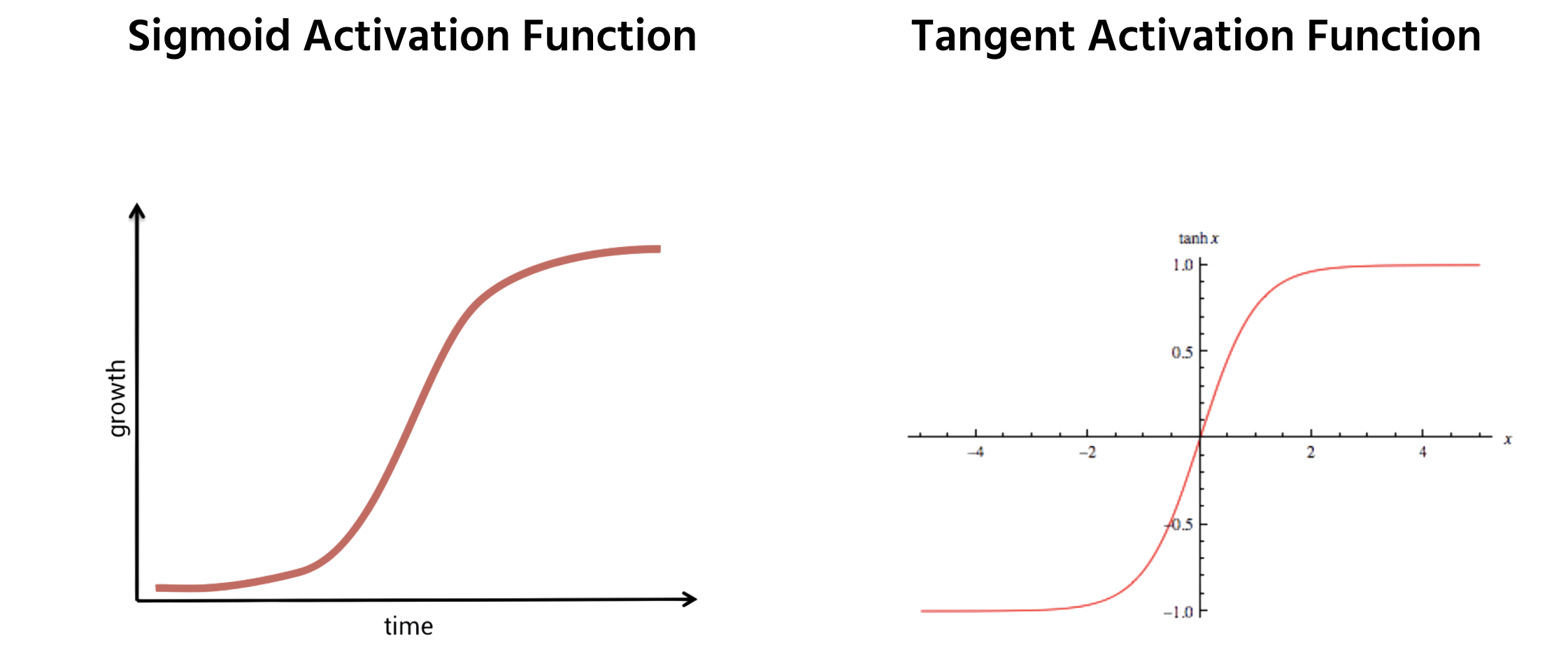
- Sigmoid activation: the sigmoid function maps input values to an output range between 0 and 1. It is commonly used in binary classification tasks, as its output can be interpreted as a probability. However, it suffers from the vanishing gradient problem when the input values are very large or very small;
- Tanh activation: the tanh function is similar to the sigmoid but maps the input values to an output range between -1 and 1. It helps center the data around zero, which can aid learning. Despite its benefits, it also suffers from the vanishing gradient problem in certain situations;
- Working of sigmoid and tanh: both functions work by squashing the input values into a bounded range. The primary difference lies in their output range: sigmoid (0 to 1) vs. tanh (-1 to 1), which affects how the network processes and updates the information.
In the next chapter, we will look at how these activation functions play a role in LSTM networks and how they help overcome some of the limitations of standard RNNs.
Tutto è chiaro?
Grazie per i tuoi commenti!
Sezione 1. Capitolo 7
Chieda ad AI

Chieda ad AI

Chieda pure quello che desidera o provi una delle domande suggerite per iniziare la nostra conversazione
Sezione 1. Capitolo 7
