Mathematical Operations in Java
メニューを表示するにはスワイプしてください
Operators
We observed that we used basic mathematical operators such as +, -, /, and *. These operators are familiar to us from calculators or mathematics; you can also use them in a code editor.
Let's go through the basics:
+– addition;-– subtraction;/– division;*– multiplication.
You can use these four fundamental operators with numerical data types (byte, short, long, float, double).
Let's explore the usage of these operators with an example code:

Main.java
1234567891011121314package com.example; public class Main { public static void main(String[] args) { // Creating an int variable with value 10 int a = 10; // Creating an int variable with value 17 int b = 17; // Creating an int variable to store the sum of `a` and `b` int res = a + b; // Printing the result to the console System.out.println(res); } }
As we can see, the variable res holds the value 27, which is the sum of 10 and 17.
Let's consider a few more examples:
Main.java
12345678910111213141516171819package com.example; public class Main { public static void main(String[] args) { // Creating an int variable with the sum of 16 and 4 int plus = 16 + 4; /* Creating an int variable with the value of the subtraction of the `plus` variable and 10 */ int minus = plus - 10; /* Variable that holds the result of multiplying the `minus` variable by 4 */ int multiplying = minus * 4; /* Using subtraction and division operations on the `multiplying` variable */ int complexDivision = (multiplying - 4) / 9; // Printing the result to the console System.out.println(complexDivision); } }
We can use both numbers and variables in operations, but creating many variables increases stack memory usage, so using numbers directly is often preferable. Operator precedence is applied: parentheses first, then multiplication or division, and finally addition or subtraction.
This allows us to perform simple operations with different numeric values.
Order of Operations
Java follows the basic principles of mathematics, and operations also have an order of execution. Let's take a look at an example:
main.java
12345678package com.example; public class Main { public static void main(String[] args) { int result = (10 + 5) * 2 - 8 / 4 + 1; System.out.println(result); } }
Here we arrived at the result by performing operations sequentially. Let's take a look at the order:
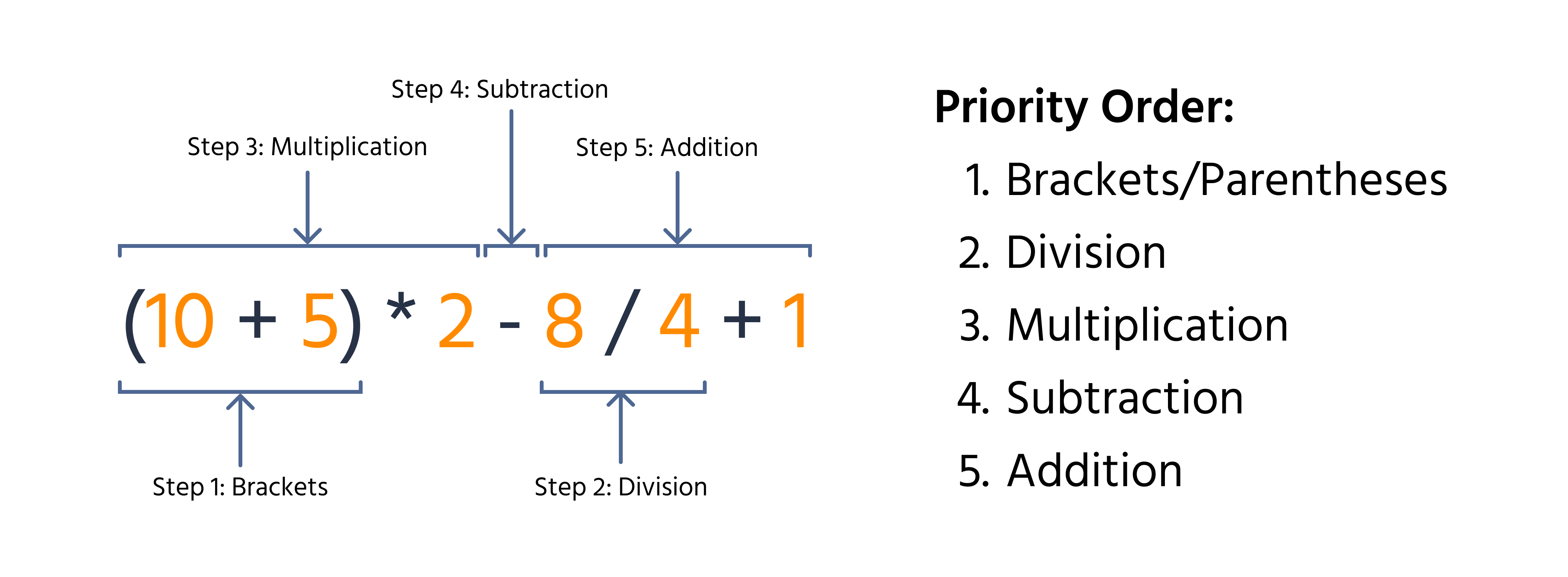
So, you can prioritize the execution of operations using regular parentheses, just like in arithmetic.
スワイプしてコーディングを開始
- Add the values of the variables
firstNumberandsecondNumber. - Divide the sum by the value of the variable
thirdNumber. - Store the final result in the variable
result.
解答
 実践的な練習のためにデスクトップに切り替える下記のオプションのいずれかを利用して、現在の場所から続行する
フィードバックありがとうございます!

single
AIに質問する

AIに質問する

何でも質問するか、提案された質問の1つを試してチャットを始めてください
