Term vs. Whole Life
メニューを表示するにはスワイプしてください

The life insurance industry offers dozens of product variations, but they all descend from two fundamental types: term life and permanent life (of which whole life is the most common form).
The difference between them is not subtle. One is a straightforward, affordable protection product. The other is a complex, expensive hybrid of insurance and investment that benefits the insurance company and its agents far more than it benefits most policyholders. Understanding the distinction — and the sales tactics used to obscure it — is one of the more valuable things you can do for your long-term finances.
Term Life Insurance
Term life insurance provides a death benefit for a defined period — the term. If you die within the term, your beneficiaries receive the payout. If you outlive the term, the policy expires with no payout and no cash value. That is the entirety of what it does.
Key characteristics:
- Pure protection — no investment component, no cash value, no complexity;
- Fixed premiums — your premium is locked at purchase for the length of the term;
- Defined terms — typically 10, 15, 20, 25, or 30 years;
- Low cost — a healthy 30-year-old can get $1,000,000 of 20-year coverage for $30–$50/month;
- Transparent — what you see is what you get; no hidden fees, no surrender charges, no moving parts.
Term life is designed to cover a specific window of financial vulnerability — the years when dependents rely on your income, debts are significant, and assets are not yet large enough to self-insure. When that window closes, the policy expires. Simple, honest, effective.
Whole Life Insurance
Whole life insurance provides a death benefit for your entire life — not a defined term — combined with a savings component called cash value that grows over time at a guaranteed (but modest) rate.
Key characteristics:
- Permanent coverage — does not expire as long as premiums are paid;
- Cash value accumulation — a portion of each premium builds a savings account within the policy;
- Borrowing against cash value — policyholders can take loans against the accumulated cash value;
- Dividends — some policies pay dividends that can be reinvested or taken as cash;
- High cost — premiums are typically 5–15× higher than equivalent term coverage;
- Complexity — multiple moving parts, surrender charges, loan provisions, and fee structures that are deliberately difficult to evaluate.
On the surface, whole life sounds appealing — permanent coverage plus a savings component. In practice, the economics rarely work in the policyholder's favor.
Why Term Almost Always Wins
The Cost Comparison Is Stark
A 35-year-old male in good health purchasing $500,000 of coverage:
The whole life policy costs 12–16× more for the same death benefit. That difference — roughly $270–$375/month — invested in a low-cost index fund over 20 years at 7% annual return would grow to approximately $170,000–$235,000.
This is the foundational argument against whole life for most people: the premium difference, invested separately, produces far more wealth than the cash value component of a whole life policy ever will.
Cash Value Growth Is Slow and Opaque
The cash value in a whole life policy grows at a guaranteed rate — typically 1–3% — with potential dividends on top. This is not competitive with long-run equity market returns of 6–8%. The insurance company invests your premiums, earns market returns, keeps the difference, and returns the modest guaranteed rate to you.
Additionally, in the early years of a whole life policy, the vast majority of your premium covers agent commissions and administrative fees — not cash value. It typically takes 10–15 years before the cash value exceeds the total premiums paid. Surrendering the policy before that point results in a direct financial loss.
The Death Benefit and Cash Value Are Not Additive
This surprises many policyholders: when you die, your beneficiaries receive the death benefit — but not the death benefit plus the accumulated cash value. The insurance company keeps the cash value. You built it for decades, and it disappears at death.
To access cash value while alive, you must either surrender the policy (losing coverage) or take a loan against it — which accrues interest and reduces the eventual death benefit if not repaid. The cash value is simultaneously the product's main selling point and its most misunderstood feature.
The "Forced Savings" Argument Does Not Hold Up
The most common defense of whole life is that it forces disciplined savings for people who would otherwise spend the premium difference. This is a real behavioral consideration — but it is a thin justification for paying 12× more for the same death benefit.
Better alternatives for people who need savings discipline:
- Automatic monthly transfers to an index fund;
- Maxing out tax-advantaged accounts (401k, IRA, Roth) before any discretionary investing;
- A simple target-date fund with automatic contributions.
These options produce better returns, maintain full liquidity, and do not lock savings behind surrender charges and loan provisions.
When Whole Life Might Make Sense
Whole life insurance is not appropriate for most people — but there are narrow, specific situations where it has legitimate uses:
Irrevocable Life Insurance Trust (ILIT) for estate planning: Very high net worth individuals — estates exceeding the federal estate tax exemption — sometimes use whole life inside an ILIT to provide liquidity for estate tax obligations without forcing heirs to sell assets. This is a sophisticated strategy for a narrow population.
Special needs planning: Parents of children with permanent disabilities sometimes use whole life to ensure a death benefit is available regardless of when they die — since the need for support does not expire on a defined timeline the way most financial dependencies do.
Business succession funding: Buy-sell agreements between business partners sometimes use permanent life insurance to fund the buyout of a deceased partner's ownership stake, particularly when the timeline of need is genuinely indefinite.
In each of these cases, the permanent nature of whole life — coverage that does not expire — is the specific feature being purchased. For everyone else, the need is temporary, and term coverage is the appropriate tool.
Other Permanent Life Variants
Universal life: A flexible-premium version of permanent life insurance. Premiums and death benefits can be adjusted over time. More flexible than whole life but similarly expensive and complex. Subject to lapse risk if cash value is insufficient to cover internal charges — a risk that has blindsided many policyholders in low-interest-rate environments.
Variable life and variable universal life: Permanent life insurance where cash value is invested in sub-accounts similar to mutual funds. Combines insurance costs with investment risk and high fees. Offers upside potential but also downside risk — your cash value can decline. Rarely the most efficient vehicle for either insurance or investing.
Indexed universal life (IUL): Cash value growth linked to a market index with a floor and a cap. Marketed aggressively as offering market upside without downside risk. In practice, caps limit gains significantly, internal fees are high, and the complexity makes honest comparison nearly impossible. Approached with extreme caution by most independent financial planners.
The "Buy Term and Invest the Difference" Strategy
The alternative to whole life is not complicated: buy the cheapest term policy that covers your actual need, invest the premium difference in low-cost index funds, and build wealth through the market rather than through an insurance product.
Over a 20–30 year period, this approach consistently outperforms whole life on a pure wealth-accumulation basis — while maintaining full liquidity, full transparency, and no surrender charges.
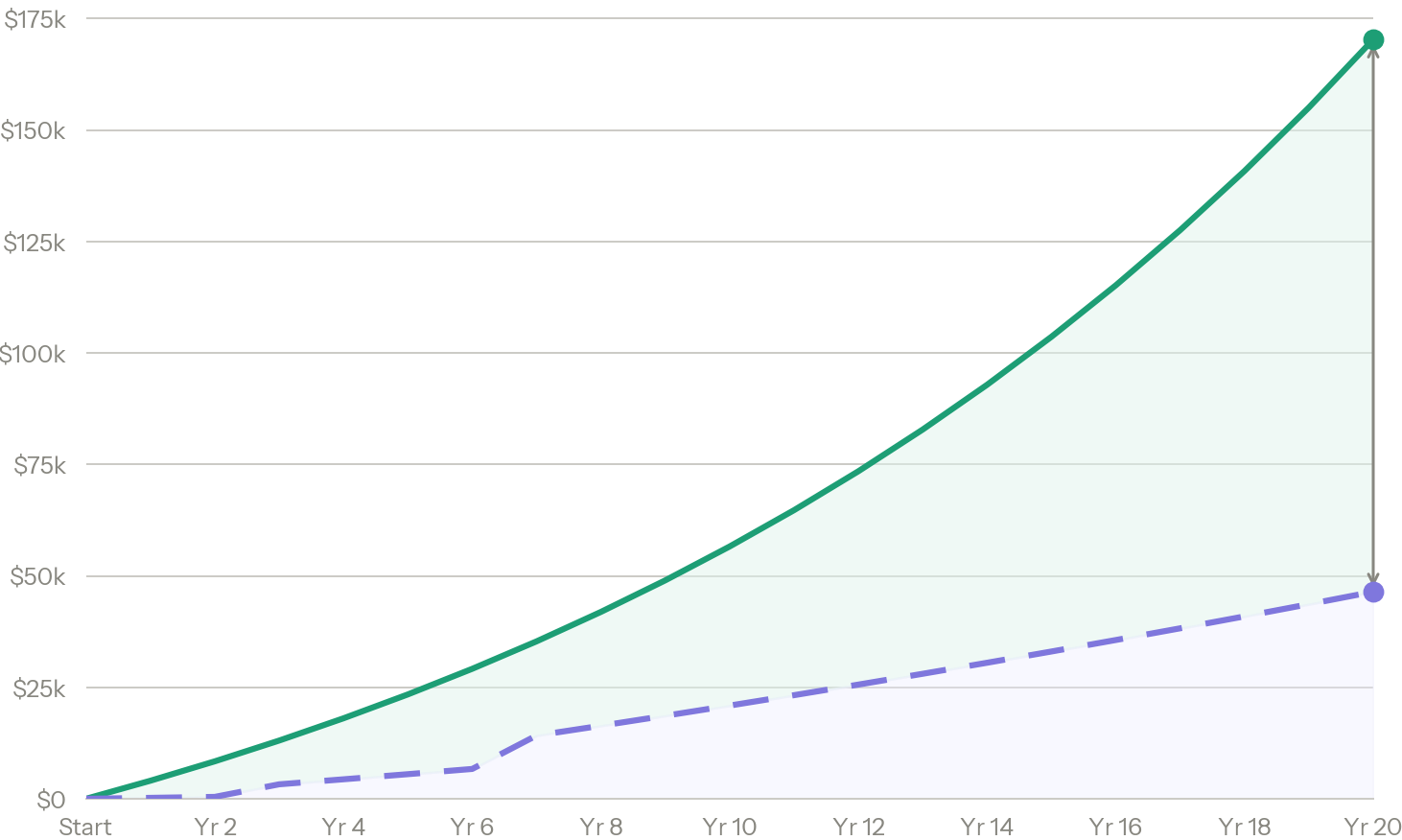
The gap between the two lines is the argument. Investing the premium difference — roughly $325/month — in a low-cost index fund produces more than double the wealth of whole life cash value over 20 years, with full liquidity at every point along the way.
The strategy only fails if:
- You do not actually invest the difference (a behavioral, not financial, problem);
- You develop a health condition that makes future insurance uninsurable (mitigated by buying adequate term coverage upfront and locking in while healthy);
- You live to an age where you genuinely need permanent coverage (relevant for the estate planning and special needs cases above).
For the vast majority of people, none of these exceptions apply.
Practical Guidance for Buying Term
- Lock in coverage while young and healthy — premiums are determined at purchase and fixed for the term; a 30-year-old pays dramatically less than a 45-year-old for identical coverage;
- Match the term to your actual need — if your youngest child will be independent in 18 years, a 20-year term covers the window with margin;
- Level premium, level benefit — the simplest structure; avoid decreasing benefit policies unless the specific debt being covered is also decreasing;
- Buy from financially strong insurers — check AM Best ratings; stick to A or above;
- No-exam policies are available — for coverage under $1,000,000, many insurers now offer accelerated underwriting with no medical exam, using health data and algorithms instead.
Key Takeaways
- Term life is pure, affordable income replacement — a defined death benefit for a defined period, with no investment component, no complexity, and no hidden costs;
- Whole life costs 12–16× more than equivalent term coverage — the premium difference, invested in low-cost index funds, produces far greater wealth than the cash value component of any whole life policy;
- The cash value and death benefit are not additive — at death, the insurance company keeps the accumulated cash value; policyholders who understand this rarely choose whole life voluntarily;
- Whole life has legitimate uses in narrow situations — estate tax planning for very high net worth individuals, special needs planning, and certain business succession structures — but these apply to a small minority of people;
- Buy term, invest the difference — match the term length to your actual window of financial vulnerability, lock in coverage while young and healthy, and build wealth through the market rather than through an insurance product.
1. Which of the following statements accurately reflect the differences between term and whole life insurance?
2. Which statements accurately reflect the financial differences between term and whole life insurance?
フィードバックありがとうございます!
AIに質問する

AIに質問する

何でも質問するか、提案された質問の1つを試してチャットを始めてください
