Ethical Dimensions of Digital Work
メニューを表示するにはスワイプしてください
Digital tools expand capability. They also expand the surface area for ethical decisions — situations where something is technically possible, perhaps technically permitted, but where the right course of action requires judgment rather than rule-following.
Most professionals will encounter these situations within the first few years of working with digital tools. Having a framework for them — before they arise under pressure — is more useful than discovering you needed one after the fact.
Four Situations That Require Digital Ethical Judgment
AI authorship and transparency
Using AI to draft a document, generate an analysis, or produce a report is increasingly common and often entirely appropriate. The ethical question is transparency: when is it important to disclose that AI was involved in generating work product, and when does non-disclosure cross into misrepresentation?
There's no universal answer, but a useful test: if the person receiving the work would materially change their evaluation of it — their trust in its accuracy, their assessment of the person's capabilities, their decision about whether to rely on it — if they knew AI was involved, then non-disclosure is ethically problematic. A client paying for expert analysis has a reasonable expectation that a human expert performed it.
Data use within technical permissions
Technically having access to data is not the same as being authorized to use it for any purpose. An employee with database access to customer records for their specific job function has technical access to all customer records — but using that access to pull data for a personal project, to share with a third party, or to satisfy curiosity about a specific individual crosses into unauthorized use regardless of technical access.
The principle: access rights describe what the system allows. Ethics describes what you should do. They're not always the same.
Accuracy and the temptation of workslop
As AI tools make first-draft generation faster, there's a growing temptation to pass AI output to clients, colleagues, or leadership with less review than the content deserves — particularly under time pressure. The result, as described in Section 2, is "workslop": low-quality AI-generated content that carries errors, hallucinations, or generic responses into professional contexts.
Submitting AI-generated work as your own without adequate review isn't just a quality risk — it's a representation issue. You're implying a level of care and judgment that the work doesn't reflect.
Speaking up about digital systems that produce unfair outcomes
Algorithmic and AI-driven systems — hiring filters, performance management tools, customer segmentation algorithms — can produce outcomes that disadvantage specific groups in ways that aren't visible to their designers. When an employee notices that a digital system is systematically producing unfair outcomes, staying silent because "it's just how the tool works" is an ethical choice, not a neutral one.
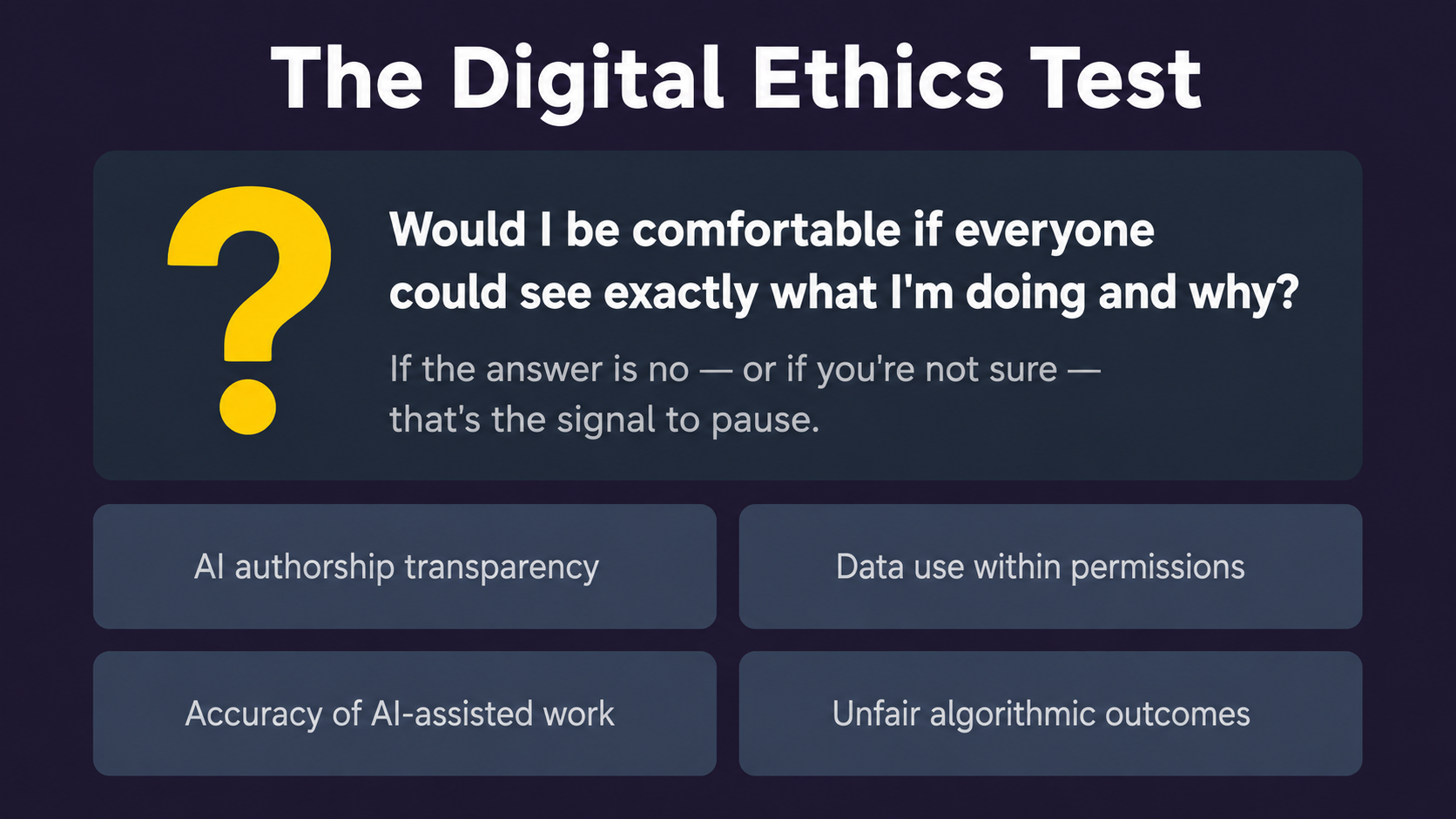
The Framework: The Transparency Test
When facing a digital ethical decision without a clear rule, one question surfaces the answer faster than most frameworks:
"Would I be comfortable if everyone who has a stake in this decision — my manager, my client, my colleagues, the person whose data this is — could see exactly what I'm doing and exactly why I'm doing it?"
If yes, proceed. If no, or if you're not sure, that's the signal to pause, think through what's making you hesitant, and either adjust your approach or seek guidance.
The transparency test doesn't resolve every situation. But it catches the majority of cases where a technically permitted action crosses into ethically questionable territory — because the discomfort it surfaces is almost always pointing at something real.
フィードバックありがとうございます!
AIに質問する

AIに質問する

何でも質問するか、提案された質問の1つを試してチャットを始めてください
