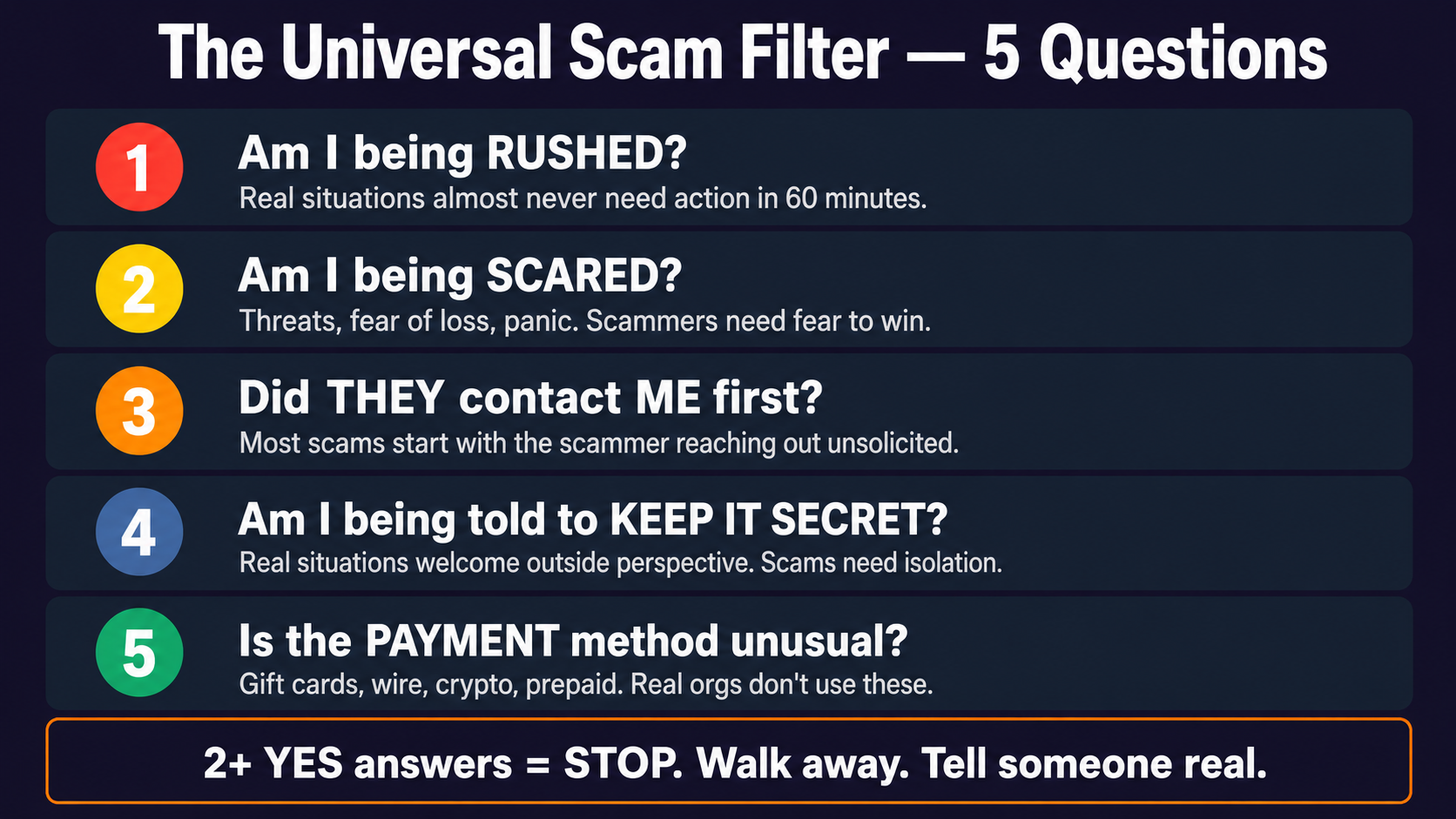
The Universal Scam Filter — 5 Questions
メニューを表示するにはスワイプしてください
You've now seen the main scam types — phishing emails, voice clones, romance scams, QR codes, clone sites. They look completely different on the surface. Different channels, different stories, different victims.
Underneath, they share the same five mechanics. Master five questions, and you catch them all — including scams that don't exist yet, that use technology not invented yet. The pattern is more durable than the specifics.
This is the most valuable chapter of the section. Read it twice. Tell your family.
Question 1 — Am I Being Rushed?
"You have 24 hours to respond." "Your account closes in 1 hour." "Send the money in the next 30 minutes or it's lost." "If you don't act now, the discount disappears."
The single most consistent feature of every scam is urgency. Why? Because rushed brains make worse decisions than calm brains. A scammer needs you to act before your judgment catches up.
The reality check:
- Real banks give you time. If a real transaction is suspicious, they freeze it and contact you — you have days to clarify;
- Real police don't make threats over the phone with 60-minute deadlines. They show up in person or send certified mail;
- Real family emergencies survive 10 minutes of "let me hang up and call you back";
- Real refunds, real warranties, real product returns — none require action in the next hour;
- Real businesses don't have "the last copy of this item must be paid for in 15 minutes."
Test: if the situation asks you to act faster than you'd act on any non-emergency in your normal life, ask why. Most of the time, the answer is "because if I wait, I'll figure out it's a scam."
Question 2 — Am I Being Scared?
Fear of harm — your loved one is in trouble. Fear of loss — your account will be closed, your money is at risk. Fear of consequences — police are coming, taxes are owed, embarrassing photos will be published. Fear of missing out — this opportunity vanishes if you don't act.
Real institutions don't lead with fear. They lead with information. The IRS doesn't open conversations with "you will be arrested in 24 hours unless you pay." It opens with a letter explaining a discrepancy.
The reality check:
- Real legal proceedings come with paperwork, court dates, attorneys, and time;
- Real financial issues come with notices, account messages, statements you can verify by logging in yourself;
- Real family emergencies are handled by the actual hospital or police calling you back through their official switchboard, with a name and a callback;
- Real "missed opportunities" almost never matter — if you missed the deal, another comes around next month.
Test: if your dominant emotion right now is fear or panic, the scammer's hook is set. Stop. Take a walk. Call someone you trust. The "opportunity" or "emergency" will look completely different after 30 minutes of cooling down.
Question 3 — Did They Contact Me First?
About 90% of consumer scams start with the scammer reaching out — email, text, phone call, DM, knock at the door. You didn't initiate contact.
This flips the burden of proof. When you call your bank, you know it's your bank — you typed the number yourself. When they call you saying they're your bank — the burden of proving who they are is on them, and they can't reliably do it over a phone they initiated.
The reality check:
- Real businesses you have an account with rarely initiate emergency contact. They might send you a marketing email or a routine bill, but they don't call you out of the blue demanding immediate action;
- Real police, IRS, ICE, FBI don't reach out by phone, email, or text for the things scammers claim — those are always in-person or certified mail;
- Real "your computer has a virus" warnings don't come from popups or phone calls;
- Real opportunities don't slide into your DMs from strangers.
Test: if you didn't start this interaction, assume hostile until proven otherwise. Hang up. Look up the real number for the institution. Call them yourself. If it's real, you'll find the same conversation waiting on their end. If it's a scam, it dissolves.
Question 4 — Am I Being Told To Keep It Secret?
"Don't tell your wife." "Don't tell the bank." "Don't tell anyone — this is confidential." "If you tell, the deal is off." "The case is sensitive."
Real situations encourage outside perspective. Real authorities want you to consult with lawyers, family, bankers. Real opportunities survive a second opinion.
Scams require isolation. Because the moment a second person hears the story, the scam usually dies.
The reality check:
- Real police arrests are public records — no officer says "don't tell anyone";
- Real bank fraud cases are handled by the bank's fraud team, who want you to consult internally;
- Real family emergencies involve all family members, not just one isolated relative;
- Real investment opportunities don't fail because you "told your spouse";
- Real "confidential" matters in business have written NDAs, not phone-call confidentiality demands.
Test: ask "Can I call my husband / wife / parent / friend before deciding?" A real situation says yes. A scam says no, with various excuses ("you'll lose the opportunity," "they won't understand," "we need to act now").
This is the most powerful single test in the filter. A scammer's worst nightmare is the victim hanging up and saying "let me think about this and check with my brother." That conversation kills almost every scam in existence.
Question 5 — Is The Payment Method Unusual?
Gift cards. Wire transfers. Cryptocurrency. Prepaid debit cards. Western Union. Money orders to a P.O. box.
These are the laundering methods of choice for modern scams because they're hard to reverse and hard to trace. Real institutions don't use them.
The reality check:
- The IRS does not accept Bitcoin, Amazon gift cards, iTunes cards, or wire transfers for tax payments. They accept checks, bank transfers via direct.gov.uk equivalent, or in-person at IRS offices;
- Microsoft, Apple, Google, Amazon don't have a "support" team that asks for gift cards to fix anything;
- Your utility company doesn't disconnect you in 30 minutes for unpaid bills that you settle via gift card;
- Your bank doesn't ask you to transfer money to a "safe account" via wire transfer to resolve fraud;
- Real government fines are paid through official portals with major credit cards, never gift cards.
The pattern is so consistent that gift cards in particular have become the universal scam payment. Anyone asking you to buy gift cards for any urgent reason — even if they claim to be your boss, your bank, your family, or the police — is a scammer. No exceptions.
Test: if the payment requested is anything other than a normal credit card, debit card, ACH transfer, or major payment service (Apple Pay, Google Pay, PayPal), pause. Real bills are paid through real systems.
How To Use The Filter
You don't need all five to be "yes" to call it a scam. Most scams trigger at least three. Many trigger all five.
The rule: if two or more of these questions answer "yes," stop everything.
- Pause;
- Walk away from the device or the phone;
- Tell someone in your real life — your spouse, your sibling, your friend, your bank's fraud line;
- Sleep on it if at all possible;
- Re-evaluate the situation in the cold light of morning.
A real situation survives this process intact. A scam almost never does.
The Filter Works Against Scams You've Never Heard Of
Here's the magic of this approach. You don't need to know the specific scam name or technology. The pattern works across:
- Phishing emails (covered in Chapter 2);
- Voice-clone family emergencies (Chapter 3);
- Pig butchering (Chapter 4);
- QR-code traps and clone shops (Chapter 5);
- Every scam in 2027, 2028, 2029, using technology that doesn't exist yet.
Because the underlying psychology — rush, fear, unsolicited contact, isolation, untraceable payment — doesn't change as the technology evolves. AI made the surface more convincing. It didn't change what the scammer needs from you.
If a future scam uses VR avatars of your dead grandmother to ask for crypto, the filter still works:
- Am I being rushed? Yes.
- Am I being scared? Yes.
- Did they contact me first? Yes (your grandmother is dead).
- Am I being told to keep it secret? Probably yes.
- Is the payment method unusual? Crypto.
Five out of five. Scam. Walk away.
What To Tell Your Family
If you do one thing after Section 2, send a single message to your family group chat:
"Hey, big AI scams are everywhere now. Two things I want us to do:
Agree on a family safe word — what should it be? Anyone can ask for it during a weird phone call.
If any of us ever gets a message or call that feels urgent — rushed, scary, secret, or asking for gift cards / wire / crypto — promise we'll call each other before doing anything."
That single message protects more people than any antivirus you'll ever install.
1. Is feeling rushed or pressured to act quickly a strong indicator that a situation might be a scam, according to the first universal scam filter question?
2. Why do scammers use fear as a tactic, according to the scam filter question 'Am I being scared?'
3. Why is it important to be cautious if you are contacted unexpectedly by phone, email, or message?
フィードバックありがとうございます!
AIに質問する

AIに質問する

何でも質問するか、提案された質問の1つを試してチャットを始めてください
The Universal Scam Filter — 5 Questions
You've now seen the main scam types — phishing emails, voice clones, romance scams, QR codes, clone sites. They look completely different on the surface. Different channels, different stories, different victims.
Underneath, they share the same five mechanics. Master five questions, and you catch them all — including scams that don't exist yet, that use technology not invented yet. The pattern is more durable than the specifics.
This is the most valuable chapter of the section. Read it twice. Tell your family.
Question 1 — Am I Being Rushed?
"You have 24 hours to respond." "Your account closes in 1 hour." "Send the money in the next 30 minutes or it's lost." "If you don't act now, the discount disappears."
The single most consistent feature of every scam is urgency. Why? Because rushed brains make worse decisions than calm brains. A scammer needs you to act before your judgment catches up.
The reality check:
- Real banks give you time. If a real transaction is suspicious, they freeze it and contact you — you have days to clarify;
- Real police don't make threats over the phone with 60-minute deadlines. They show up in person or send certified mail;
- Real family emergencies survive 10 minutes of "let me hang up and call you back";
- Real refunds, real warranties, real product returns — none require action in the next hour;
- Real businesses don't have "the last copy of this item must be paid for in 15 minutes."
Test: if the situation asks you to act faster than you'd act on any non-emergency in your normal life, ask why. Most of the time, the answer is "because if I wait, I'll figure out it's a scam."
Question 2 — Am I Being Scared?
Fear of harm — your loved one is in trouble. Fear of loss — your account will be closed, your money is at risk. Fear of consequences — police are coming, taxes are owed, embarrassing photos will be published. Fear of missing out — this opportunity vanishes if you don't act.
Real institutions don't lead with fear. They lead with information. The IRS doesn't open conversations with "you will be arrested in 24 hours unless you pay." It opens with a letter explaining a discrepancy.
The reality check:
- Real legal proceedings come with paperwork, court dates, attorneys, and time;
- Real financial issues come with notices, account messages, statements you can verify by logging in yourself;
- Real family emergencies are handled by the actual hospital or police calling you back through their official switchboard, with a name and a callback;
- Real "missed opportunities" almost never matter — if you missed the deal, another comes around next month.
Test: if your dominant emotion right now is fear or panic, the scammer's hook is set. Stop. Take a walk. Call someone you trust. The "opportunity" or "emergency" will look completely different after 30 minutes of cooling down.
Question 3 — Did They Contact Me First?
About 90% of consumer scams start with the scammer reaching out — email, text, phone call, DM, knock at the door. You didn't initiate contact.
This flips the burden of proof. When you call your bank, you know it's your bank — you typed the number yourself. When they call you saying they're your bank — the burden of proving who they are is on them, and they can't reliably do it over a phone they initiated.
The reality check:
- Real businesses you have an account with rarely initiate emergency contact. They might send you a marketing email or a routine bill, but they don't call you out of the blue demanding immediate action;
- Real police, IRS, ICE, FBI don't reach out by phone, email, or text for the things scammers claim — those are always in-person or certified mail;
- Real "your computer has a virus" warnings don't come from popups or phone calls;
- Real opportunities don't slide into your DMs from strangers.
Test: if you didn't start this interaction, assume hostile until proven otherwise. Hang up. Look up the real number for the institution. Call them yourself. If it's real, you'll find the same conversation waiting on their end. If it's a scam, it dissolves.
Question 4 — Am I Being Told To Keep It Secret?
"Don't tell your wife." "Don't tell the bank." "Don't tell anyone — this is confidential." "If you tell, the deal is off." "The case is sensitive."
Real situations encourage outside perspective. Real authorities want you to consult with lawyers, family, bankers. Real opportunities survive a second opinion.
Scams require isolation. Because the moment a second person hears the story, the scam usually dies.
The reality check:
- Real police arrests are public records — no officer says "don't tell anyone";
- Real bank fraud cases are handled by the bank's fraud team, who want you to consult internally;
- Real family emergencies involve all family members, not just one isolated relative;
- Real investment opportunities don't fail because you "told your spouse";
- Real "confidential" matters in business have written NDAs, not phone-call confidentiality demands.
Test: ask "Can I call my husband / wife / parent / friend before deciding?" A real situation says yes. A scam says no, with various excuses ("you'll lose the opportunity," "they won't understand," "we need to act now").
This is the most powerful single test in the filter. A scammer's worst nightmare is the victim hanging up and saying "let me think about this and check with my brother." That conversation kills almost every scam in existence.
Question 5 — Is The Payment Method Unusual?
Gift cards. Wire transfers. Cryptocurrency. Prepaid debit cards. Western Union. Money orders to a P.O. box.
These are the laundering methods of choice for modern scams because they're hard to reverse and hard to trace. Real institutions don't use them.
The reality check:
- The IRS does not accept Bitcoin, Amazon gift cards, iTunes cards, or wire transfers for tax payments. They accept checks, bank transfers via direct.gov.uk equivalent, or in-person at IRS offices;
- Microsoft, Apple, Google, Amazon don't have a "support" team that asks for gift cards to fix anything;
- Your utility company doesn't disconnect you in 30 minutes for unpaid bills that you settle via gift card;
- Your bank doesn't ask you to transfer money to a "safe account" via wire transfer to resolve fraud;
- Real government fines are paid through official portals with major credit cards, never gift cards.
The pattern is so consistent that gift cards in particular have become the universal scam payment. Anyone asking you to buy gift cards for any urgent reason — even if they claim to be your boss, your bank, your family, or the police — is a scammer. No exceptions.
Test: if the payment requested is anything other than a normal credit card, debit card, ACH transfer, or major payment service (Apple Pay, Google Pay, PayPal), pause. Real bills are paid through real systems.
How To Use The Filter
You don't need all five to be "yes" to call it a scam. Most scams trigger at least three. Many trigger all five.
The rule: if two or more of these questions answer "yes," stop everything.
- Pause;
- Walk away from the device or the phone;
- Tell someone in your real life — your spouse, your sibling, your friend, your bank's fraud line;
- Sleep on it if at all possible;
- Re-evaluate the situation in the cold light of morning.
A real situation survives this process intact. A scam almost never does.
The Filter Works Against Scams You've Never Heard Of
Here's the magic of this approach. You don't need to know the specific scam name or technology. The pattern works across:
- Phishing emails (covered in Chapter 2);
- Voice-clone family emergencies (Chapter 3);
- Pig butchering (Chapter 4);
- QR-code traps and clone shops (Chapter 5);
- Every scam in 2027, 2028, 2029, using technology that doesn't exist yet.
Because the underlying psychology — rush, fear, unsolicited contact, isolation, untraceable payment — doesn't change as the technology evolves. AI made the surface more convincing. It didn't change what the scammer needs from you.
If a future scam uses VR avatars of your dead grandmother to ask for crypto, the filter still works:
- Am I being rushed? Yes.
- Am I being scared? Yes.
- Did they contact me first? Yes (your grandmother is dead).
- Am I being told to keep it secret? Probably yes.
- Is the payment method unusual? Crypto.
Five out of five. Scam. Walk away.
What To Tell Your Family
If you do one thing after Section 2, send a single message to your family group chat:
"Hey, big AI scams are everywhere now. Two things I want us to do:
Agree on a family safe word — what should it be? Anyone can ask for it during a weird phone call.
If any of us ever gets a message or call that feels urgent — rushed, scary, secret, or asking for gift cards / wire / crypto — promise we'll call each other before doing anything."
That single message protects more people than any antivirus you'll ever install.
フィードバックありがとうございます!
