Challenge: Implementing Logistic Regression
メニューを表示するにはスワイプしてください
To implement Logistic Regression in Python, the LogisticRegression class is used:
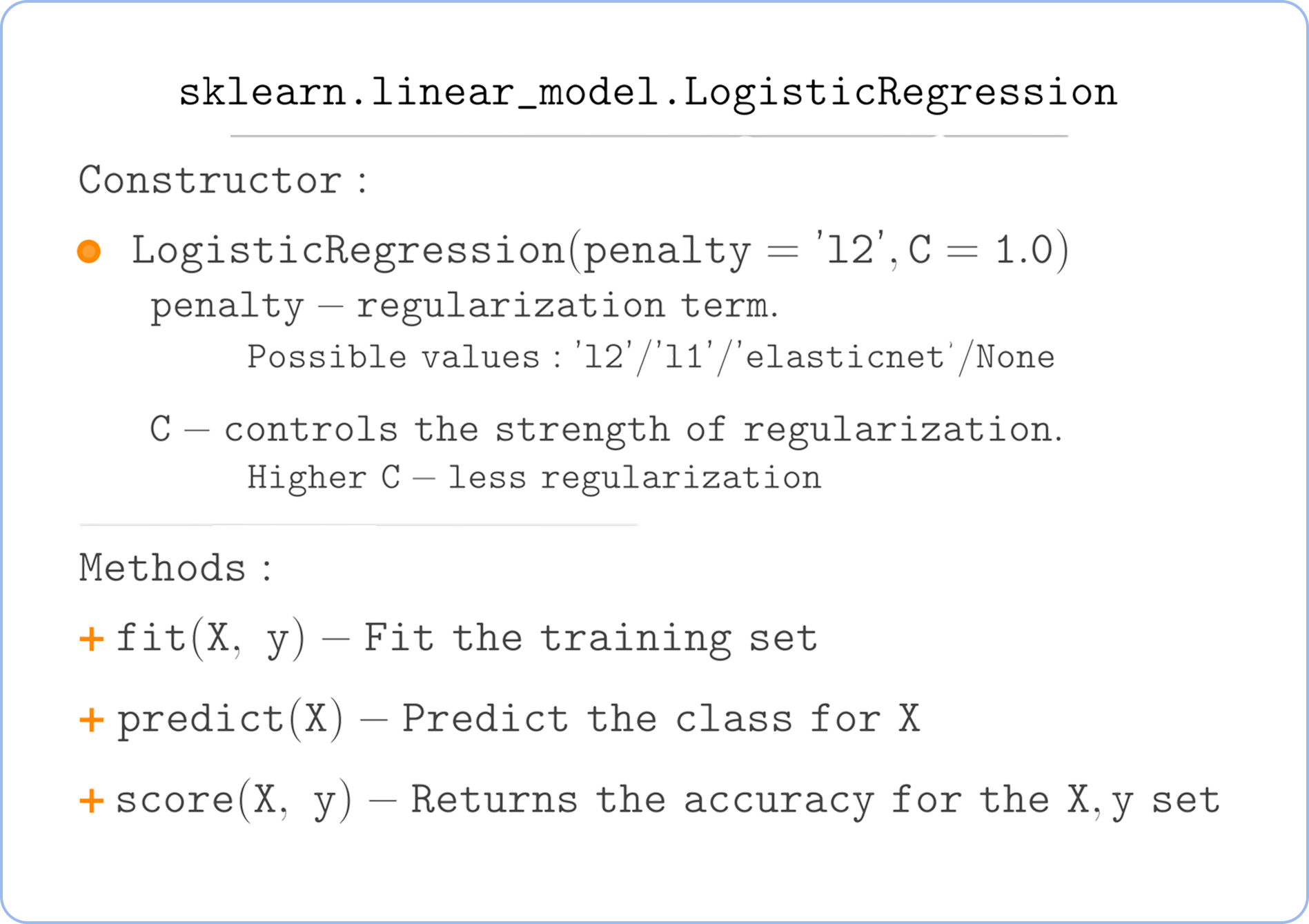
For now, you can stick with the default parameters. Creating and fitting the model can be done in a single line:
logistic_regression = LogisticRegression().fit(X_train, y_train)
The dataset for this chapter comes from a Portuguese banking institution and contains information from marketing campaigns conducted via phone calls. The goal is to predict whether a client will subscribe to a term deposit, based on their personal, financial, and contact-related details, as well as outcomes of previous marketing interactions.
The data is already preprocessed and ready to be fed to the model.
スワイプしてコーディングを開始
You are given a Portuguese bank marketing dataset stored as a DataFrame in the df variable.
- Split the dataset into training and test sets, allocating 80% for the training data. Set
random_state=42, and store the resulting sets in theX_train,X_test,y_train,y_testvariables. - Initialize and fit a Logistic Regression model on the training set, storing the fitted model in the
lrvariable. - Calculate the accuracy on the test set and store the result in the
test_accuracyvariable.
解答
 実践的な練習のためにデスクトップに切り替える下記のオプションのいずれかを利用して、現在の場所から続行する
フィードバックありがとうございます!

single
AIに質問する

AIに質問する

何でも質問するか、提案された質問の1つを試してチャットを始めてください
