Why Smart People Believe Wrong Things
メニューを表示するにはスワイプしてください
In 2023, a lawyer named Steven Schwartz submitted a legal brief to a federal court in New York. It cited six real-looking cases — complete with judges' names, dates, and legal reasoning. The opposing counsel flagged them. The judge reviewed them. Every single case was fiction. ChatGPT had invented them, and Schwartz had trusted the output without checking.
Schwartz wasn't careless or dim. He was a practicing attorney with three decades of experience. He simply didn't know that AI could hallucinate with the same confidence it uses when it's correct.
This course starts here — not with a lesson about AI, but with a lesson about trust.
The Brain's Lazy Shortcut
Your brain is not built for accuracy. It's built for speed.
Psychologists call it cognitive ease — the tendency to accept information that feels fluent, familiar, and effortless to process. When something reads smoothly, our brain interprets that smoothness as a signal of truth. It's a shortcut that served humans well for most of history. It's a liability in the age of AI.
AI-generated text is extraordinarily fluent. It is, almost by definition, optimized for readability. Which means it triggers your brain's "this sounds right" reflex more reliably than almost any other type of content.
Why Intelligence Isn't Enough
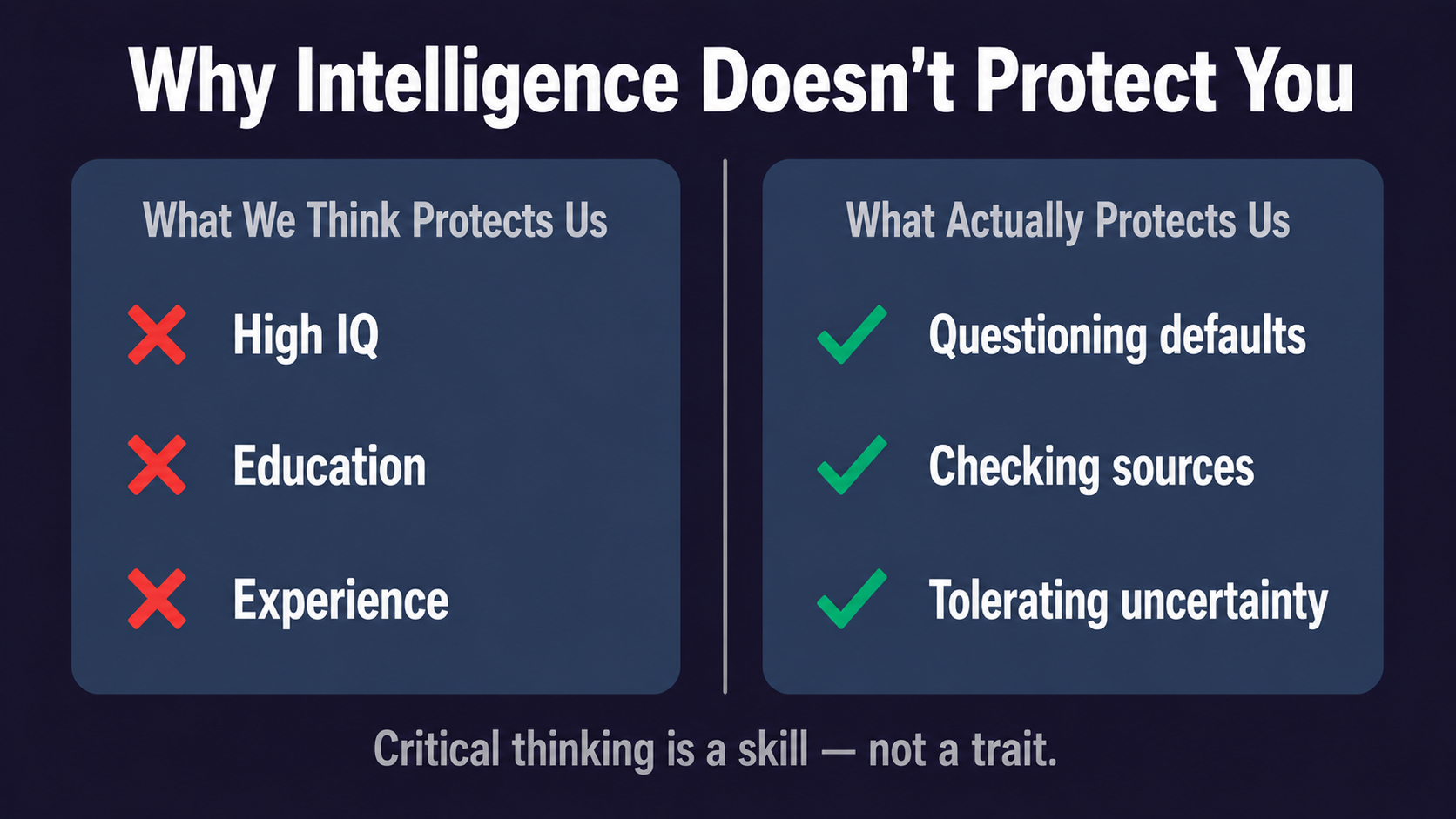
There's a persistent myth that critical thinking is about raw intelligence — that smarter people are naturally better at detecting falsehoods. The research says otherwise.
Studies on motivated reasoning show that higher-IQ individuals are actually better at constructing elaborate justifications for beliefs they already hold. Intelligence, without the right habits, becomes a tool for rationalizing rather than evaluating.
What protects you isn't IQ. It's a specific set of mental habits — practiced, deliberate, and applicable regardless of the subject matter.
What This Course Is
This is not a course about distrusting AI. AI is a genuinely useful tool — one that's already changing how people work, write, research, and decide. The goal isn't paranoia. It's calibration.
By the end of this course, you'll know exactly when to trust AI output, when to verify it, and how to spot the specific failure modes that fool even careful users. You'll have a concrete toolkit — not vague advice like "think critically," but specific questions, frameworks, and habits.
We'll cover how AI actually generates text (and why that makes hallucinations inevitable), how to evaluate sources in a world of synthetic content, how to spot logical fallacies whether they come from humans or machines, and how to make better decisions under uncertainty.
The lawyer who submitted fake cases didn't need to be more suspicious of AI. He needed to know one specific thing about how it works. Let's start there.
フィードバックありがとうございます!
AIに質問する

AIに質問する

何でも質問するか、提案された質問の1つを試してチャットを始めてください
