Life Insurance
Sveip for å vise menyen

Life insurance is one of the most oversold and simultaneously most misunderstood financial products in existence. Insurance agents have strong financial incentives to sell you more of it than you need, in forms more complex and expensive than necessary. The personal finance industry has overcorrected by sometimes dismissing it entirely.
The truth is straightforward: life insurance is essential in specific circumstances and completely unnecessary in others. The goal of this chapter is to give you a clear framework for deciding whether you need it, how much you need, and when you can stop paying for it — without being sold something you do not need or leaving your family unprotected.
What Life Insurance Actually Is
Life insurance is income replacement. That is its core purpose. If someone depends on your income and you die, life insurance replaces that income so their life is not financially devastated by your death.
That single sentence contains the entire framework for deciding whether you need it:
- Does anyone depend on your income? If no — no dependents, no co-signed debts, no one whose financial life would be materially damaged by your death — you probably do not need life insurance at all;
- If yes — how much income would need replacing, and for how long?
Everything else follows from those two questions.
Who Needs Life Insurance
Parents with Dependent Children
This is the clearest and most urgent case. If you have children who depend on your income for housing, food, education, and daily life, your death without adequate coverage is a financial catastrophe for them. Life insurance is not optional in this situation — it is a fundamental responsibility.
The need is particularly acute for:
- Single-income households where one partner earns and one manages the home;
- Dual-income households where either income loss would require significant lifestyle changes;
- Single parents with no co-parent to absorb the financial impact.
People with Significant Shared Debt
If you have co-signed debt — a mortgage, a business loan, a car loan — with another person, your death leaves them solely responsible for that obligation. Life insurance sized to cover shared debts protects your co-borrower from a financial crisis layered on top of a personal one.
People Whose Death Would Create Financial Hardship for a Dependent Partner
Even without children, if your partner depends on your income to maintain their standard of living — particularly if they have limited earning capacity due to age, health, or career interruption — life insurance replaces what they would lose.
Business Owners with Key-Person Dependencies
If your death would materially damage a business — through loss of your skills, relationships, or the need to buy out your ownership stake — business life insurance protects partners, employees, and the enterprise itself.
Who Probably Does Not Need Life Insurance
- Single people with no dependents — no one's financial life depends on your income;
- Couples with no children, dual incomes, and no co-signed debt — each partner can sustain themselves independently;
- People who have already reached financial independence — your portfolio replaces your income; life insurance is redundant when passive income covers all expenses;
- Children — children have no dependents and no income to replace; policies marketed for children are almost universally unnecessary and primarily benefit the insurance company;
- Retirees with sufficient assets — by the time your children are grown and your debts are paid, the need that justified life insurance has usually disappeared.
How Much Coverage You Actually Need
The standard insurance industry advice — 10× your annual income — is a rough starting point, not a precise calculation. A more useful approach works from actual need:
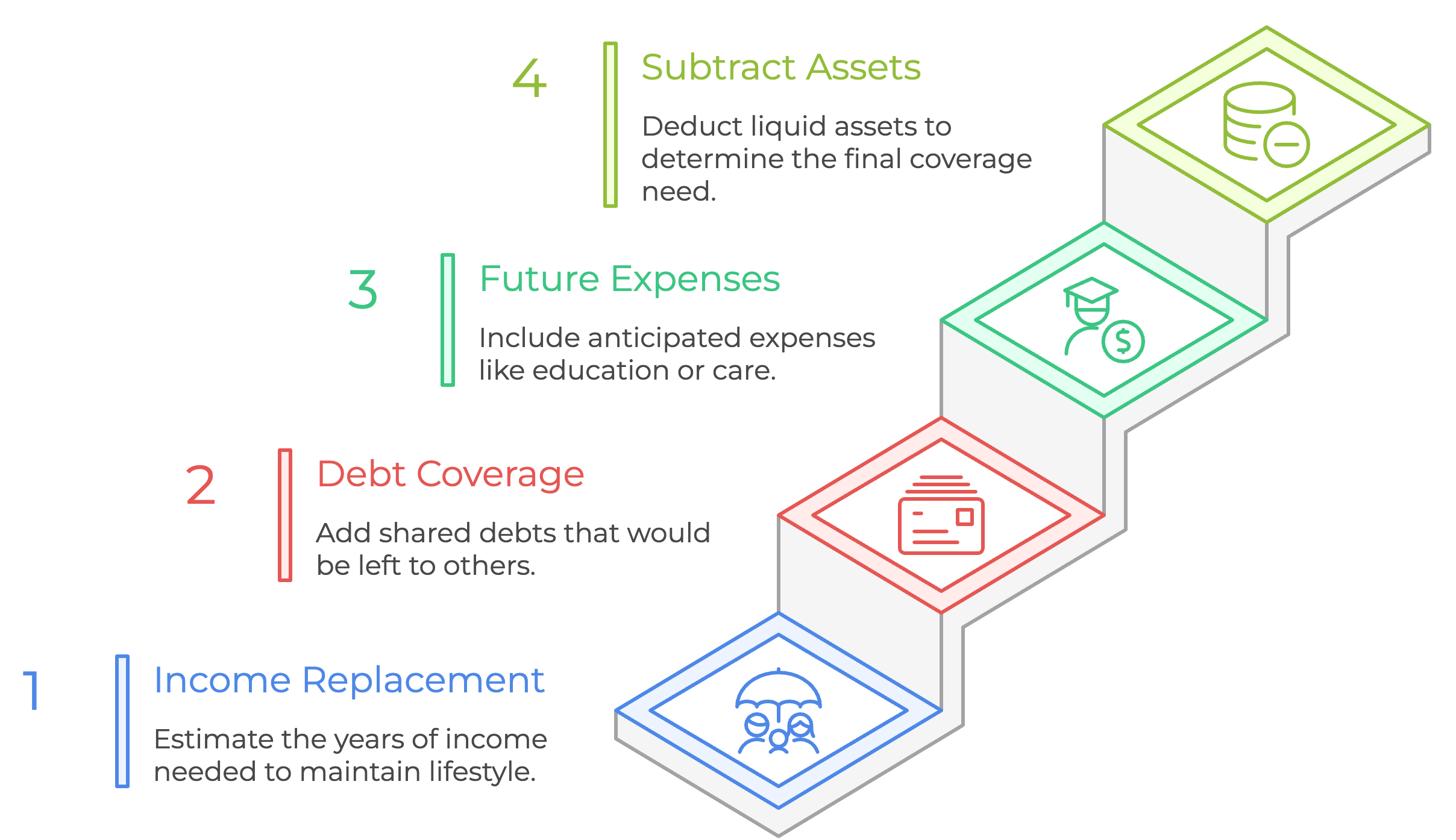
Step 1 — Income replacement. How many years of income would your dependents need to maintain their lifestyle and reach financial stability without you? Multiply your annual income by that number;
Step 2 — Debt coverage. Add the total of any shared debts — mortgage balance, car loans, business obligations — that your death would leave to others;
Step 3 — Specific future expenses. Add any large anticipated expenses your income would have covered — children's education, a dependent parent's care costs, a partner's career retraining;
Step 4 — Subtract existing assets. Subtract liquid assets your family could access — savings, existing investments, other insurance. The gap is your coverage need.
Example:
- 10 years of income replacement: $700,000;
- Mortgage balance: $280,000;
- Children's education fund: $120,000;
- Existing savings: −$80,000;
- Coverage needed: $1,020,000.
Round to the nearest $250,000 for simplicity — a $1,000,000 or $1,250,000 policy covers this need cleanly.
When the Need Disappears
Life insurance needs are not permanent — they diminish as your financial situation changes. The need shrinks as:
- Children become financially independent — the largest driver of coverage need is gone;
- Debts are paid off — mortgage eliminated, no shared obligations remaining;
- Assets accumulate — as your investment portfolio grows, it increasingly replaces what insurance was covering;
- You approach or reach financial independence — at full FI, passive income covers all expenses and life insurance becomes redundant.
This is why term life insurance — covered in depth in Chapter 13 — is the right tool for most people. It provides coverage for a defined period that matches the window of actual need, then expires when the need has passed.
A common mistake: continuing to pay life insurance premiums long after the need has disappeared because the policy was set up years ago and never reviewed. Review your coverage every 3–5 years or after any major life change.
The Life Insurance Needs Curve
Think of your life insurance need as a curve over time:
- Starts low — young, no dependents, no major debts;
- Rises sharply — marriage, mortgage, children, income dependencies created;
- Peaks — maximum dependents, maximum debt, maximum income to replace;
- Declines gradually — children grow up, debts reduce, assets accumulate;
- Approaches zero — financial independence reached, dependents self-sufficient, debts eliminated.
The goal is to have coverage that matches this curve — enough when the need is high, phasing out as the need diminishes. Paying for maximum coverage when you are 58, debt-free, and your children are grown is money wasted on a need that no longer exists.
Special Situations Worth Noting
Stay-at-home parents: The economic value of a stay-at-home parent — childcare, household management, scheduling, emotional labor — is real and significant. Replacing it costs money. A stay-at-home parent without life insurance leaves the surviving working partner facing substantial childcare and household costs on a single income. Coverage on both partners is warranted in single-income households with children.
High-debt, low-asset early stage: Young people early in their careers often have significant student debt, a new mortgage, young children, and minimal savings. This is the highest-need, lowest-asset moment of the financial life cycle — and the cheapest time to buy term life insurance. Locking in coverage in your late 20s or early 30s, when premiums are lowest, is one of the better financial decisions available at that stage.
Approaching financial independence: As your FI number comes within reach, model the crossover point at which your portfolio could sustain your family without insurance. Once your assets can do the job insurance was doing, the policy can be allowed to expire or cancelled without replacement.
Key Takeaways
- Life insurance is income replacement — its sole purpose is to protect people who depend on your income from financial devastation if you die; if no one depends on your income, you likely do not need it;
- The clearest cases for coverage are parents with dependent children, people with significant shared debt, and partners whose financial stability depends on your income;
- Coverage need is not permanent — it rises when dependents and debts are created and falls as children grow up, debts are paid, and assets accumulate toward financial independence;
- Calculate your actual need from income replacement, debt coverage, and specific future expenses, then subtract existing assets — the 10× income rule is a rough benchmark, not a precise answer;
- Review your coverage every 3–5 years — continuing to pay for coverage that no longer matches your actual need is one of the most common and easily avoided financial wastes.
1. What is the core purpose of life insurance, and what should primarily determine whether you need it?
2. Which statements accurately describe how life insurance coverage needs change over the course of your life according to the life insurance needs curve?
Takk for tilbakemeldingene dine!
Spør AI

Spør AI

Spør om hva du vil, eller prøv ett av de foreslåtte spørsmålene for å starte chatten vår
