Auditing Your Workflows for AI Potential
Sveip for å vise menyen
Auditing Your Workflows for AI Potential
Before you can improve anything with AI, you need a clear picture of where your team's time actually goes. Most managers have a rough sense of this – but rough is not enough when you are trying to prioritize where to start. A structured workflow audit gives you the data to make that decision confidently.
What You Are Looking For
Not every task is a good AI candidate. The ones worth targeting share a specific set of characteristics:
- High frequency – the task happens multiple times per week, not once a quarter;
- Predictable structure – the process follows roughly the same steps each time;
- Information-heavy – the task involves reading, writing, summarizing or reformatting data;
- Low creative judgment – the output follows a pattern rather than requiring original strategic thinking.
Tasks that match all four criteria are your highest-priority targets. Tasks that match two or three are worth a second look. Tasks that match one or none are better left to human judgment for now.

Workflow audit – a structured review of how your team currently spends its time, with the goal of identifying which tasks are high-frequency, rule-based and information-heavy enough to benefit from AI assistance.
How to Run the Audit
The fastest way to audit your workflows is to spend one week tracking how your team's time is actually spent – not how you think it is spent.
Ask each team member to log their tasks in 30-minute blocks for five working days. You do not need sophisticated time-tracking software – a simple shared spreadsheet works fine. At the end of the week, categorize each task type and calculate the total time spent.
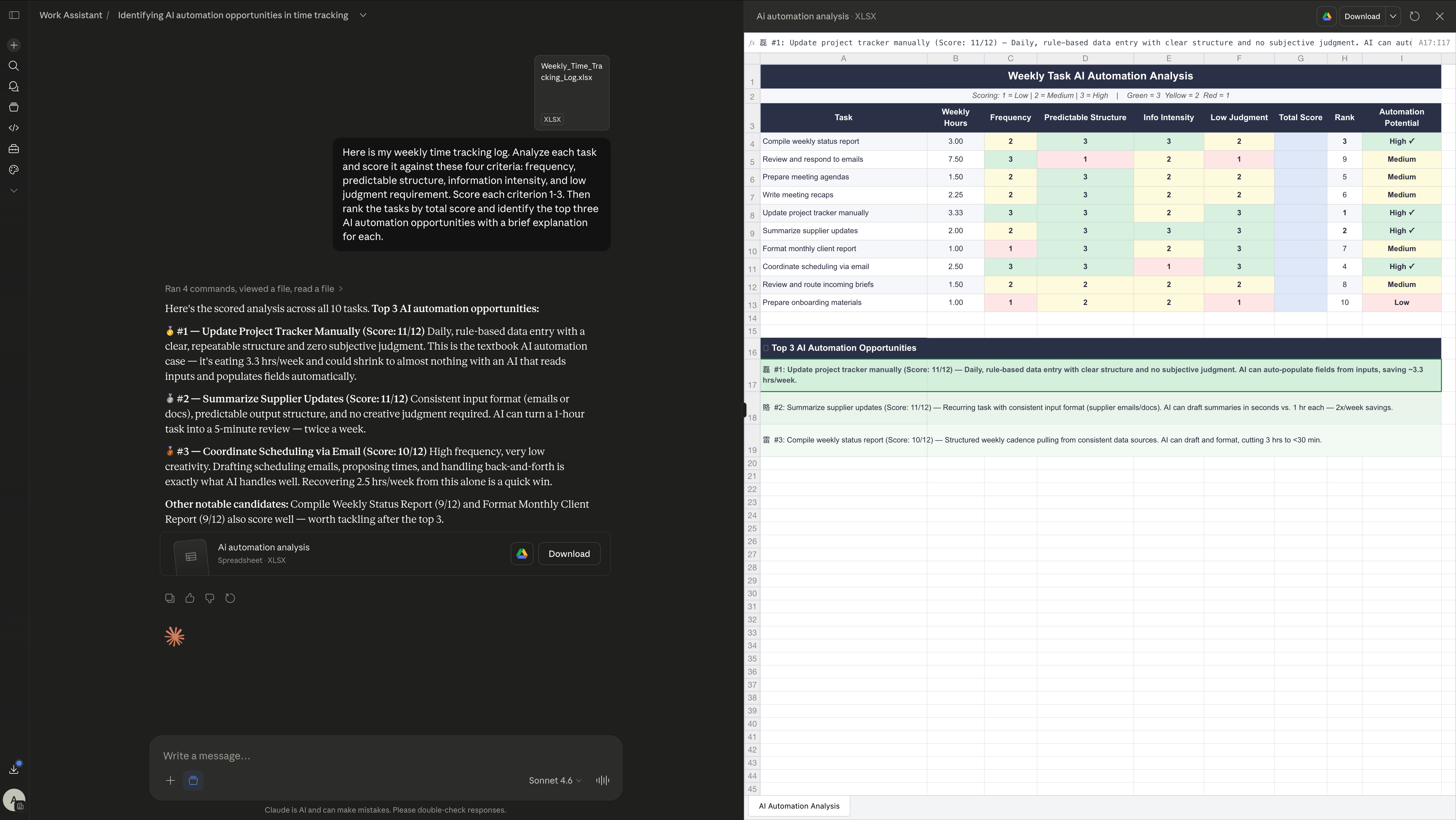

| Task | Frequency | Time per Occurrence | Weekly Hours |
|---|---|---|---|
| Compile weekly status report | 1x per week | 3 hours | 3.00 |
| Review and respond to emails | Daily (5x per week) | 1.5 hours | 7.50 |
| Prepare meeting agendas | 3x per week | 30 minutes | 1.50 |
| Write meeting recaps | 3x per week | 45 minutes | 2.25 |
| Update project tracker manually | Daily (5x per week) | 40 minutes | 3.33 |
| Summarize supplier updates | 2x per week | 1 hour | 2.00 |
| Format monthly client report | 1x per month | 4 hours | 1.00 |
| Coordinate scheduling via email | Daily (5x per week) | 30 minutes | 2.50 |
| Review and route incoming briefs | 2x per week | 45 minutes | 1.50 |
| Prepare onboarding materials | 2x per month | 2 hours | 1.00 |
| TOTAL | 25.58 |
What you typically find surprises most managers. In operations teams, between 30% and 50% of weekly time tends to go toward tasks that fit the AI criteria above – most commonly reporting, email management, document processing and meeting follow-up.

You do not need a perfect audit to start. A rough categorization of your own tasks over one week gives you enough signal to identify your top two or three AI opportunities. Perfect data is less valuable than a decision made quickly and iterated on.
Categorizing What You Find
Once you have the time-tracking data, sort your tasks into three buckets:
- Automate – high-frequency, structured, information-heavy tasks with low judgment requirements. These are your immediate AI targets;
- Augment – tasks that require human judgment but involve significant information processing. AI handles the research and drafting, you handle the decision;
- Keep human – tasks where the value comes primarily from relationships, strategic thinking or accountability. AI adds little here.
Most teams find that 30–40% of their weekly tasks fall into the Automate bucket, 30–40% into Augment, and the remainder into Keep Human.
What if My Team Resists the Audit Process?
Resistance to time-tracking is common, particularly in teams that are already stretched. The most effective way to address it is to frame the audit as a tool for removing work from their plate rather than monitoring their performance.
The framing matters: "We are doing this to find the tasks we can take off your list" lands very differently than "We are doing this to see how you spend your time." If you lead with the former and follow through by actually removing tasks from the team's workload based on the results, you will find adoption increases significantly for both the audit and the subsequent AI implementations.
Takk for tilbakemeldingene dine!
Spør AI

Spør AI

Spør om hva du vil, eller prøv ett av de foreslåtte spørsmålene for å starte chatten vår
