Pattern Recognition vs. Real Understanding
Sveip for å vise menyen
Ask an AI to complete the sentence "The capital of France is..." and it will say "Paris" — correctly, confidently, instantly. Now ask it: "If France moved its capital to Lyon tomorrow, what would be the new capital of France?"
A careful human pauses, notices the hypothetical, and answers "Lyon."
Many LLMs, at least in early generations, would still say "Paris" — because the pattern "capital of France" points overwhelmingly to "Paris" in training data, and the hypothetical doesn't override that pull.
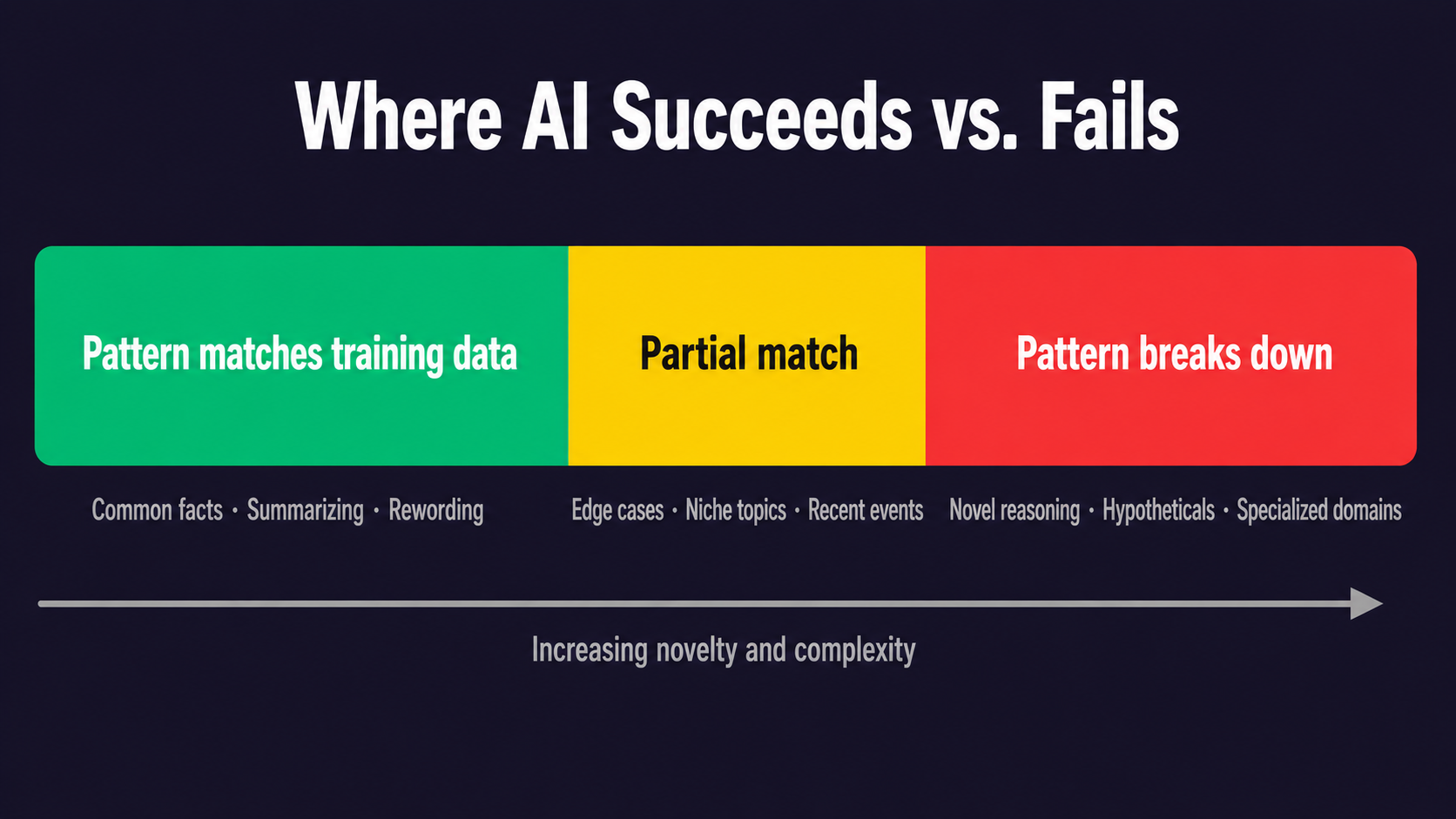
This is the gap between pattern recognition and real understanding.
What AI Is Actually Doing
When an LLM generates a response, it's not modeling the world. It's not building a mental picture of France, or of capitals, or of what "moving a capital" would mean in practice. It's recognizing patterns in text and generating the most statistically consistent continuation.
For most everyday questions, those patterns are accurate. The capital of France really is Paris. The boiling point of water really is 100°C at sea level. Common medical symptoms really do cluster in predictable ways.
The failure comes at the edges — when the question is slightly novel, when context matters in a way the model doesn't fully process, or when the right answer requires reasoning beyond pattern-matching.
The Human Version of This Problem
This isn't exclusively an AI problem. Humans also rely heavily on pattern recognition — it's what intuition is. An experienced doctor recognizes the pattern of symptoms that suggests appendicitis. An experienced investor recognizes the pattern of a company in early financial distress.
The difference: humans can, in principle, step outside the pattern. We can notice when something doesn't fit, ask "wait, is this situation actually the same as the others I've seen?", and reason through the gap.
This metacognitive ability — thinking about your own thinking — is exactly what critical thinking develops. And it's exactly what AI doesn't have.
Why This Matters for Everyday Use
Maria uses AI to help analyze a business problem. She describes her situation, the AI produces a structured analysis that looks thorough and logical, and she acts on it. What she doesn't notice: her situation had an unusual constraint — a regulatory requirement specific to her industry — that the AI's pattern-matching skipped over entirely, because that combination is rare in its training data.
The output looked right because it fit the general pattern. The specific case was different.
The habit to build: after receiving any AI-generated analysis, ask yourself — "What's unusual or specific about my situation that might not be captured here?"
Takk for tilbakemeldingene dine!
Spør AI

Spør AI

Spør om hva du vil, eller prøv ett av de foreslåtte spørsmålene for å starte chatten vår
