Decision-Making Under Uncertainty
Veeg om het menu te tonen
Here's a situation that feels familiar to anyone who uses AI regularly for consequential work:
You ask an AI to help you analyze a decision. You get a thorough, well-structured response. You ask a follow-up, refine the framing, and get a different analysis that's equally thorough and equally plausible. You try one more approach and get a third perspective that partially contradicts the first two.
All three responses are fluent. All three sound confident. None of them is obviously wrong.
Now you have to decide — and you're less certain than when you started.
The Outcome-Process Fallacy
The most persistent mistake in decision-making is judging the quality of a decision by its outcome. A risky decision that worked out was not necessarily a good decision. A careful, well-reasoned decision that went wrong was not necessarily a bad one.
This matters for AI-assisted decisions because the output of a decision is visible and the process that produced it often isn't. If you made a significant call based on unverified AI output and it happened to be right, you were lucky — not skilled. The process was still flawed.
The standard to apply isn't "did it work out?" It's "would I be comfortable explaining exactly how I made this decision, including what I verified, what I didn't, and what uncertainty I accepted?"
Pre-Mortem: The Best Tool You're Not Using
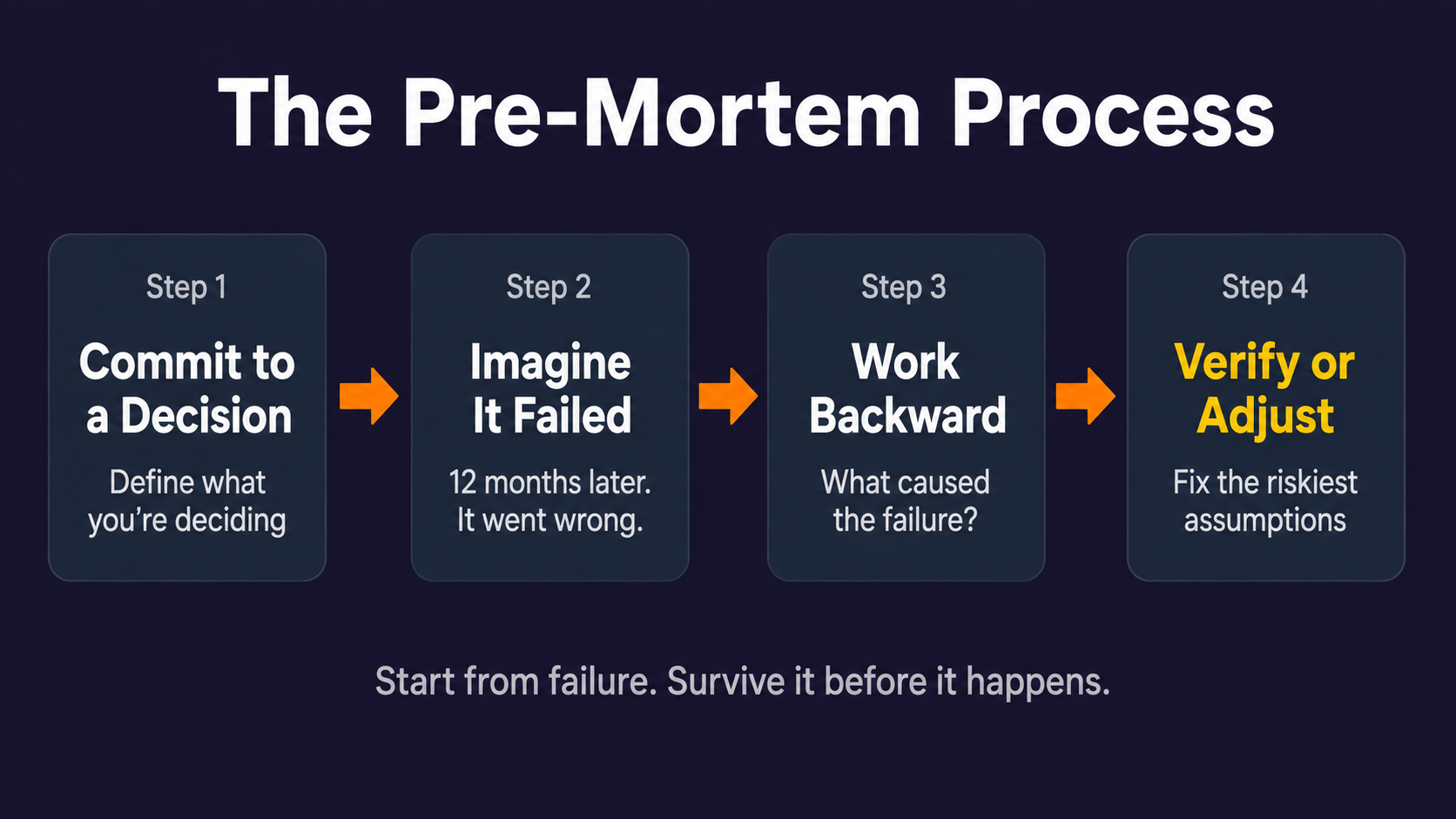
A pre-mortem is a structured thinking exercise developed by psychologist Gary Klein. Before committing to a decision, imagine it is twelve months later and the decision has failed badly. Now ask: what went wrong?
This inversion — starting from failure and working backward — surfaces risks that forward-looking planning misses. It bypasses the optimism bias that makes planned outcomes look more likely than they are.
Applied to AI-assisted decisions, the pre-mortem is particularly powerful. Ask:
- If the AI output I'm relying on turns out to be wrong in a specific way, how does the decision fail?
- Which piece of AI-generated analysis am I taking the most on faith?
- What's the version of events where I look back and wish I had checked something? These questions don't require certainty. They require honest identification of where your uncertainty actually lives — which is exactly the information you need to decide how much verification is worth the time.
Calibrated Uncertainty
One of the most practically useful skills in decision-making is calibration — matching your expressed confidence to your actual evidence. Overconfident decisions don't just fail more often; they fail without warning, because the overconfidence prevents the early warning signals from registering.
A simple calibration habit: before finalizing any significant AI-assisted decision, write one sentence that states what you don't know. Not what could go wrong, but what specific piece of information, if different from what you've assumed, would change your decision.
If you can't write that sentence, you haven't thought carefully enough about the decision yet.
Bedankt voor je feedback!
Vraag AI

Vraag AI

Vraag wat u wilt of probeer een van de voorgestelde vragen om onze chat te starten.
