AI at Work — Where to Trust, Where to Verify
Veeg om het menu te tonen
Welcome to Section 3. You now have the diagnostic framework from Section 1 and the full toolkit from Section 2. This section is about contact with the real world — specific situations, specific decisions, specific habits that activate under pressure.
We start at work, because that's where most people use AI most often, and where the consequences of unchecked AI output are most concrete.
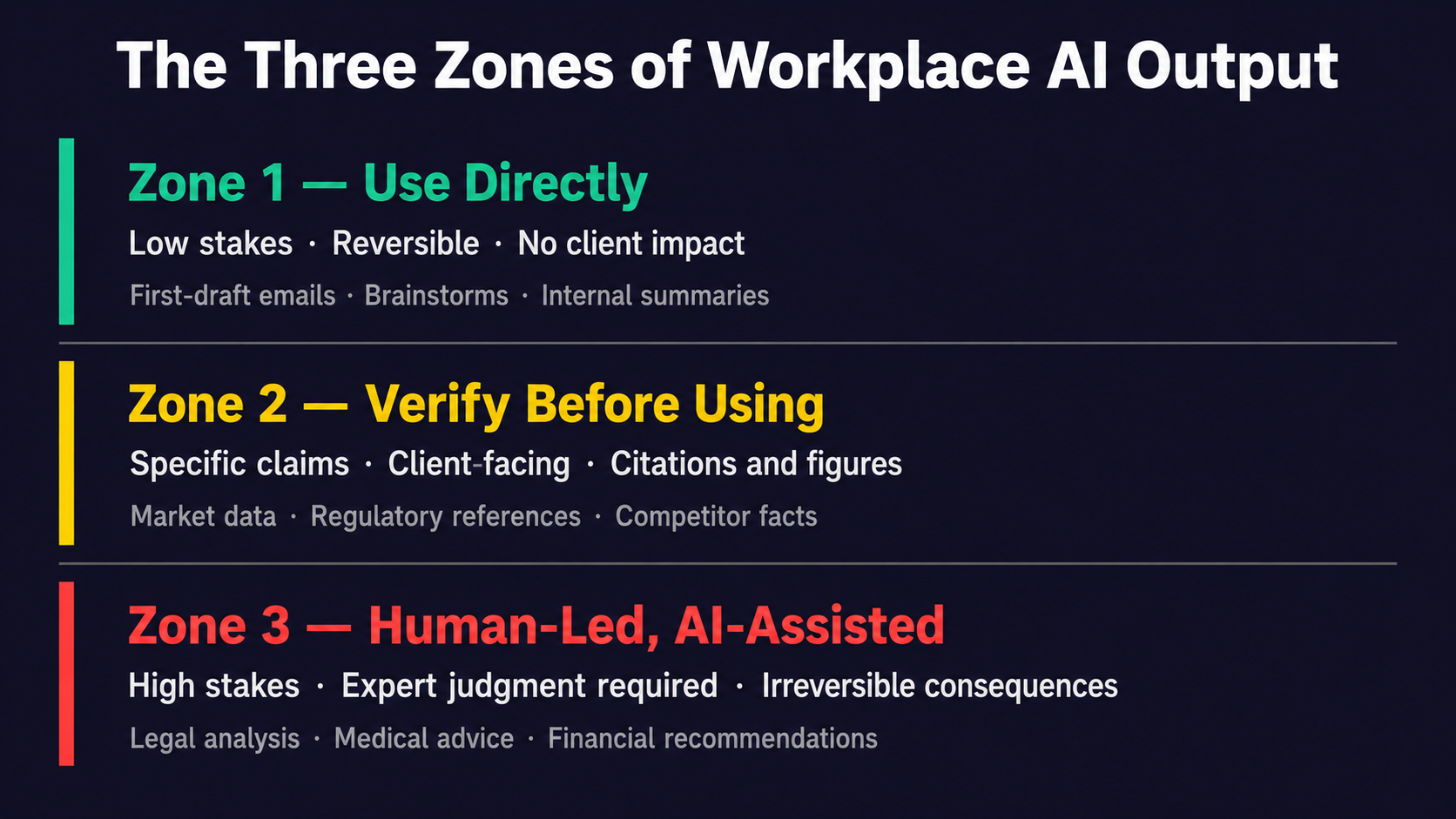
The Three Zones of Workplace AI Output
Not all AI-generated work output carries the same risk. A useful mental model divides outputs into three zones based on the cost of being wrong.
Zone 1 — Use directly (low stakes, easily reversible)
Drafting a first-pass email. Generating a list of brainstorming ideas. Reformatting a table. Summarizing a document you've pasted in full. Creating a first draft of an internal process document.
In these cases, errors are visible, reversible, and low-consequence. A badly worded email gets rewritten. A brainstorm idea that doesn't land gets dropped. Use AI freely here — the speed benefit is real and the downside is minimal.
Zone 2 — Verify before using (medium stakes, specific claims)
Any output that contains specific factual claims, citations, statistics, regulatory references, or client-facing content. A market size figure in a proposal. A legal requirement mentioned in a compliance summary. A competitor's pricing cited in a strategy document.
These require the targeted verification habit from Section 2: identify the claim that matters most, trace it to a verifiable source, and confirm it before the output leaves your hands.
Zone 3 — Human-led, AI-assisted (high stakes, expert judgment required)
Medical advice. Legal analysis. Financial recommendations. Engineering specifications where errors cause physical consequences. Any output where being wrong has significant, potentially irreversible consequences for real people.
AI can be a useful input here — surfacing considerations, drafting structures, flagging gaps. But the judgment, the verification, and the accountability must be human. The model doesn't carry liability. You do.
The Habit That Changes Everything
The single most impactful workplace habit isn't a checklist or a framework. It's a consistent practice of asking one question before passing any AI output to someone else:
"If this contains an error I haven't caught, what's the worst thing that happens?"
If the answer is "nothing serious," move on. If the answer is "a client makes a wrong decision" or "we submit incorrect data to a regulator," you've identified a Zone 3 output wearing Zone 1 clothes. Check it.
A Word on AI Confidence at Work
One pattern worth naming explicitly: AI outputs often sound more certain than they should be in professional contexts. A model asked to analyze a market will produce an analysis. It won't say "I'm not sure this applies to your specific geography" unless you ask.
The confidence of the output is not calibrated to your situation. It's calibrated to the general pattern of similar professional documents in its training data.
This is why the Zone system matters more than any individual fact-check. Knowing which zone you're in before you start tells you how much skepticism to bring to the whole output — not just to specific claims within it.
1. Which of the following AI-generated outputs are appropriate to use directly without additional verification, according to the Three Zones of Workplace AI Output?
2. What is the key question you should consistently ask before passing any AI output to someone else, and why is it important?
Bedankt voor je feedback!
Vraag AI

Vraag AI

Vraag wat u wilt of probeer een van de voorgestelde vragen om onze chat te starten.
