Questions That Cut Through Noise
Veeg om het menu te tonen
It starts with questions. Not checklists, not frameworks, not complicated protocols. Questions are faster, more portable, and more powerful than any tool you'll build later.
Why Most People Don't Ask Enough
When we receive a well-structured, confident-sounding answer — from a colleague, an expert, or an AI — we tend to stop thinking and start accepting. This is especially true under time pressure. The output looks complete. Asking a question feels like slowing things down.
This is the wrong instinct. Asking one targeted question at the right moment costs 30 seconds. Acting on a wrong answer can cost days, money, or credibility.
The habit to build: treat every significant AI output as a draft that needs interrogation, not a final answer that needs execution.
Three Questions That Do the Heavy Lifting
Not all questions are equal. These three cut through noise faster than anything else:
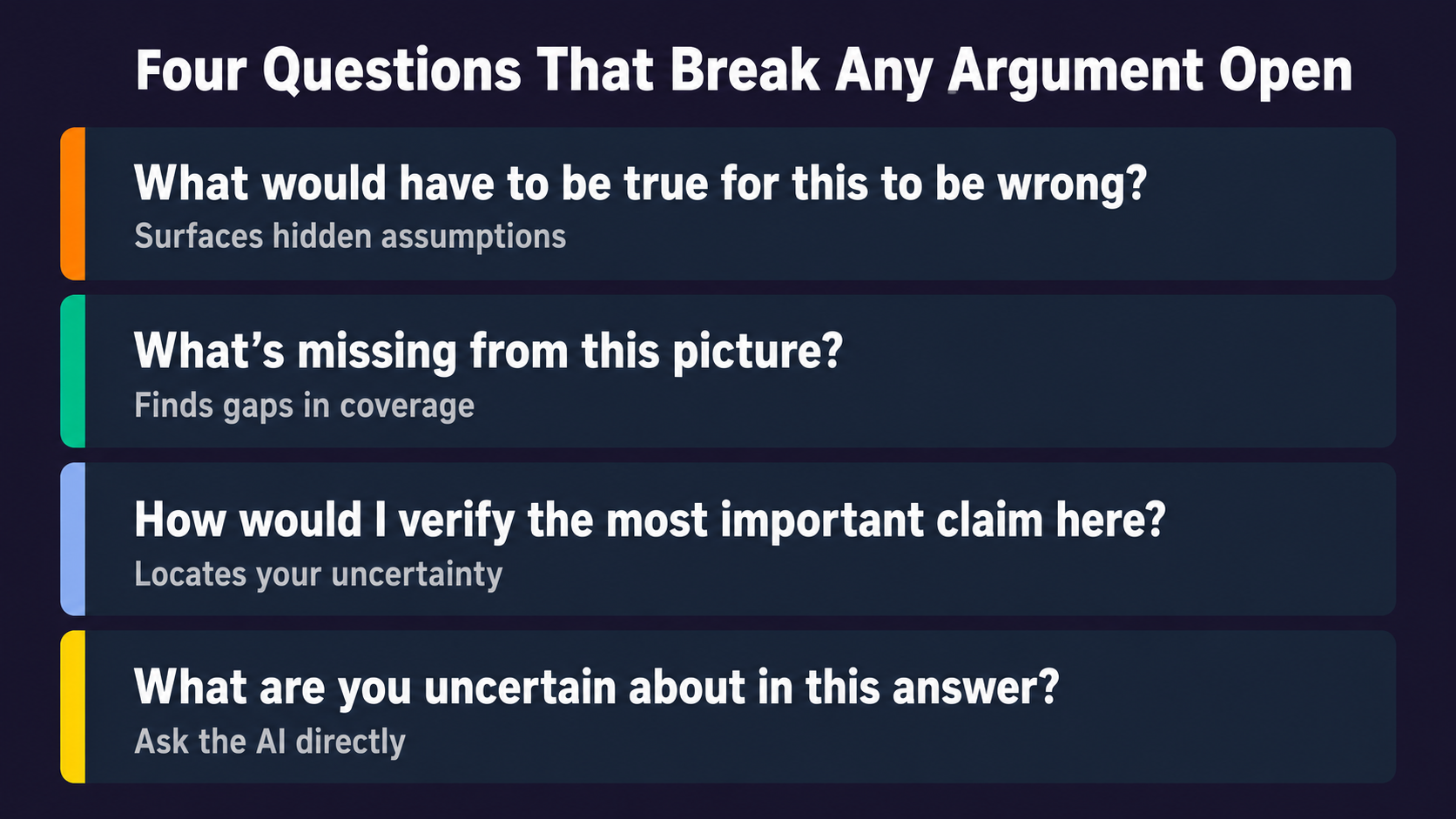
"What would have to be true for this to be wrong?"
This is the most powerful question in critical thinking. It forces you to think about the assumptions buried in an answer rather than just its surface content. If an AI recommends a pricing strategy, ask what market conditions, customer behavior, or competitive dynamics would have to exist for that recommendation to fail. If you can name three conditions easily, the recommendation is shakier than it looked.
"What's missing from this picture?"
AI outputs are optimized for completeness-at-first-glance. They fill space fluently. But fluency isn't coverage. Ask what perspective, stakeholder, data source, or time period isn't represented in the answer. Sarah asks AI to analyze the risks of expanding into a new market. The output covers financial and competitive risks in detail. It says nothing about regulatory requirements specific to that country. That silence is the answer.
"How would I verify the most important claim here?"
Identify the single claim that, if wrong, would change everything about the output. Then ask how you'd check it. If the answer is "I couldn't check it without significant research," that's information. It tells you exactly where your uncertainty lives.
The Follow-Up Question Nobody Uses
There's a fourth question, simpler than the others, that most people never think to ask the AI itself:
"What are you uncertain about in this answer?"
Modern AI systems can often surface their own uncertainty when directly asked. The response isn't always accurate — but it can flag the parts of the output that deserve more scrutiny. It takes five seconds to type, and it sometimes saves hours.
Making It a Habit, Not a Ritual
The risk with any framework is that it becomes a ritual — something you do because you're supposed to, not because you're actually thinking. The goal isn't to run all four questions on every AI output. The goal is to have them ready so you reach for the right one instinctively when it matters.
A practical shortcut: before using any AI output for something that matters, spend 60 seconds asking just one of the four. Pick the one that feels most uncomfortable to answer. Discomfort usually means you've found the right question.
1. Why are the three core critical thinking questions described in the chapter so effective when analyzing AI outputs?
2. Why are targeted questions essential when evaluating AI-generated answers?
Bedankt voor je feedback!
Vraag AI

Vraag AI

Vraag wat u wilt of probeer een van de voorgestelde vragen om onze chat te starten.
