Data. What It Is and Why Everyone Wants It
Deslize para mostrar o menu
"Data" is one of those words that sounds technical until you realize it describes almost everything. Every form a customer fills out is data. Every transaction your company processes is data. Every email, every click on your website, every support ticket, every inventory count — all data.
In a professional context, data is the raw material that organizations use to make decisions, serve customers, track performance, and compete. Understanding what it is, where it lives, and why it matters is no longer optional for anyone whose work contributes to an organization's decisions.
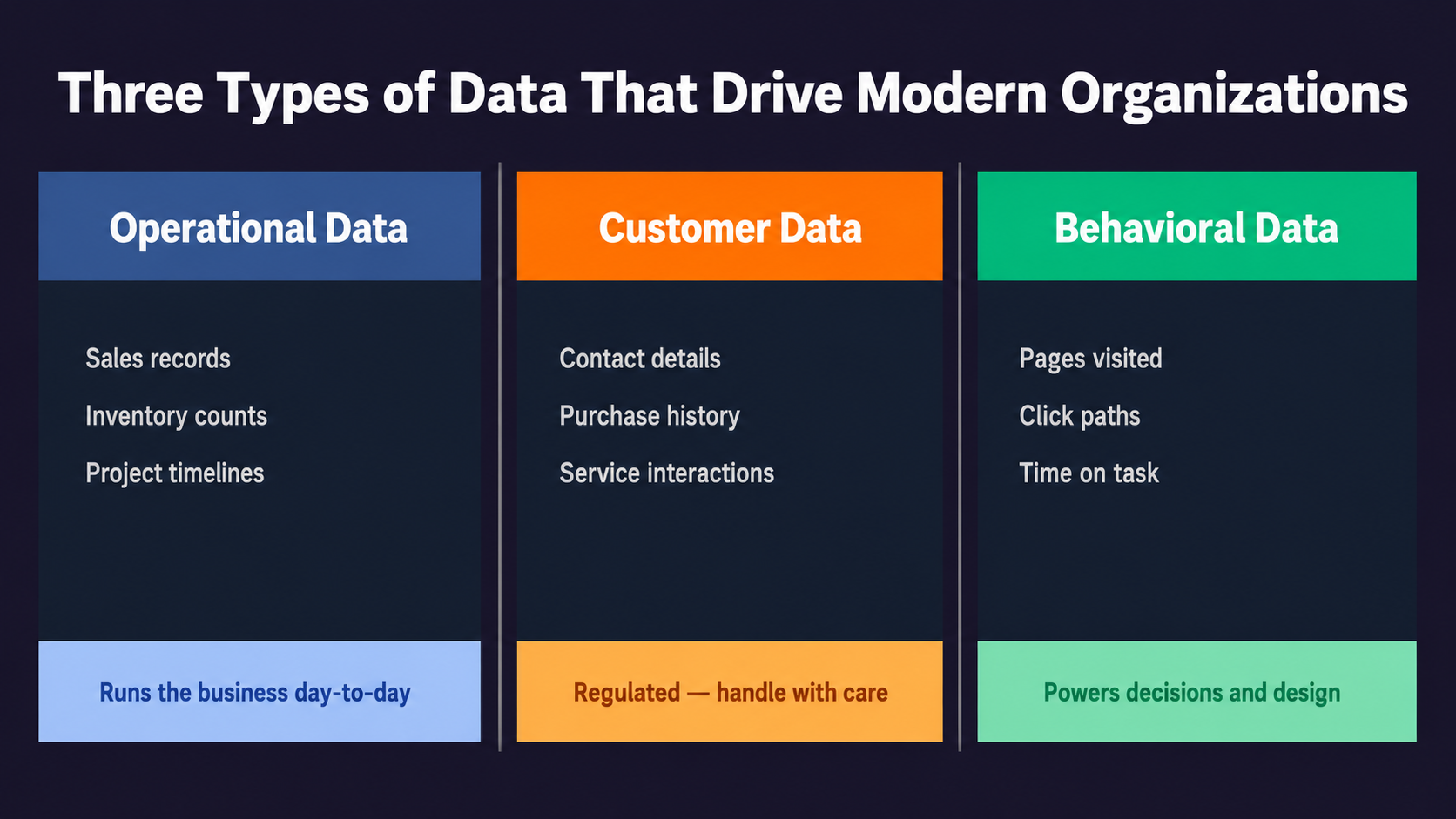
Three Types of Data That Matter at Work
Operational data is the information your organization generates just by doing business: sales records, inventory levels, employee timesheets, project status updates, financial transactions. This is the data that runs the day-to-day. When your company's CRM shows that a client hasn't renewed their contract in 14 months, that's operational data telling a story.
Customer data is information about the people or organizations your company serves: names, contact details, purchase history, service interactions, preferences, and behavior. This data is valuable — and regulated. Depending on your jurisdiction and industry, customer data is subject to strict rules about how it's collected, stored, shared, and deleted. GDPR in Europe, CCPA in California, and sector-specific regulations like HIPAA in healthcare all establish legal obligations around customer data that employees at every level need to be aware of.
Behavioral data is information about how people interact with digital systems: which pages a user visits on your website, how long they stay, what they click, what path they take through a process. This type of data is the foundation of modern marketing, product design, and user experience — and it's collected at a scale most people don't realize.
Why Data Has Value — and Risk
Data has value because it reduces uncertainty. A decision made with good data is more likely to be right than one made without it. Companies that use customer behavior data to personalize their service retain customers longer. Companies that analyze operational data find inefficiencies before they become expensive. The business case for data is straightforward.
The risk sits alongside the value. Data about real people — your customers, your employees, your partners — carries obligations. Storing it insecurely creates legal liability. Sharing it inappropriately violates trust and regulation. Losing it in a breach can cost millions in fines and remediation.
IBM's 2025 Cost of a Data Breach Report put the average global breach cost at $4.44 million — and $10.22 million for US organizations specifically. The majority of those breaches involved human behavior, not technical failures.
Your Role in Data Stewardship
You don't need to be a data scientist or a compliance officer to have responsibilities around data. At any level of a modern organization, you're likely to encounter data that belongs to customers, colleagues, or partners — and how you handle it matters.
Three practical habits that apply to almost every role:
- Only access data you need for your specific task — the principle of least privilege;
- Never share customer or sensitive data through unsecured channels like personal email or messaging apps;
- When you're unsure whether sharing specific data is appropriate, the default is to ask, not to assume it's fine.
Obrigado pelo seu feedback!
Pergunte à IA

Pergunte à IA

Pergunte o que quiser ou experimente uma das perguntas sugeridas para iniciar nosso bate-papo
