Disability Insurance
Svep för att visa menyn

Most people insure their car, their home, and their life without hesitation. Almost nobody insures their ability to earn an income — which is, for most working adults, their single largest financial asset by a wide margin.
A 35-year-old earning $80,000 a year has roughly $1,600,000 in future earning potential before traditional retirement age. Life insurance protects against death. Nothing protects against the far more common event of being unable to work — unless you have disability insurance.
The statistics make the neglect hard to justify: more than one in four workers will experience a disability lasting 90 days or more before reaching retirement age. The average long-term disability claim lasts nearly three years. For many people, a disability is not a brief interruption — it is a permanent change to their financial life.
Why Disability Insurance Is Ignored
Several factors combine to keep disability insurance chronically underowned:
It is invisible until needed. Life insurance has a clear, emotionally resonant trigger. Disability is abstract until it happens — and most people assume it will not happen to them.
Employer coverage creates false confidence. Many employers offer group short-term and long-term disability coverage as a benefit. Employees see this listed in their benefits package and assume they are covered. In most cases, the coverage is far weaker than it appears.
It is more expensive than life insurance. A robust individual disability policy costs $150–$400/month depending on age, income, occupation, and benefit amount. This is real money, and it is easy to deprioritize compared to more tangible expenses.
It is complicated to evaluate. Disability policies have more moving parts than almost any other insurance product — elimination periods, benefit periods, own-occupation definitions, residual benefits, cost-of-living adjustments. Most people do not know how to compare policies and default to avoiding the decision entirely.
The Problem with Employer Coverage
Group disability coverage through an employer is better than nothing. It is rarely enough.
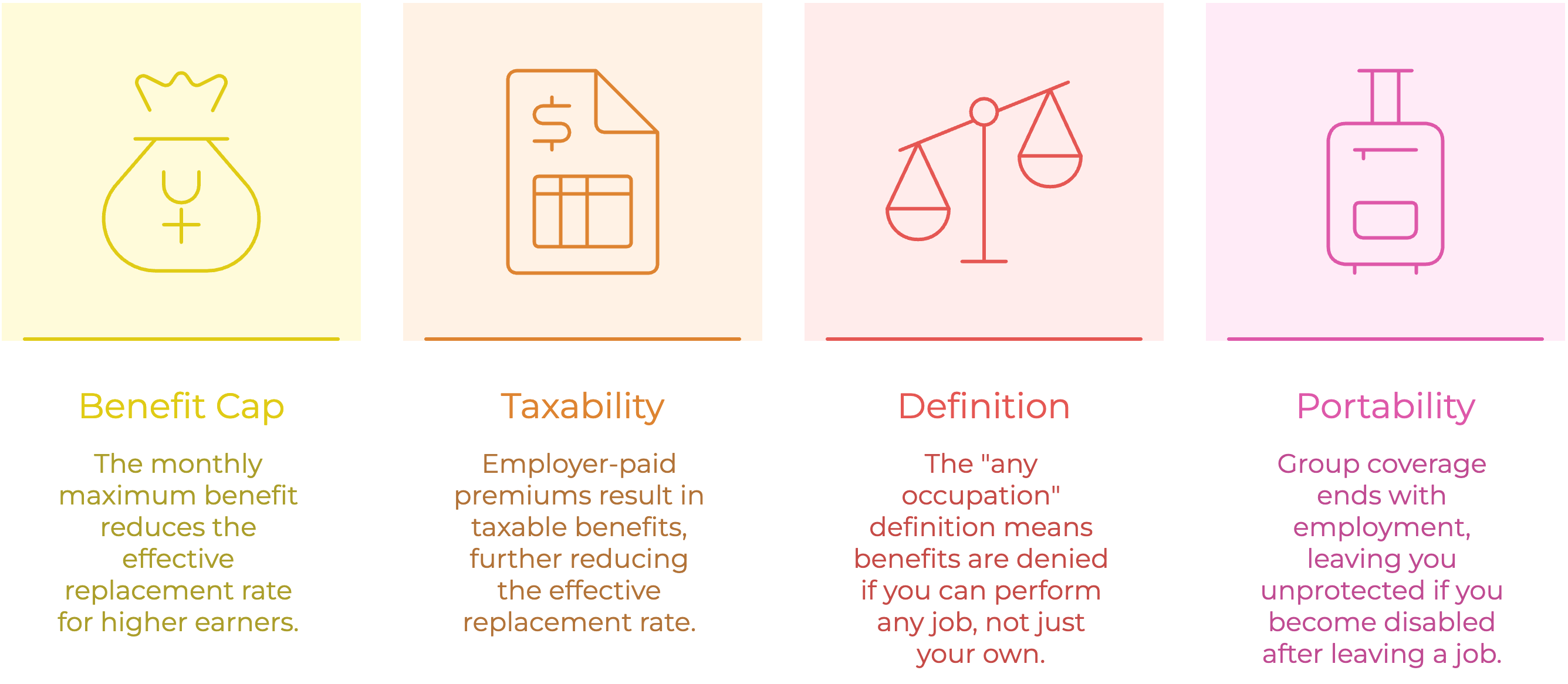
The benefit cap problem. Most group long-term disability policies replace 60% of base salary — up to a monthly maximum, typically $5,000–$10,000. For higher earners, this cap means the effective replacement rate is far below 60%. A person earning $200,000 receiving a $6,000/month benefit is replacing 36% of their income, not 60%.
The taxability problem. When your employer pays the premiums for group disability coverage, the benefits you receive are taxable as ordinary income. A $6,000/month benefit becomes roughly $4,200–$4,500 after taxes — further reducing the effective replacement rate.
The definition problem. Group policies typically use an "any occupation" definition of disability after an initial period — meaning you qualify for benefits only if you cannot perform any job, not just your own. A surgeon who loses fine motor control may still be able to work as a medical records clerk — and may be denied benefits under an any-occupation policy.
The portability problem. Group coverage ends when your employment ends. If you become disabled after leaving a job — or while between jobs — you have no coverage. Individual policies follow you regardless of employment status.
The Key Policy Features
Own-Occupation Definition
This is the single most important feature in a disability policy. An own-occupation policy pays benefits if you cannot perform the material duties of your specific occupation — regardless of whether you could theoretically work in some other capacity.
A dentist with a hand tremor who cannot practice dentistry but could theoretically teach or consult receives full benefits under an own-occupation policy. Under an any-occupation policy, they may receive nothing.
Own-occupation coverage is more expensive — and worth every dollar for anyone whose income depends on specific skills, training, or physical capacity.
Elimination Period
The elimination period is the waiting period between the onset of disability and when benefits begin — typically 30, 60, 90, or 180 days. Longer elimination periods mean lower premiums. The standard recommendation is a 90-day elimination period, matched to an emergency fund that can cover 3 months of expenses.
Choosing a 180-day elimination period reduces premiums further — but requires a 6-month emergency fund to bridge the gap. Do not choose an elimination period your savings cannot actually cover.
Benefit Period
How long benefits are paid if you remain disabled. Options typically include 2 years, 5 years, to age 65, or to age 67. The right answer for most people is to age 65 — the period during which earned income is most critical. Shorter benefit periods are cheaper but leave catastrophic long-term disability uninsured.
Benefit Amount
Most insurers will cover 60–70% of pre-disability income. This is by design — a 100% replacement rate removes the financial incentive to return to work. Target coverage that, combined with any other income sources, covers your essential expenses and savings obligations.
Cost-of-Living Adjustment (COLA)
An optional rider that increases your benefit annually in line with inflation during a claim. Without COLA, a fixed $5,000/month benefit loses significant purchasing power over a multi-year or permanent disability. For long benefit periods, COLA is worth the additional premium.
Residual or Partial Disability Benefit
Pays a proportional benefit if you can work in a reduced capacity — part-time, or in a lower-earning role — following a disability. Without this rider, policies pay full benefits when you are fully disabled and nothing when you return to any work. Residual benefits provide a bridge for gradual recovery and partial return to work.
How Much Coverage You Need
A simple framework:
Step 1 — Calculate your monthly essential obligations. Essential expenses plus savings contributions you want to maintain. This is your minimum replacement target;
Step 2 — Identify existing coverage. Add up any employer group coverage (after tax), Social Security Disability Insurance (SSDI) you might qualify for, and any existing individual policies;
Step 3 — Close the gap. The difference between your monthly target and your existing coverage is the amount an individual policy needs to provide.
Example:
- Monthly essential obligations: $6,500;
- After-tax employer group benefit: $3,200;
- SSDI estimate: $1,500;
- Gap requiring individual coverage: $1,800/month.
A relatively modest individual policy closes a gap that would otherwise be devastating.
Social Security Disability Insurance
SSDI provides federal disability benefits to workers who have paid into Social Security and meet a strict disability definition. The average benefit is approximately $1,400/month — meaningful but rarely sufficient as a primary income replacement.
The qualification bar is high: SSDI requires that your condition prevents you from performing any substantial gainful activity — effectively an any-occupation standard. Approval rates at initial application are below 40%, and the average processing time is 3–6 months, with appeals taking significantly longer.
SSDI should be factored into your disability planning as a potential supplement — not relied upon as a primary defense.
Who Needs Individual Disability Insurance
- Anyone whose household depends on their earned income — single earners, primary earners in single-income households, anyone without sufficient assets to self-insure a multi-year income disruption;
- High earners with employer group coverage — group coverage caps mean high earners are the most underinsured relative to their actual income;
- Professionals with specialized skills — physicians, attorneys, dentists, engineers, and others whose income depends on specific training or physical capacity need own-occupation coverage;
- Self-employed and business owners — no employer group coverage exists; individual policy is the only option;
- People early in their wealth-building years — those who have not yet accumulated enough assets to absorb a multi-year income disruption without permanent damage to their financial plan.
When You Can Reduce or Drop Coverage
As with life insurance, disability insurance need diminishes as assets accumulate. The threshold question is: if you became disabled today and never earned another dollar, could your existing assets sustain your lifestyle?
When your investment portfolio reaches your FI number — when passive income covers all expenses — disability insurance becomes redundant. Your money is doing the job your income was doing. At that point, coverage can be allowed to expire or cancelled.
For most people pursuing FIRE, this crossover arrives well before traditional retirement age — which is one of the underappreciated financial benefits of reaching financial independence early.
Key Takeaways
- Disability is far more likely than death during working years — more than one in four workers will experience a disability lasting 90 days or more, yet most people have no individual disability coverage;
- Employer group coverage is a starting point, not a solution — benefit caps, taxability, any-occupation definitions, and lack of portability leave most covered employees significantly underinsured;
- Own-occupation definition is the most important policy feature — it determines whether you collect benefits based on your inability to do your specific job, rather than any job at all;
- Match your elimination period to your emergency fund — a 90-day elimination period requires 3 months of expenses in cash; choosing a longer period without the savings to back it up is false economy;
- Coverage need disappears at financial independence — when passive income covers all expenses, disability insurance becomes redundant and can be dropped, one of the underappreciated milestones of reaching your FI number.
1. Which statements accurately reflect important considerations when evaluating disability insurance policy features and employer coverage limitations?
2. Which statements accurately describe common pitfalls of employer group disability coverage related to taxes and benefit caps?
3. Which statements accurately reflect the relationship between elimination periods, benefit periods, and emergency funds when choosing disability insurance?
Tack för dina kommentarer!
Fråga AI

Fråga AI

Fråga vad du vill eller prova någon av de föreslagna frågorna för att starta vårt samtal
