Umbrella Insurance
Svep för att visa menyn

Umbrella insurance is the most cost-effective protection most people never buy. For $150–$300 a year, it provides $1,000,000 or more of liability coverage that sits on top of your existing home and auto policies — protecting your assets, your income, and your future earnings from lawsuits that exceed your standard policy limits.
It is called an umbrella because it extends over everything else you have. And for anyone who has spent years building wealth, it is one of the few insurance products that is genuinely difficult to argue against.
What Umbrella Insurance Covers
Umbrella insurance kicks in when a liability claim exceeds the limits of your underlying home or auto policy. It covers:
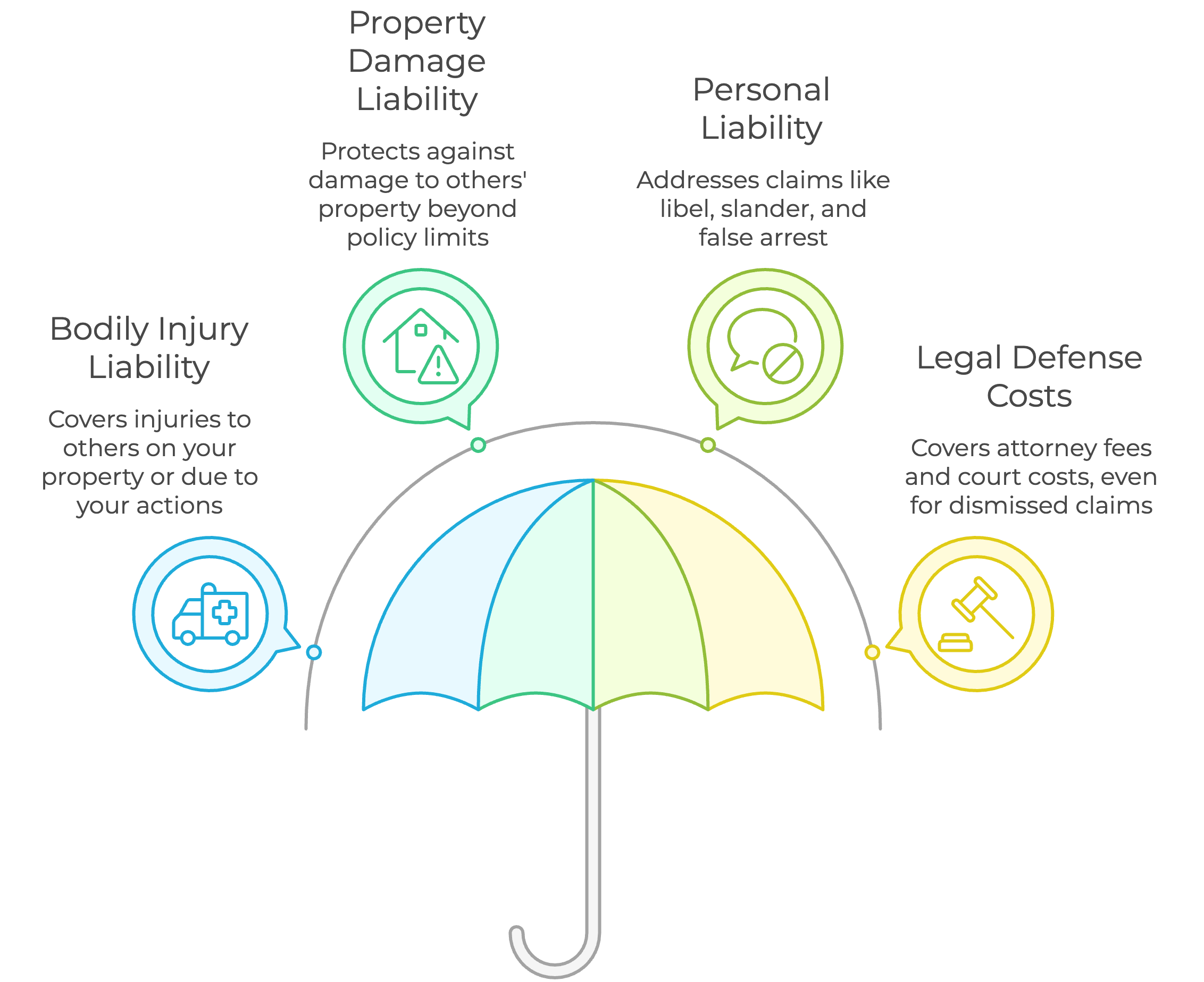
- Bodily injury liability — someone is injured on your property, in a car accident you caused, or in an incident you are held responsible for;
- Property damage liability — you or a family member damages someone else's property beyond your standard policy limits;
- Personal liability — libel, slander, defamation, false arrest, invasion of privacy;
- Legal defense costs — attorney fees and court costs, even for claims that are ultimately dismissed.
It covers you, your spouse, and typically your dependent children living at home — including incidents involving their vehicles, their actions, and property you own.
What It Does Not Cover
Umbrella insurance is liability coverage only. It does not cover:
- Your own injuries or property damage;
- Intentional or criminal acts;
- Business-related liability (a separate business umbrella policy handles this);
- Professional liability (covered by errors and omissions or malpractice insurance).
Why the Math Is Compelling
A $1,000,000 umbrella policy typically costs $150–$300/year — roughly $15–$25/month. A $2,000,000 policy adds another $75–$100/year. The cost per dollar of coverage is extraordinarily low compared to any other insurance product.
The scenarios it protects against are not hypothetical:
- A serious car accident where you are at fault and the injured party sues for medical costs, lost wages, and pain and suffering far exceeding your auto policy's $300,000 liability limit;
- A guest slips and falls at your home, sustains a serious injury, and sues for $800,000 — your homeowner's policy covers $300,000 and the umbrella covers the rest;
- Your teenager causes a serious accident while driving;
- You are sued for defamation after something posted online;
- A contractor working on your property is injured and sues beyond your homeowner's liability limits.
Without an umbrella policy, a judgment exceeding your standard policy limits can be satisfied from your personal assets — savings, investments, and in many states, future wages through garnishment.
Who Needs It Most
Umbrella insurance becomes more valuable as assets grow — because there is more to protect. But several factors increase exposure regardless of asset level:
- Owning property — rental properties, vacation homes, or any property where others are present;
- Teenage drivers — statistically the highest-risk drivers on the road, and their liability is yours;
- Dogs — dog bite liability is one of the most common homeowner claims;
- Swimming pools, trampolines, or other attractive hazards on your property;
- High public profile — anyone with a public presence, social media following, or business visibility faces elevated defamation and personal liability exposure;
- Significant net worth — the more you have built, the more attractive a target you are for litigation.
How to Buy It
Umbrella insurance is typically purchased through the same insurer that holds your home and auto policies. Most insurers require minimum underlying liability limits before issuing an umbrella — usually $300,000 on homeowner's and $250,000–$300,000 per occurrence on auto.
If your current underlying limits are below these thresholds, you will need to increase them first — which adds a small amount to your existing premiums but is worth doing regardless of the umbrella.
Coverage amounts to consider:
- $1,000,000 — the standard starting point; appropriate for most households;
- $2,000,000–$3,000,000 — suitable for higher net worth households, rental property owners, or anyone with elevated liability exposure;
- $5,000,000+ — for very high net worth individuals, those with significant public profiles, or multiple properties.
A general rule of thumb: your umbrella coverage should at minimum equal your net worth. If you have $800,000 in assets, a $1,000,000 umbrella is the floor.
The Asymmetry of the Decision
The defining characteristic of umbrella insurance is its asymmetry. The premium is small and certain. The protection is large and uncertain — but catastrophic if the risk materializes without coverage.
Paying $200/year to protect $1,000,000 in assets is a 0.02% annual cost for full protection. Skipping it to save $200/year while carrying $1,000,000 in exposed assets is a trade-off that makes no financial sense once the numbers are laid out plainly.
For anyone who has worked for years to build financial independence, losing a significant portion of that wealth to a single lawsuit judgment — an event that can happen to anyone, regardless of how carefully they live — is precisely the kind of catastrophic, low-probability outcome that insurance exists to prevent.
Key Takeaways
- Umbrella insurance provides $1,000,000 or more of liability coverage for $150–$300/year — the lowest cost-per-dollar-of-protection of any insurance product available to individuals;
- It covers liability claims that exceed your home and auto policy limits — lawsuits from car accidents, property incidents, personal liability, and legal defense costs;
- The need grows with assets — the more you have built, the more a large judgment threatens your financial independence, and the more valuable the coverage becomes;
- Match coverage to net worth — a $1,000,000 policy is the standard floor; higher net worth, rental properties, teenage drivers, or elevated public profile justify higher limits;
- The asymmetry makes it difficult to argue against — $200/year to protect $1,000,000 in assets is a 0.02% annual cost; skipping it is one of the few financial decisions where the math almost universally points one direction.
Tack för dina kommentarer!
Fråga AI

Fråga AI

Fråga vad du vill eller prova någon av de föreslagna frågorna för att starta vårt samtal
