Talking to Your Parents About Their Finances
Svep för att visa menyn

At some point — often triggered by a health scare, a parent's retirement, or a sudden crisis — adult children face one of the most emotionally complex conversations in family life: talking to their parents about money. It is a conversation most families never have until it is too late, and the absence of it creates avoidable crises that play out in the worst possible circumstances.
This chapter is not about taking control of your parents' finances. It is about understanding enough to help when help is needed — and creating the conditions for that help to be given gracefully, before an emergency forces the issue.
Why This Conversation Is So Hard
The difficulty is not primarily financial. It is psychological and relational.
For parents:
- Money represents independence, competence, and privacy — discussing it with children can feel like an admission of decline;
- Many parents from older generations were raised with the belief that finances are strictly private, even within families;
- Sharing financial details with adult children can feel like a role reversal that neither party is ready for;
- Fear of being managed, judged, or having decisions taken away is real and reasonable.
For adult children:
- Bringing up parents' finances can feel presumptuous, intrusive, or morbid;
- There is discomfort in acknowledging that parents are aging and may need help;
- Siblings may have different relationships with parents and different views on involvement;
- The conversation risks damaging a relationship that has no financial dimension currently.
Understanding these dynamics does not make the conversation easy. It makes it possible to approach with the right frame.
What You Actually Need to Know
The goal of this conversation is not a full accounting of every asset and liability. It is to understand enough to help effectively in an emergency — and to ensure the basic legal and financial infrastructure is in place.
The essential information:
- Where documents are located — will, trust, power of attorney, healthcare directive, insurance policies. Not the contents necessarily — just where they are and how to access them;
- Who the key professionals are — attorney, financial advisor, accountant, insurance agent. Names and contact information;
- What accounts exist — broadly, not necessarily specific balances. Bank accounts, investment accounts, retirement accounts, pension if applicable;
- What insurance coverage exists — health, life, long-term care, Medicare supplement. Policy numbers and insurer contact information;
- What debts exist — mortgage, any significant obligations;
- What their wishes are — broadly, regarding care preferences, living arrangements if health declines, end-of-life wishes.
This is not a financial audit. It is a roadmap for a crisis you hope never happens.
Framing the Conversation
How you open this conversation matters enormously. The difference between a conversation that builds trust and one that triggers defensiveness is almost entirely in the framing.
Framings that tend to work:
"I've been doing my own estate planning and it made me realize I don't know where to find your documents if something happened. Can we talk about that?"
Starting with your own financial planning normalizes the topic and removes the implication that the conversation is about their decline specifically.
"I want to make sure I can help you effectively if there's ever an emergency — I don't need to know everything, just enough to know who to call."
Framing it as practical preparation rather than oversight reduces defensiveness and positions you as a resource rather than an auditor.
"I've been reading about what happens when families don't have this information — it can create real problems at the worst possible time. I'd rather we figure it out now when there's no pressure."
Using an external reference — something you read, a friend's experience, a news story — depersonalizes the prompt and makes it about the situation rather than about their age or health.
Framings that tend to backfire:
- Leading with concern about their age or health;
- Implying they may not be managing things well;
- Bringing it up during or immediately after a health event when defenses are highest;
- Having the conversation in front of siblings who are not equally trusted by the parents;
- Treating it as a single conversation that must be completed in one sitting.
Choosing the Right Moment
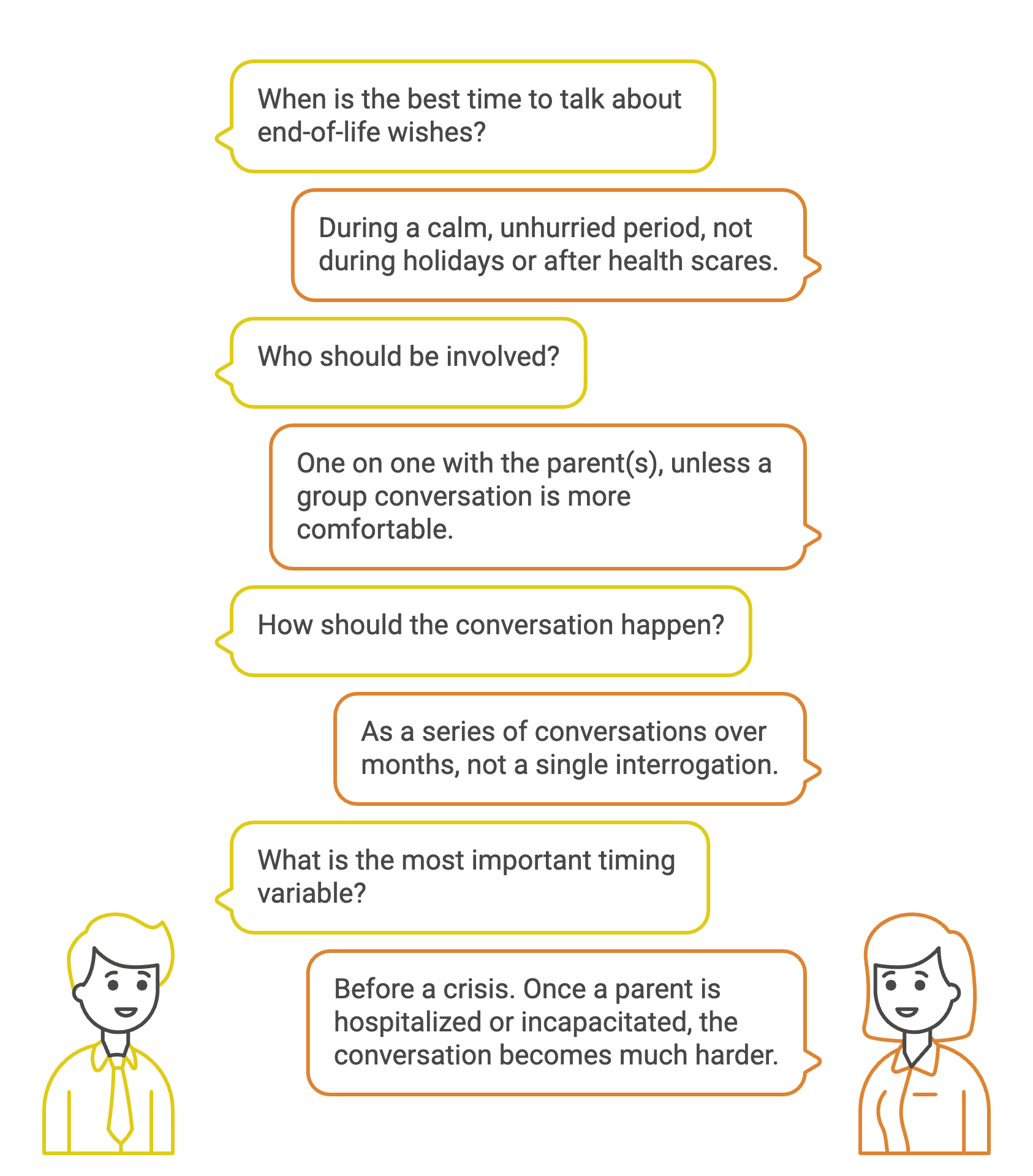
Timing matters as much as framing.
What to Do With What You Learn
Information without action is insufficient. After the conversation:
Verify the documents exist and are current. Ask to see — not necessarily read — the will, power of attorney, and healthcare directive. Confirm they were executed recently enough to reflect current wishes and circumstances. Documents from 1995 that name a deceased spouse as executor are not functional documents.
Ensure beneficiary designations are updated. As covered in Chapter 9, beneficiary designations override wills. If your parent's retirement account still names a deceased spouse or an estranged sibling, that needs to be corrected.
Confirm you or a sibling has legal authority to act. Is someone named as durable power of attorney? If your parent becomes incapacitated, does the named person have the legal authority — and practical ability — to manage financial affairs? If not, this is a gap to address now, not during a crisis.
Create a simple reference document. After the conversation, compile what you learned into a single document — account locations, key contacts, document locations — and store it somewhere accessible to the right people. This document does not need to contain sensitive financial details. It needs to be a roadmap.
When Parents Resist
Not every parent is willing to have this conversation. Resistance is common and does not mean the door is permanently closed.
If they resist sharing financial details: Accept that limitation and focus on the documents and professionals instead. Knowing where the will is and who the attorney is provides most of the practical value without requiring disclosure of balances or account details.
If they resist the conversation entirely: Plant the seed and return to it later. A single comment — "I just want you to know I'm here to help with anything if you ever want to talk about it" — opens a door without forcing it. Many parents who initially resist come around after time, after a friend's spouse passes without documents in order, or after their own health makes the topic feel more relevant.
If cognitive decline is already present: Move quickly. The legal capacity to execute documents — a power of attorney, an updated will — requires mental competency at the time of signing. If cognitive decline is progressing, the window for putting legal infrastructure in place may be closing. This is a situation where involving an elder law attorney promptly is important.
The Sibling Dynamic
In families with multiple adult children, the conversation about parents' finances rarely stays bilateral. Siblings have different relationships with parents, different geographic proximity, different levels of financial sophistication, and sometimes different financial interests.
Principles that tend to reduce conflict:
- Establish early who is the primary contact — not necessarily who manages everything, but who coordinates information and communication;
- Keep siblings informed even if they are not involved — information asymmetry between siblings is a reliable source of conflict and suspicion;
- Separate caretaking from financial decision-making — the sibling who provides the most hands-on care is not automatically the right person to manage finances, and conflating the two creates resentment;
- Document decisions — when financial decisions are made on parents' behalf, brief written records protect everyone.
Key Takeaways
- The goal is not a full financial accounting — it is knowing where documents are, who the key professionals are, and having enough information to help effectively in an emergency;
- Framing determines success — leading with your own financial planning, practical preparation, or an external reference works far better than leading with concern about their age or decline;
- Timing matters as much as content — the best conversations happen during calm periods, before any crisis, and as a series of conversations rather than a single comprehensive session;
- Information requires follow-up action — verifying documents are current, confirming legal authority exists, and creating a simple reference document converts the conversation into actual protection;
- Resistance is common and not permanent — if parents resist, plant the seed and return to it; if cognitive decline is already present, move quickly as the legal window for executing documents may be closing.
1. Which statements accurately reflect psychological and relational challenges in discussing finances with parents?
2. Which of the following are essential pieces of information adult children should know from their parents to help effectively in a financial emergency?
Tack för dina kommentarer!
Fråga AI

Fråga AI

Fråga vad du vill eller prova någon av de föreslagna frågorna för att starta vårt samtal
