Spotting Misinformation in a Professional Context
Svep för att visa menyn
Judgment starts with information. Specifically, with the question of whether the information driving a professional decision is actually accurate.
Why Misinformation Is a Workplace Problem
Most conversations about misinformation focus on social media and politics. The professional context gets less attention — but the consequences there are often more concrete. A strategy built on a fabricated market statistic. A compliance decision based on an outdated regulation. A client presentation citing a study that doesn't say what the presenter thinks it says. These errors cost money, relationships, and credibility.
The sources of professional misinformation have also multiplied. AI-generated content (as covered in depth in the Critical Thinking in the Age of AI course) can produce authoritative-sounding false claims at scale. Industry newsletters and trade publications make errors. Research findings get misrepresented in secondary reporting. Outdated data circulates long after it's been superseded.
The environment isn't going to become more reliable. The habit is what changes.
The Two-Minute Professional Verification Habit
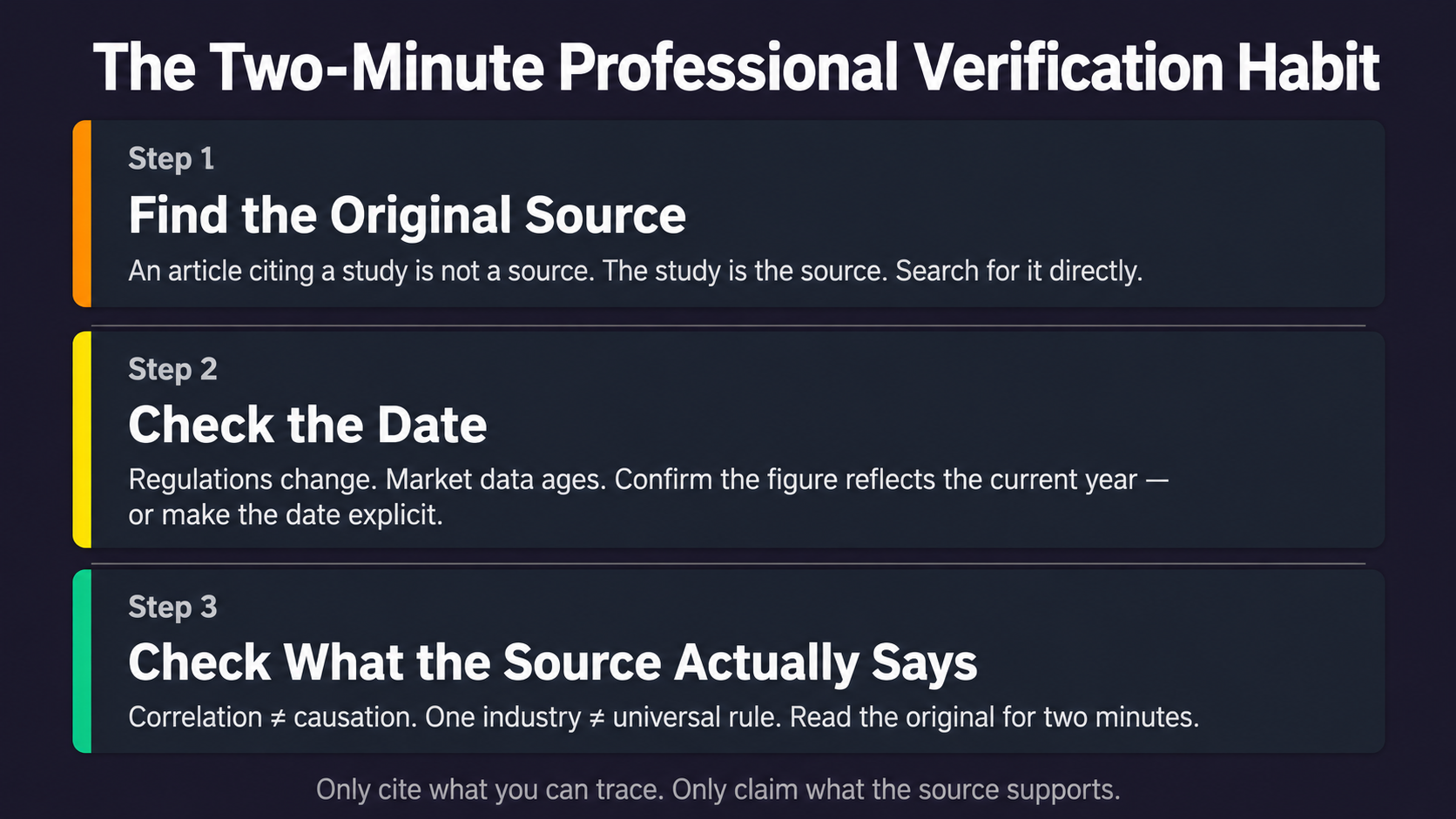
Most pieces of information that matter in a professional context can be meaningfully evaluated in two minutes using three steps:
Step 1 — Find the original source. Any significant claim — a statistic, a regulatory requirement, a research finding — should be traceable to an original document. An article saying "studies show that X" is not a source. The study itself is the source. Two minutes of searching usually finds it, or confirms it doesn't exist as described.
Step 2 — Check the date. Regulations change. Market data becomes outdated. A statistic from 2019 presented as current may be significantly wrong. Before citing any figure professionally, confirm it reflects the current year or make the date explicit.
Step 3 — Check whether the conclusion matches what the source actually says. The most common professional misinformation isn't fabrication — it's misrepresentation. A study that found a correlation between two variables gets reported as proving causation. A finding that applied to one industry gets cited as a universal rule. Reading the actual source for two minutes often reveals the gap.
The Professional Standard: Cite What You Can Stand Behind
The practical rule for professional communications is simple: only cite what you can trace to a verifiable source, and only claim what the source actually supports.
"Research suggests..." followed by an AI-generated statistic you haven't checked is not research. "According to McKinsey's 2025 Global AI Report..." followed by the actual finding is a citation. The difference is not just accuracy — it's professional credibility. When someone follows up to ask where a figure came from, "I found it in an article" is a different answer than "here's the original report, page 14."
This standard takes discipline to maintain under time pressure. It's also the standard that separates professionals who can be trusted with important communications from those who cannot.
Red Flags Worth Recognizing
Three patterns that should trigger a verification check before professional use:
Surprising statistics with no named source — "70% of employees..." without a named study or organization. Real research has authors and institutions.
Regulatory claims presented as current fact — "The law requires..." without a named regulation, jurisdiction, or date. Laws vary by location and change over time.
Findings stated more strongly than research typically supports — "Proves that," "guarantees," "always results in." Research findings are rarely this absolute. Overclaiming is a sign the communication has moved away from what the original source said.
1. Which sequence best represents the recommended process for verifying important information in a professional context?
2. Which of the following are examples of red flags that should prompt you to verify information before using it professionally?
Tack för dina kommentarer!
Fråga AI

Fråga AI

Fråga vad du vill eller prova någon av de föreslagna frågorna för att starta vårt samtal
