Implementing SARSA in Python
Svep för att visa menyn
import numpy as np
import gymnasium as gym

# Initialize grid-world environment
env = gym.make("FrozenLake-v1", is_slippery=False)  # Deterministic grid-world

num_states = env.observation_space.n
num_actions = env.action_space.n

# Initialize Q-table for SARSA
Q = np.zeros((num_states, num_actions))

# Set SARSA hyperparameters
alpha = 0.1      # Learning rate
gamma = 0.99     # Discount factor
epsilon = 0.1    # Exploration rate
episodes = 1000  # Number of training episodes
def epsilon_greedy(Q, state, epsilon):
    if np.random.rand() < epsilon:
        return np.random.choice(Q.shape[1])
    else:
        return np.argmax(Q[state])

for episode in range(episodes):
    state, _ = env.reset()
    action = epsilon_greedy(Q, state, epsilon)
    done = False

    while not done:
        next_state, reward, terminated, truncated, _ = env.step(action)
        done = terminated or truncated
        next_action = epsilon_greedy(Q, next_state, epsilon)

        # SARSA update rule
        Q[state, action] += alpha * (reward + gamma * Q[next_state, next_action] - Q[state, action])

        state = next_state
        action = next_action
In SARSA, the agent learns the value of the policy it is actually following, including the exploration steps. The Q-table is updated using the action chosen by the current policy (which may be exploratory), rather than the greedy action used in Q-learning. This on-policy approach can make SARSA more robust in environments where exploratory actions could lead to poor outcomes, as it directly incorporates the effects of exploration into the learning process. In grid-world, you may notice that SARSA's policy tends to avoid risky paths more often than Q-learning, especially when the environment has negative rewards or traps.
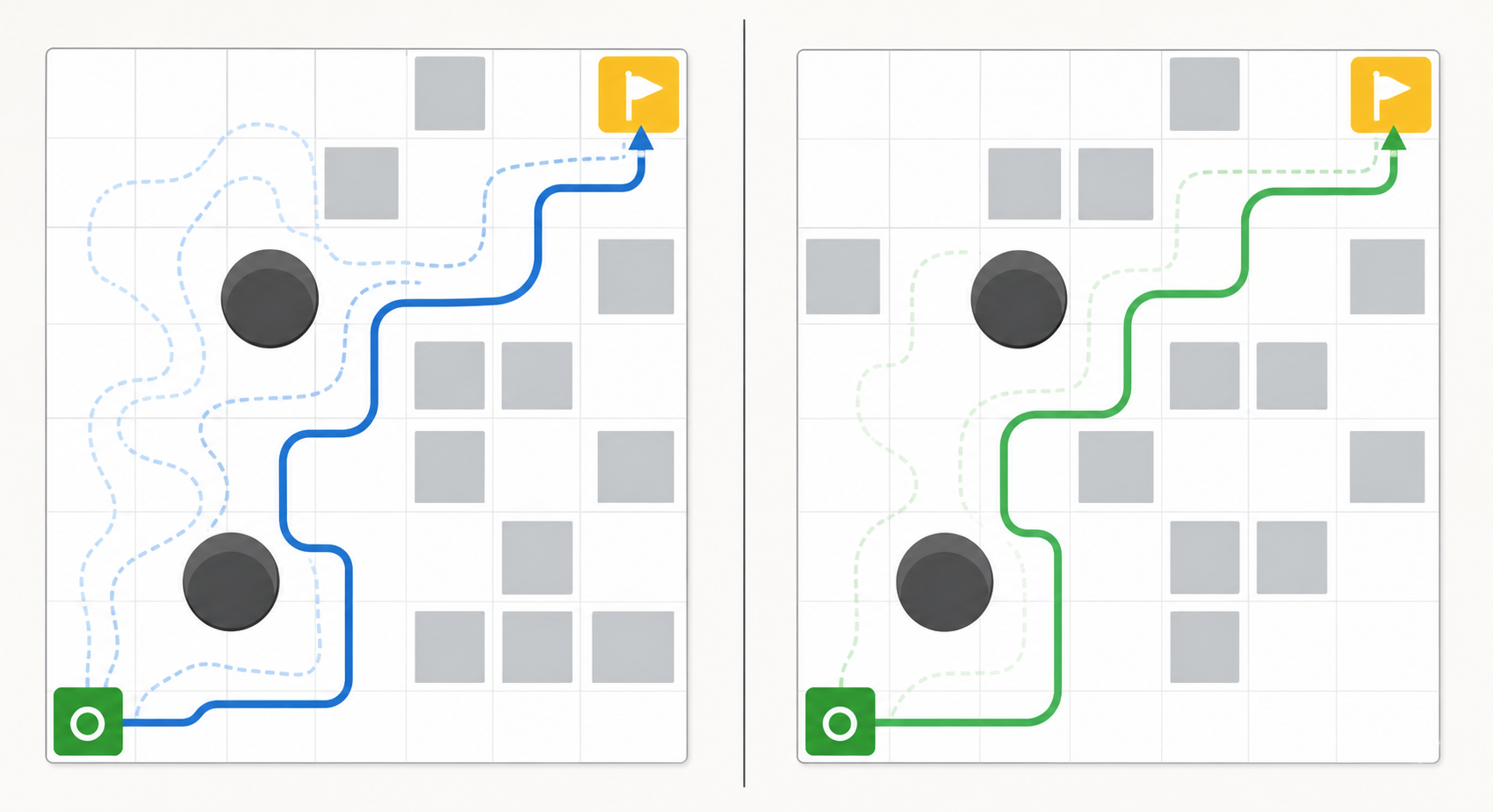

To evaluate and visualize the performance of SARSA versus Q-learning, you can record the total rewards obtained in each episode and plot them using matplotlib. This allows you to compare how quickly each algorithm learns and how consistent their performance is over time.
Tack för dina kommentarer!
Fråga AI

Fråga AI

Fråga vad du vill eller prova någon av de föreslagna frågorna för att starta vårt samtal
