Cost-Benefit Analysis for AI Tools
Svep för att visa menyn
Cost-Benefit Analysis for AI Tools
Choosing to implement an AI tool is a business decision, not a technology decision. That means it needs to be evaluated the same way you would evaluate any other investment – with a clear-eyed look at what it costs, what it returns, and how long before the return exceeds the cost.
This chapter gives you a practical framework for making that calculation, and a realistic picture of what the numbers typically look like.
What AI Tools Actually Cost
The direct costs of most AI tools are straightforward. A Claude Pro subscription is $20 per month. Zapier's professional plan starts at around $50 per month. Otter.ai's business plan runs approximately $20 per user per month. For a team of five, you are looking at $100–200 per month in tool costs for a complete AI workflow stack.
The less obvious costs are implementation time and the learning curve. A new Zapier workflow takes between 2 and 8 hours to build and test properly. Refining Claude prompts for a recurring task takes 3–5 hours of iteration before they are reliable. These are one-time costs, but they are real and worth accounting for upfront.

Most AI tools offer free tiers that are sufficient for testing and initial implementation. Run your pilot on the free tier before committing to a paid plan – this reduces financial risk and gives you real usage data to inform the decision.
Building the Return Side of the Equation
The return on an AI investment comes almost entirely from time recovered. To calculate it, you need three numbers:
- Hours saved per week – the difference between current time spent on the task and expected time with AI assistance;
- Fully-loaded hourly cost – the total cost of the employee's time including salary, benefits and overhead. A rough estimate is sufficient;
- Weeks per year the task occurs – most operational tasks run 48–50 weeks per year.
Multiply these three numbers together and you have your annual return.
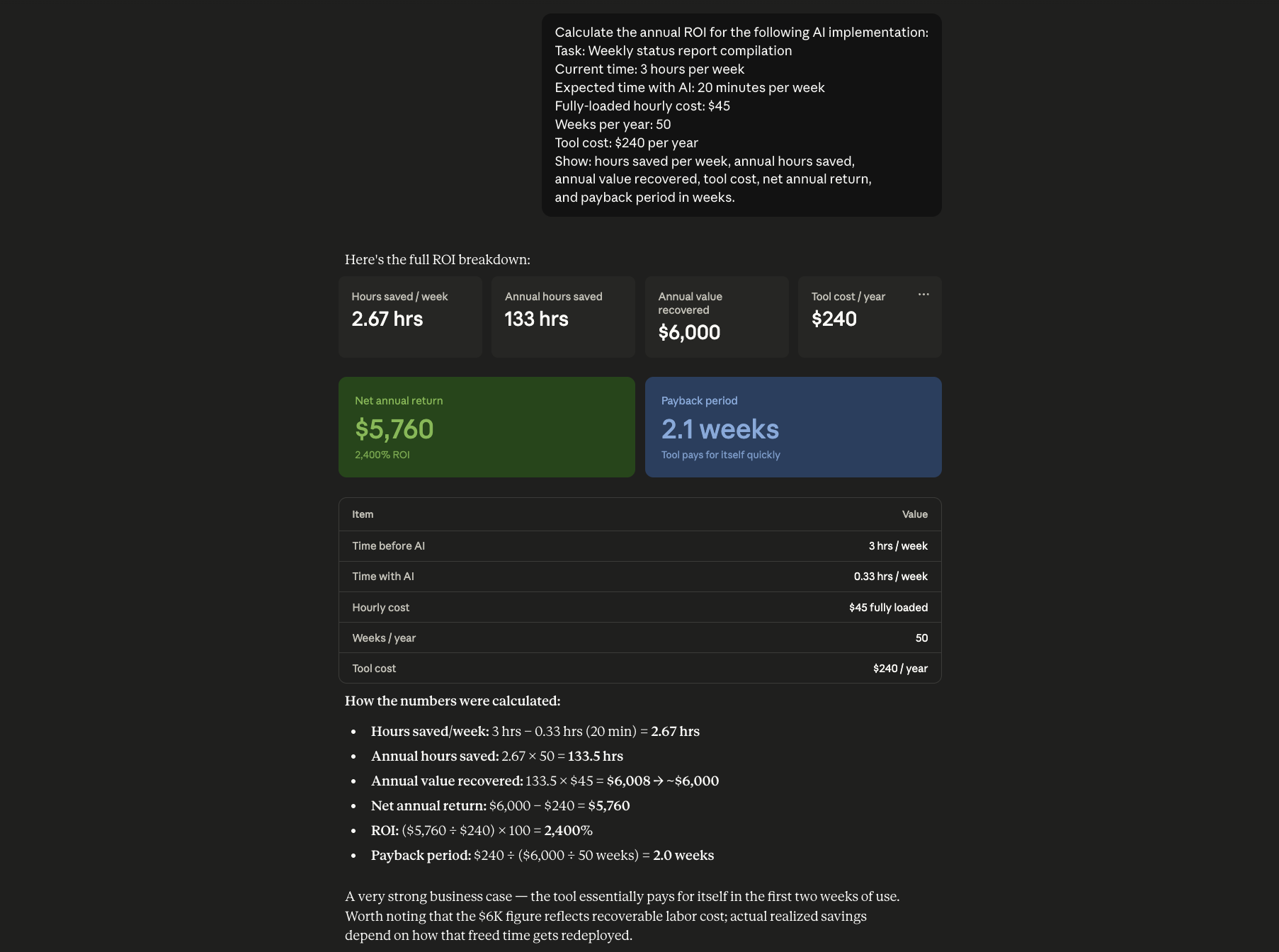
A realistic example: A weekly operations report currently takes 3 hours to compile manually from five data sources. With Claude processing the uploaded export and a Zapier automation pulling the data on schedule, it takes 20 minutes to review and send. That is 2 hours 40 minutes saved per week.
At a fully-loaded hourly cost of $45, over 50 weeks, that is $6,000 in recovered capacity per year – against a tool cost of $240 per year. The net annual return is $5,760, with a payback period of just over two weeks.

Payback period – the time it takes for the cumulative return from an investment to exceed its cumulative cost. For most AI tool implementations, the payback period is between one and three months when the target process is well chosen.
What the Numbers Usually Look Like
Across typical operations workflows, AI implementations targeting high-frequency reporting and communication tasks tend to produce:
- 3–8x return on tool costs within the first year;
- Payback period of 4–8 weeks for well-targeted implementations;
- 10–25% reduction in time spent on administrative and reporting tasks across the team.
These are conservative estimates. Implementations that target the right processes and are properly maintained tend to outperform them.
How Do I Present This to Leadership?
Leadership approval for AI tool spend is rarely about the numbers alone. The framing matters as much as the calculation.
The most effective approach is to lead with the problem, not the solution. Start with the specific operational pain – "our team spends 15 hours per week on tasks that could be automated" – before introducing the tool. This keeps the conversation focused on business outcomes rather than technology.
Support the case with a concrete pilot result rather than projected numbers wherever possible. Two weeks of real data showing 2 hours saved per person per week is more persuasive than a spreadsheet projection showing the same thing. Run the pilot first, present the results second.
Tack för dina kommentarer!
Fråga AI

Fråga AI

Fråga vad du vill eller prova någon av de föreslagna frågorna för att starta vårt samtal
