Logical Fallacies AI Loves to Use
Svep för att visa menyn
Here's something counterintuitive: larger, more capable AI models don't necessarily make fewer logical errors. A 2025 study analyzing 38 language models found a statistically significant correlation — as models became more capable, a higher share of their logical errors matched the specific patterns of human reasoning fallacies.
In other words, more sophisticated models are better at mimicking the way humans argue — including the ways humans argue badly.
This isn't malice. It's pattern completion. Fallacious arguments are extraordinarily common in human-written text — in political discourse, marketing copy, opinion journalism, and online debate. An LLM trained on this material learns the patterns of persuasive writing, flaws included.
The Fallacies That Appear Most Often
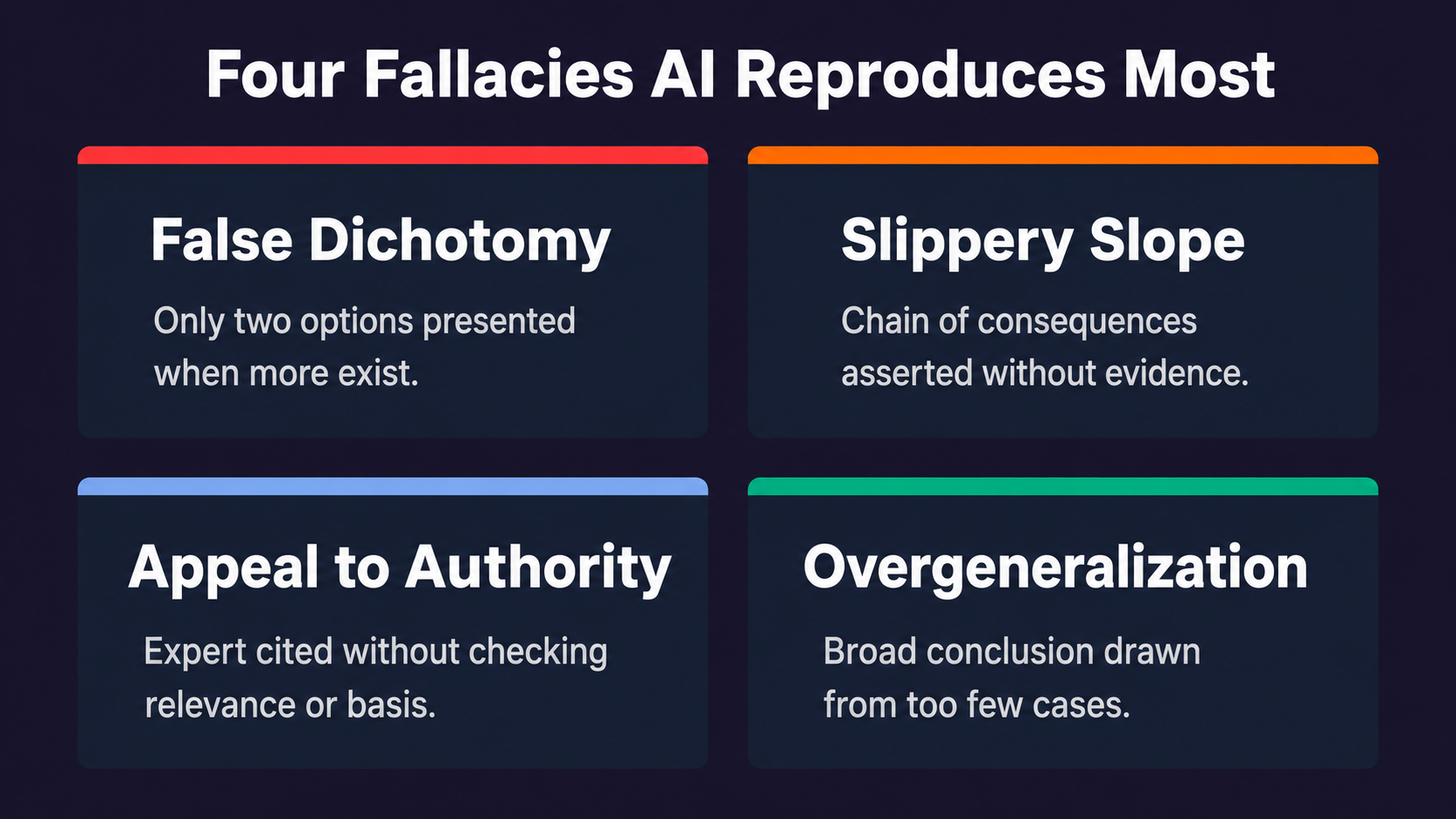
False dichotomy
Presenting two options as if they're the only possibilities, when more exist. "We either automate this process entirely or fall behind our competitors." AI outputs often frame decisions this way because it creates a clean, decisive-sounding structure. Real decisions almost always have more than two paths.
Slippery slope
Asserting that one event will inevitably lead to a chain of escalating consequences without evidence for the chain. "If we lower the price point, customers will devalue the product, then demand more discounts, then we'll lose our premium positioning entirely." Each step sounds plausible. The chain as a whole is asserted, not demonstrated.
Appeal to authority
Using an authority figure or institution to validate a claim, without examining whether the authority is relevant, current, or correct on this specific question. "Leading economists agree that..." — which economists? On what evidence? Citing an expert doesn't settle an empirical question.
Overgeneralization
Drawing a broad conclusion from a limited sample or single case. "Our last three product launches in Asia underperformed, so Asian markets aren't ready for this category." Three data points don't establish a pattern. AI frequently overgeneralizes because patterns are exactly what it's trained to find and extend.
A Practical Detection Move
You don't need to memorize a list of 40 fallacies. You need one question that catches most of them:
"Is this conclusion actually supported by what was presented, or am I being asked to accept a jump?"
When an AI output moves from evidence to conclusion, pause at that moment. Is the conclusion the only reasonable one? Are there other explanations for the same evidence? Is a chain of events being asserted as inevitable without proof?
The jump between evidence and conclusion is where most fallacies live. Train yourself to pause there.
When AI Detects Its Own Fallacies
One useful technique: after receiving an AI output that includes an argument or recommendation, ask the model directly: "Does the reasoning in your previous response contain any logical fallacies?"
The response is imperfect — models sometimes miss their own errors or flag things incorrectly — but it can surface problems worth examining. Treat it as a starting point, not a verdict.
1. Which of the following statements best illustrates a false dichotomy fallacy?
2. Which of the following statements best demonstrates a slippery slope fallacy as described in the chapter?
Tack för dina kommentarer!
Fråga AI

Fråga AI

Fråga vad du vill eller prova någon av de föreslagna frågorna för att starta vårt samtal
