FIRE
Свайпніть щоб показати меню

FIRE stands for Financial Independence, Retire Early. The movement has attracted millions of people not because early retirement is universally appealing, but because the math behind it reveals something most people never learn in school: the age at which you can stop working has almost nothing to do with how much you earn, and almost everything to do with your savings rate.
That's a genuinely counterintuitive idea. And it changes everything.
The Savings Rate is the Only Variable that Matters
Most retirement planning focuses on income: earn more, retire comfortably at 65. FIRE math focuses on the gap between income and spending — the savings rate — and shows that this single number determines your retirement timeline more than any other factor.
Here's why: your savings rate does two things simultaneously.
- It determines how fast your portfolio grows;
- It determines how small a portfolio you actually need (because a high saver is also a low spender).
These two effects compound together. Someone saving 50% of their income is building their portfolio twice as fast as someone saving 25% — and they need a portfolio half the size to sustain their lifestyle. The result is a retirement timeline that shrinks dramatically as the savings rate rises.
The Retirement Timeline Table
This table assumes a 5% real annual return (after inflation) on investments and uses the 4% withdrawal rule to determine the target portfolio size.
If you start at 25 and save 10%, you retire at about 76. If you save 50%, you retire at 42. If you save 70%, you retire at 33. The income level barely matters — a teacher saving 60% of $55,000 will retire earlier than an executive saving 10% of $250,000.
The Math in Plain Terms
Step 1: Calculate your annual spending. This is your take-home income minus everything you save. If you earn $80,000 after tax and save $32,000, you spend $48,000.
Step 2: Calculate your FI target. Annual spending × 25 = the portfolio you need. At $48,000/year: $1,200,000.
Step 3: Calculate your savings rate. Savings ÷ take-home income. $32,000 ÷ $80,000 = 40%.
Step 4: Project your timeline. At a 40% savings rate with a 5% real return, starting from zero, you reach $1,200,000 in approximately 22 years.
The shortcut: You don't need to earn more to retire early. You need to widen the gap between what you earn and what you spend — and invest the difference consistently.
The Assumptions Behind the Math
The FIRE model rests on a few key assumptions worth understanding:
The 4% withdrawal rule. Covered in Chapter 1 — a 4% annual withdrawal from a diversified portfolio has historically been sustainable for 30+ years. Early retirees often use 3.5% or 3% for extra margin since their retirement could last 50+ years.
A 5–7% real return. Historically, a diversified index fund portfolio has returned roughly 7% nominally, or 5% after inflation. This is the engine driving the math. It's not guaranteed, but it's the best available long-run benchmark.
Consistent investing. The model assumes you actually invest the difference — in index funds or equivalent vehicles — rather than letting savings sit in cash losing value to inflation.
No major gaps. Career interruptions, large unplanned expenses, or periods of zero saving extend the timeline. The table above is a clean-case estimate.
What "Retire Early" Actually Means in Practice
A common misunderstanding: FIRE doesn't necessarily mean stopping all work at 35 and watching television for the next 50 years. For most people who pursue it, "retirement" means something more specific:
- No longer needing a paycheck to cover expenses;
- Leaving a career that was tolerated rather than chosen;
- Working on different terms — part-time, freelance, on projects they care about;
- Having full time autonomy regardless of whether they work at all.
Many FIRE practitioners continue earning income after reaching financial independence. That income — even modest amounts — dramatically extends portfolio longevity. Someone with a $1,200,000 portfolio who earns even $20,000/year from occasional work only needs to withdraw $28,000 from investments instead of $48,000. That changes a 4% withdrawal rate to a 2.3% rate, making the portfolio nearly indestructible.
The Two Levers
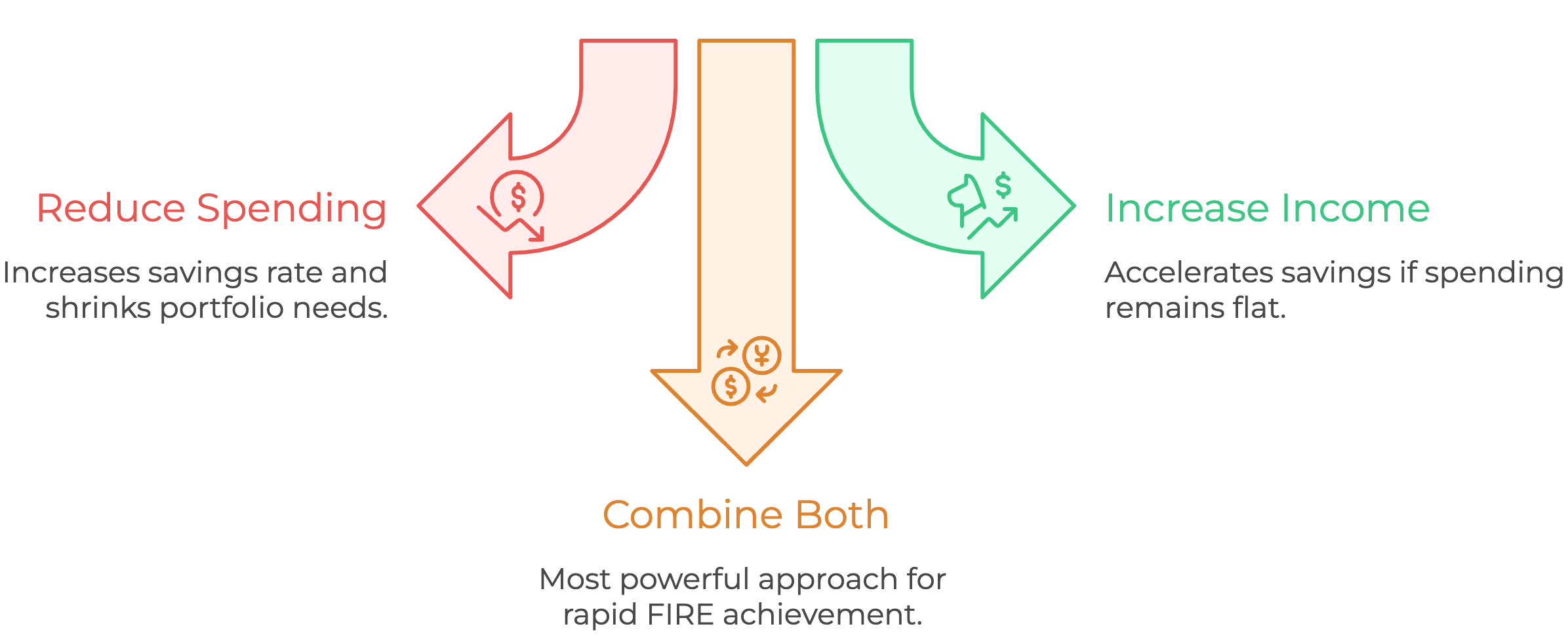
Every FIRE plan has exactly two levers:
Lever 1 — Reduce spending. Lower spending does two things: it increases your savings rate today, and it shrinks the portfolio you need to reach independence. The double effect from Chapter 1 applies here in full.
Lever 2 — Increase income. Higher income accelerates savings — but only if spending doesn't rise in parallel. Income increases that get absorbed by lifestyle inflation do nothing for your FIRE timeline. The savings rate, not the income level, is what matters.
The most powerful FIRE plans work both levers simultaneously: deliberately keeping lifestyle costs flat while aggressively growing income, so the gap between the two — the investable surplus — grows as fast as possible.

The table above assumes starting from zero. Starting later doesn't disqualify FIRE — it just changes the target.
Someone at 45 who has already accumulated $400,000 and needs $1,200,000 only needs to close a $800,000 gap, not build from scratch. At a 50% savings rate on a good income, that gap can close in 10–12 years, not 17. Starting late with a high savings rate still beats starting early with a low one.
Key Takeaways
- Your savings rate — not your income — determines when you can retire. Someone earning $50,000 and saving 60% will retire before someone earning $200,000 and saving 10%;
- The double effect of a high savings rate: it grows your portfolio faster and shrinks the portfolio you need simultaneously;
- A 5% real return on a diversified index portfolio is the engine. The math only works if savings are actually invested;
- "Retire early" usually means work becomes optional, not that you never do anything productive again. Most FIRE practitioners continue some form of income-generating activity — on their own terms;
- Both levers matter: cut spending and grow income, but make sure income growth doesn't get swallowed by lifestyle inflation.
1. Which statements accurately reflect how the savings rate and FIRE assumptions affect your retirement timeline?
2. Which of the following are key assumptions behind the FIRE math model?
3. Which statements best describe what 'Retire Early' means in practice for most people following the FIRE movement
Дякуємо за ваш відгук!
Запитати АІ

Запитати АІ

Запитайте про що завгодно або спробуйте одне із запропонованих запитань, щоб почати наш чат
