What is GEO?
Свайпніть щоб показати меню
Something quietly shifted in how people search for information. Not all at once — gradually, then suddenly. People started asking questions and getting answers. Not a list of ten blue hyperlinks to evaluate, click, and maybe find useful. An actual answer, written in plain language, often with a handful of sources attached.
This is AI search. And it is not a feature update. It is a different model of how information moves from the web to a human being — one that removes the click entirely from the equation, and in doing so, changes everything marketers and content creators thought they understood about visibility online.
Generative Engine Optimization — GEO — is the discipline of adapting to this new model. It is what search engine optimization (SEO) was to the web of 2005, applied to the web of now. If SEO was about getting ranked, GEO is about getting cited. If SEO was about earning clicks, GEO is about earning trust from a system that reads your content, evaluates it, and decides whether you deserve to be part of the answer it gives to millions of people every day.

In 20 years following the internet space, we cannot recall a faster ramp in a consumer internet app.
UBS analyst note on ChatGPT, February 2023, as reported by Reuters
That was written when ChatGPT had just crossed 100 million users in two months. By October 2025, it had 800 million weekly active users. The curve did not flatten. It accelerated.
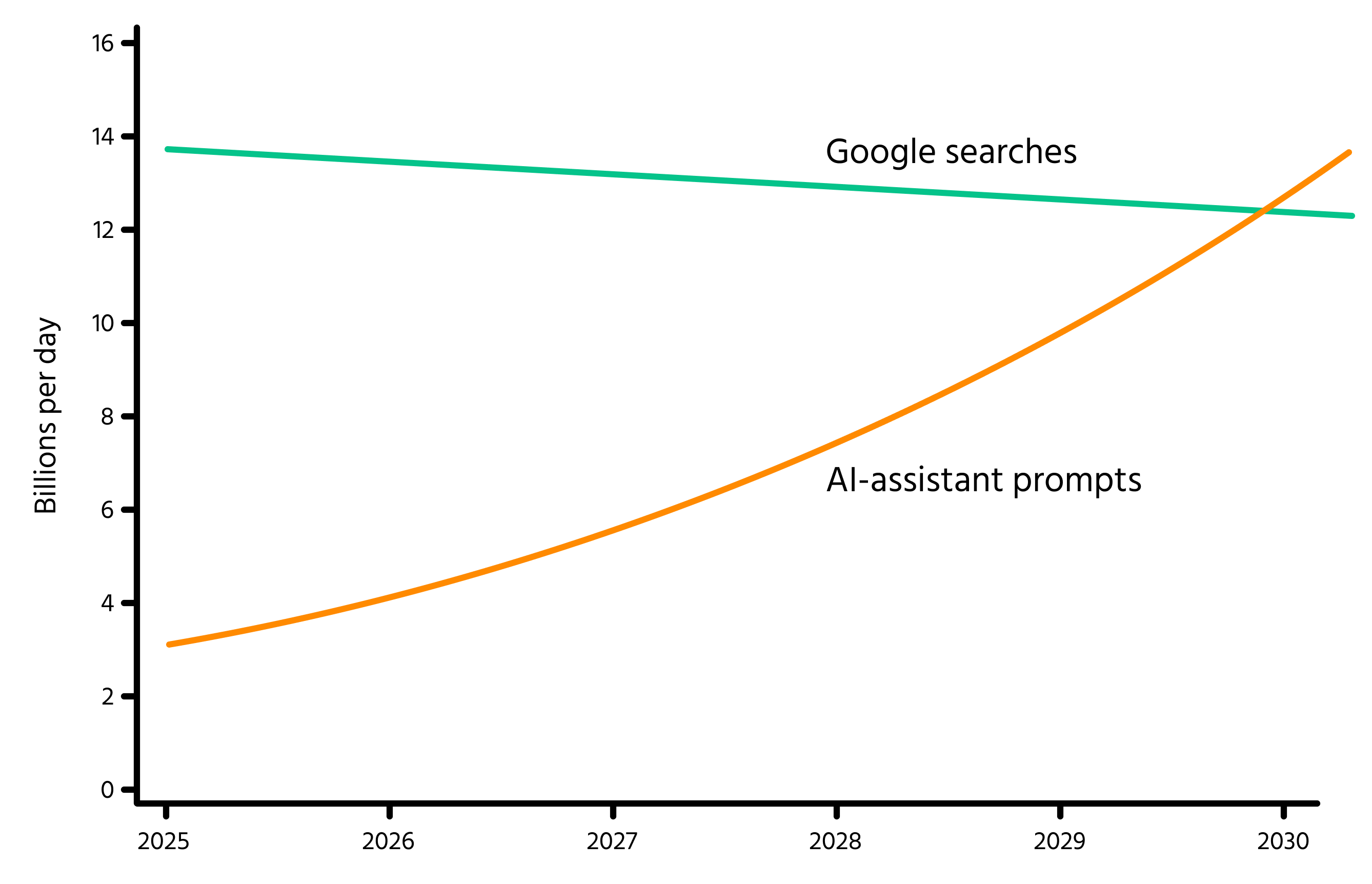
Based on current growth rates, AI-assistant prompt volume is set to equal and then exceed traditional Google search volume by around 2030. For marketers, this is not a warning about the future. It is a signal about the present: the audience is already splitting across two very different systems, and optimizing for only one of them means being invisible to a rapidly growing share of it.
Defining GEO

Generative Engine Optimization (GEO) is the practice of structuring, writing, and positioning content so that AI-powered search engines select it as a trusted source when composing answers to user queries.
The word "generative" is the key. Traditional search engines index content and rank it. Generative engines do something different: they read content, evaluate it, synthesize it, and write a new response — an answer — that is delivered directly to the user. Your content doesn't appear to the user as a link. It appears, if you're lucky, as a cited source in a paragraph the AI wrote. Or it doesn't appear at all.
Why GEO Exists
GEO exists because the internet's information-delivery infrastructure changed, and marketing didn't catch up fast enough. For twenty years, the core assumption of digital marketing was simple: put content on the web, help search engines find it, earn traffic, convert traffic. That chain — content → ranking → click → conversion — was the bedrock of the discipline.
AI search engines broke that chain at the click. They still retrieve content. They still evaluate quality. But they no longer hand the user a list of options and let them choose. They choose for the user. They synthesize, summarize, and deliver. The user may never click. The user may never visit your site. But if the AI's answer is shaped by your content, your brand is still part of that interaction — just invisibly, unless you've optimized for it.
The problem GEO solves is this: how do you remain visible, authoritative, and commercially relevant in a world where the intermediary between your content and your audience is no longer a ranked list, but a language model with its own trust criteria?
Дякуємо за ваш відгук!
Запитати АІ

Запитати АІ

Запитайте про що завгодно або спробуйте одне із запропонованих запитань, щоб почати наш чат
