Why Motivation Never Fixes Your Finances
Свайпніть щоб показати меню
Most people start financial goals with strong motivation.
A new month begins. A salary arrives. A motivational video appears online.
Suddenly everything feels different. You promise yourself:
- "This time I will budget properly."
- "This time I will finally save money."
- "This time I will stop impulse spending."
For a few days, it feels easy. Then normal life returns. Stress appears again. Work becomes exhausting. Unexpected expenses happen. Emotions take over.
And slowly, the old habits return.
The Problem with Motivation
Motivation is emotional. And emotions constantly change. Some days you feel:
- Disciplined;
- Productive;
- Focused.
Other days you feel:
- Tired;
- Stressed;
- Emotionally drained.
If your financial system depends only on motivation, your behavior will constantly rise and fall with your emotions.
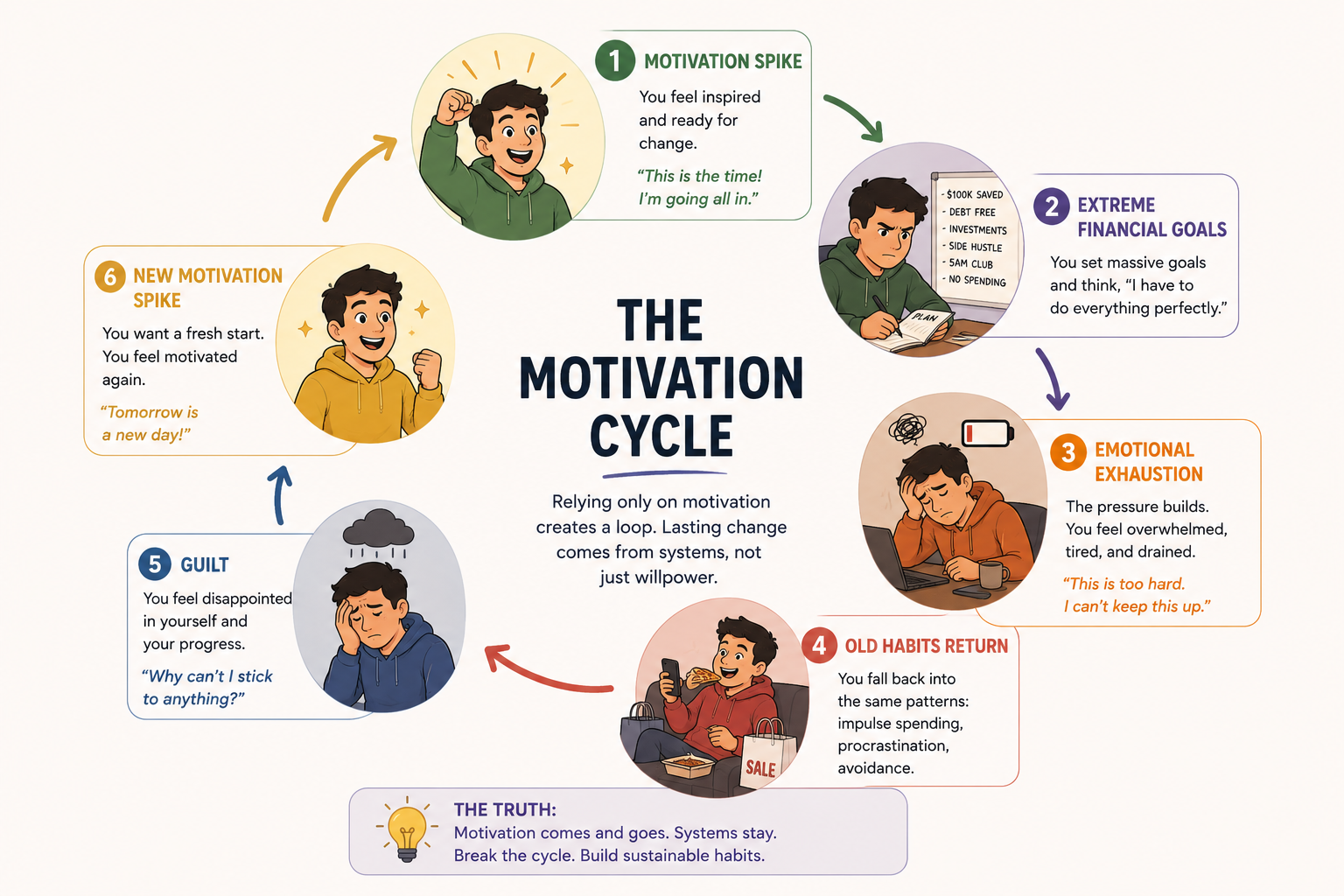
That is why many people restart budgets every month, repeatedly quit financial goals, feel trapped in endless "fresh start" cycles.
A Very Familiar Pattern
Imagine this situation.
Someone watches several productivity videos on Sunday night. They suddenly feel inspired.
They:
- Create a detailed budget;
- Download financial apps;
- Make strict saving goals;
- Promise to stop unnecessary spending completely.
For a few days, everything feels under control. Then Friday arrives after a difficult week. The emotional brain wants comfort. The strict system suddenly feels exhausting instead of motivating. Food delivery appears again. Shopping feels deserved again. The budget quietly disappears again.
Not because the person is weak.
Because motivation is temporary.
Systems Beat Emotions
People who improve financially long-term are not always more motivated.
Usually, they have better systems.
For example:
- Automatic investing;
- Automatic savings transfers;
- Spending limits;
- Delayed purchase rules;
- Reduced temptation.
Good systems reduce the number of emotional decisions you need to make.
That is extremely important because emotional decisions become harder when people are:
- Stressed;
- Exhausted;
- Overwhelmed;
- Distracted.
Why Simple Systems Often Work Better
Many people fail because they create systems that are emotionally impossible to maintain.
Extreme budgeting often fails. Perfect discipline often fails. Overly strict rules often fail. Simple systems survive longer because they work even during stressful periods. Financial success usually comes from consistency, not perfection.
The Real Goal
The goal is not becoming perfectly disciplined.
The goal is building a financial life that still works even when:
- Motivation disappears;
- Stress increases;
- Emotions become stronger.
That is what stable financial systems are designed to do.

You will build these systems step by step in the final section.

Think about one financial habit that depends mostly on motivation.
Ask yourself:
- What usually breaks the habit?
- What emotions make consistency difficult?
- How could you turn this habit into an automatic system instead?
Дякуємо за ваш відгук!
Запитати АІ

Запитати АІ

Запитайте про що завгодно або спробуйте одне із запропонованих запитань, щоб почати наш чат
