Core Techniques; Role, Examples, Step-by-Step Thinking
Swipe to show menu
Beyond the four building blocks, there are three techniques used by experienced AI users that reliably improve output quality. None of them require technical knowledge — just a slightly different way of framing your request.
Technique 1 — Role Prompting
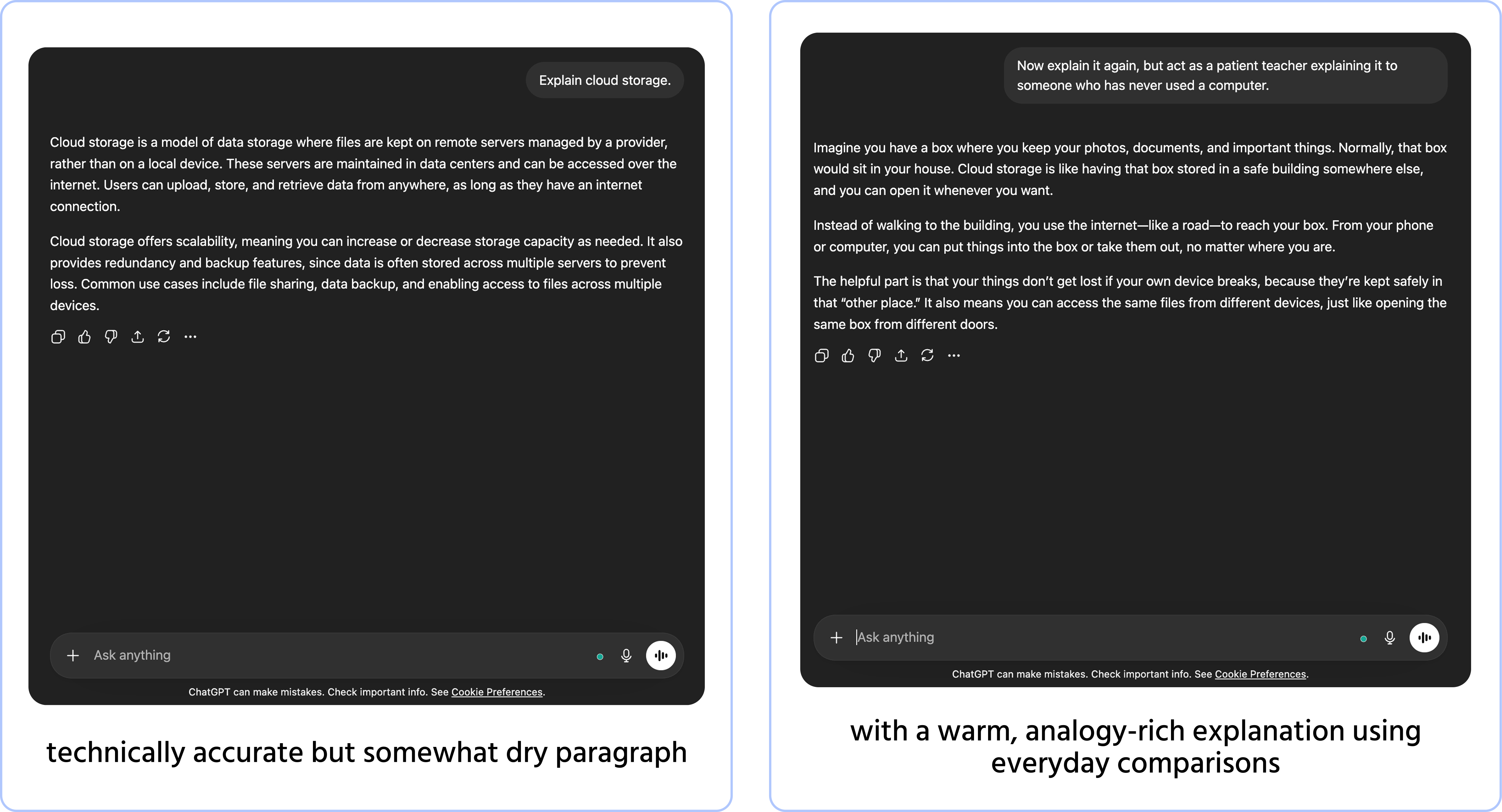
You can tell the AI to adopt a specific role or perspective before it responds. This shifts the tone, vocabulary, and frame of reference of the entire output.
How it works: Start your prompt with: "Act as a [role]..." or "You are a [role]..."
Examples:
Act as an experienced HR manager and review this job description for any language that might discourage diverse candidates.You are a skeptical investor. Read this business proposal and list the three weakest points.Act as a plain-language editor. Rewrite the following paragraph so a 16-year-old could understand it.
The role doesn't need to be a job title — it can be a mindset, a persona, or a communication style.
Technique 2 — Few-Shot Examples
If you want the AI to match a specific style, tone, or format, the most effective thing you can do is show it an example.
This is called few-shot prompting — giving the model one or two examples of the kind of output you want before asking it to produce its own.
How it works: Include a sample in your prompt: "Here's an example of the style I want: [example]. Now write [X] in the same style."
Example:
Here's an example of how we write internal announcements at our company: "Team — quick update: the office will be closed on Friday, April 18th for a company offsite. If you have urgent client meetings, please flag them to your manager by Wednesday." Using this same tone and structure, write an announcement about our new quarterly planning process starting next month.
The AI will pick up on the length, formality, sentence structure, and directness of your example — and apply it.
Technique 3 — Step-by-Step Thinking (Chain-of-Thought)
For complex tasks — analysis, decisions, structured reasoning — you can ask the AI to think through the problem step by step before giving its answer. This reduces shallow, surface-level responses.
How it works: Add a phrase like: "Think through this step by step" or "Before answering, reason through the key considerations"
Why it works: When forced to reason explicitly, the model produces more structured, considered output — rather than jumping to the first plausible conclusion.
Examples:
Think step by step: what are the main risks of launching a new product feature without user testing?;Before giving your answer, reason through the pros and cons. Should we host this event in-person or online?;Walk me through how you'd approach structuring this project plan, step by step..
This technique is especially useful when you want the AI to do analysis, not just generate text.
1. What is the main purpose of using role prompting when crafting AI prompts?
2. How does few-shot prompting help improve the quality of AI-generated output?
3. Why does asking the AI to think step by step improve its responses for complex tasks?
Thanks for your feedback!
Ask AI

Ask AI

Ask anything or try one of the suggested questions to begin our chat
Core Techniques; Role, Examples, Step-by-Step Thinking
Beyond the four building blocks, there are three techniques used by experienced AI users that reliably improve output quality. None of them require technical knowledge — just a slightly different way of framing your request.
Technique 1 — Role Prompting
You can tell the AI to adopt a specific role or perspective before it responds. This shifts the tone, vocabulary, and frame of reference of the entire output.
How it works: Start your prompt with: "Act as a [role]..." or "You are a [role]..."
Examples:
Act as an experienced HR manager and review this job description for any language that might discourage diverse candidates.You are a skeptical investor. Read this business proposal and list the three weakest points.Act as a plain-language editor. Rewrite the following paragraph so a 16-year-old could understand it.
The role doesn't need to be a job title — it can be a mindset, a persona, or a communication style.
Technique 2 — Few-Shot Examples
If you want the AI to match a specific style, tone, or format, the most effective thing you can do is show it an example.
This is called few-shot prompting — giving the model one or two examples of the kind of output you want before asking it to produce its own.
How it works: Include a sample in your prompt: "Here's an example of the style I want: [example]. Now write [X] in the same style."
Example:
Here's an example of how we write internal announcements at our company: "Team — quick update: the office will be closed on Friday, April 18th for a company offsite. If you have urgent client meetings, please flag them to your manager by Wednesday." Using this same tone and structure, write an announcement about our new quarterly planning process starting next month.
The AI will pick up on the length, formality, sentence structure, and directness of your example — and apply it.
Technique 3 — Step-by-Step Thinking (Chain-of-Thought)
For complex tasks — analysis, decisions, structured reasoning — you can ask the AI to think through the problem step by step before giving its answer. This reduces shallow, surface-level responses.
How it works: Add a phrase like: "Think through this step by step" or "Before answering, reason through the key considerations"
Why it works: When forced to reason explicitly, the model produces more structured, considered output — rather than jumping to the first plausible conclusion.
Examples:
Think step by step: what are the main risks of launching a new product feature without user testing?;Before giving your answer, reason through the pros and cons. Should we host this event in-person or online?;Walk me through how you'd approach structuring this project plan, step by step..
This technique is especially useful when you want the AI to do analysis, not just generate text.
Thanks for your feedback!
