Anatomy of an Effective Prompt
Swipe to show menu
Good prompts aren't magic — they follow a structure. Once you internalize it, writing effective prompts becomes second nature. There are four building blocks that consistently produce better results.
The Four Building Blocks
1. Task — what you want the AI to do: Be explicit about the action: write, summarize, compare, explain, translate, rewrite, list, analyze;
2. Context — what the AI needs to know: Who are you? Who is the output for? What's the background? What problem are you solving?
3. Format — how you want the output structured: Bullet points? A numbered list? A table? A short paragraph? One sentence? If you don't specify, the AI will choose — and it may not match what you need;
4. Constraints — what the AI should avoid or respect: Tone (formal / casual), length (under 100 words), things to include or exclude, language level (simple, technical).
![Screenshot description: A prompt displayed in a text box, with four color-coded brackets or underlines highlighting different parts of the same sentence. The prompt reads: "Summarize the following meeting notes into 5 bullet points [FORMAT] for a non-technical executive audience [CONTEXT] who wasn't at the meeting [CONTEXT]. Focus only on decisions made and next steps [CONSTRAINTS]. Avoid jargon [CONSTRAINTS]." Each highlighted segment has a colored label tag pointing to it: Task (blue), Context (green), Format (orange), Constraints (red). Clean layout, easy to read, white background.](https://content-media-cdn.codefinity.com/courses/03c64ada-b4fc-44e4-867c-0f11a4d4e367/screenshots/10.png?w=3840&q=75)
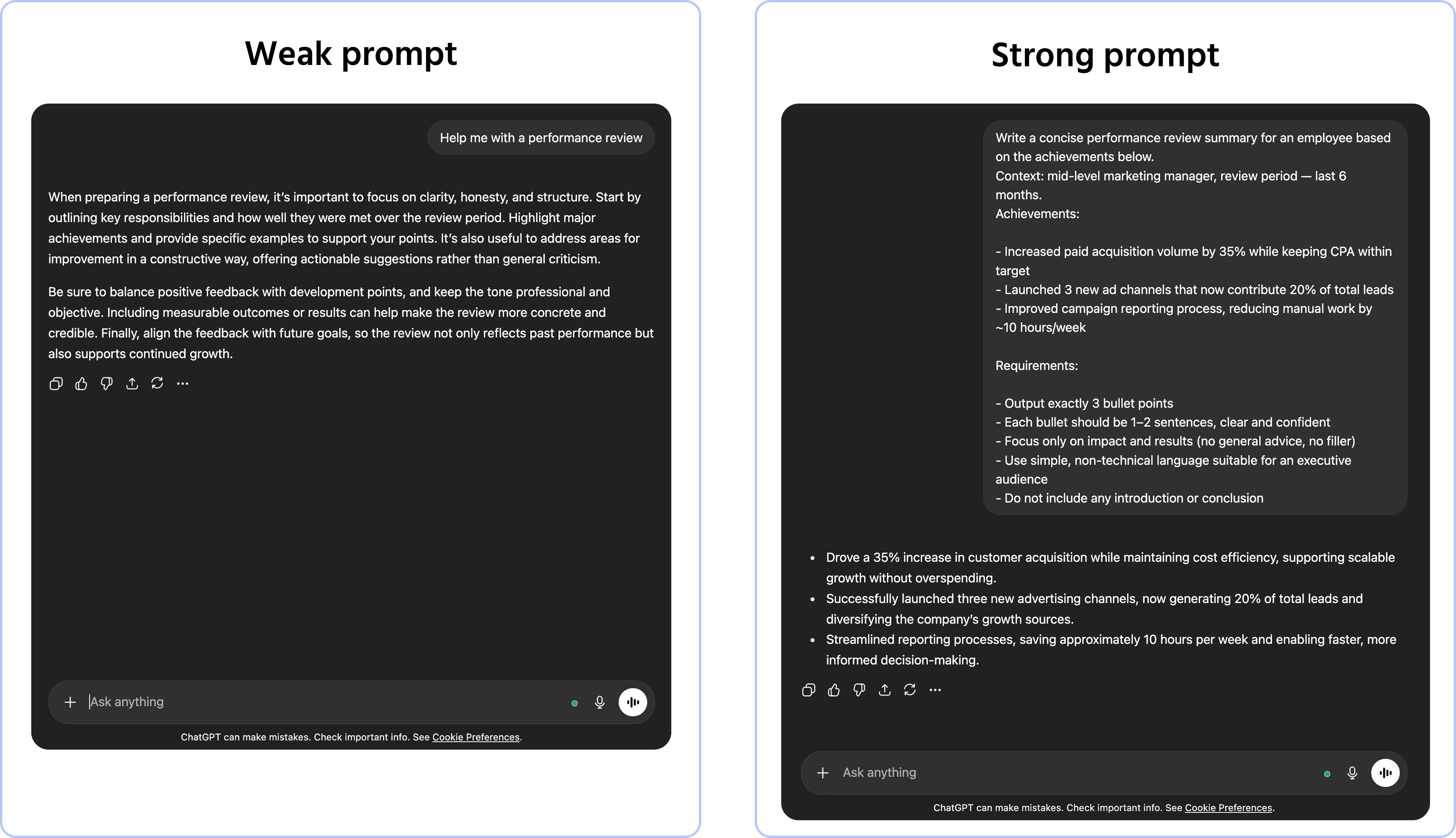
Weak vs. Strong: Side by Side
Let's look at the same request — written weakly, then with all four building blocks applied.
Topic: asking AI to help prepare for a performance review
Weak prompt:
Help me with a performance review
Strong prompt:
I'm a team lead preparing my own self-assessment for an annual performance review at a mid-size software company. Write 3 concise bullet points highlighting my achievements this quarter, based on these facts: I led the onboarding of 2 new team members, reduced deployment time by 20%, and introduced a weekly team sync that improved communication. Keep each bullet under 40 words and use confident, professional language.
The strong version isn't harder to write — it's just more deliberate. You'll get faster at this with practice.
You Don't Always Need All Four
The four building blocks are a checklist, not a rigid formula. For simple tasks, two or three are enough:
Explain what a VPN is in one sentence— Task + Format + implied Constraint (simple language) — perfectly fineж;List 5 creative names for a productivity app— Task + Format — that's enough.
The rule of thumb: add more detail when the stakes are higher or the output is more specific to your situation. For a first draft of an important client email — use all four. For a quick brainstorm — keep it light.
1. What are the four building blocks of an effective prompt?
2. Why might you not always need to include all four building blocks in a prompt?
Thanks for your feedback!
Ask AI

Ask AI

Ask anything or try one of the suggested questions to begin our chat
