AI for Project Management and Operations
Swipe to show menu
Project managers and operations professionals spend a significant portion of their time on communication and documentation — meeting summaries, status updates, stakeholder messages, planning documents, and process guides. Most of this work follows predictable patterns, which makes it highly amenable to AI assistance.
Where AI Adds the Most Value in Project Management
- Meeting summaries — turning raw notes or a transcript into a structured summary with decisions, action items, and owners;
- Status update drafts — generating a weekly project update from a list of bullet points, formatted for the right audience;
- Stakeholder communications — drafting messages that need to balance technical detail with executive clarity;
- Risk and issue logs — structuring risks into a consistent format with likelihood, impact, and mitigation steps;
- Process documentation — turning a verbal description of how something works into a clear, step-by-step written process;
- Agenda preparation — generating meeting agendas from a description of the goals and attendees.
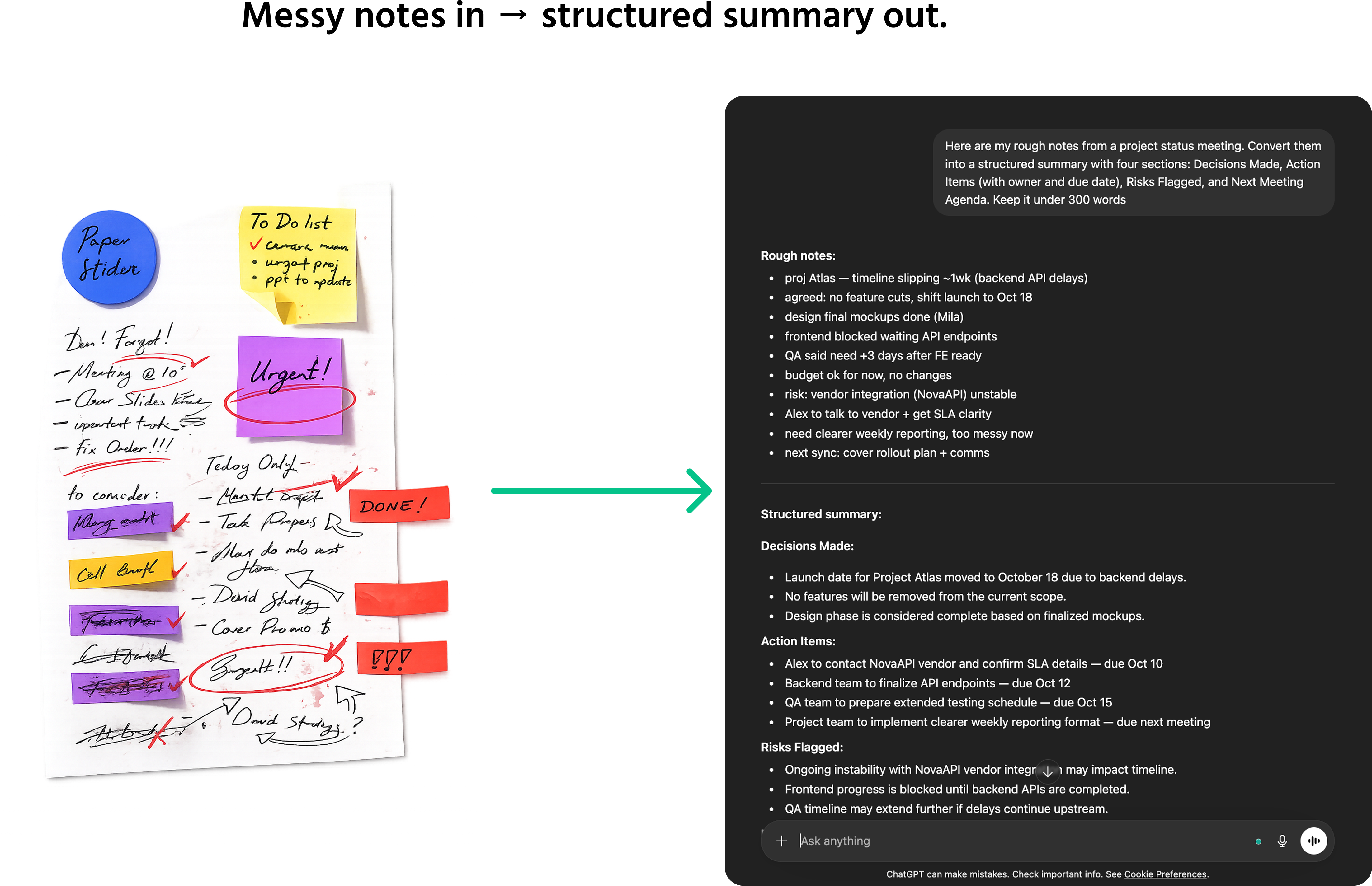
Automating Routine Communication
A significant portion of project management communication is repetitive — the same types of messages sent to different stakeholders at different stages. AI handles this well when you give it the right template.
A useful approach: build a small library of prompt templates for your most common communication tasks. Examples:
- A weekly status update template for your team;
- A stakeholder escalation message template;
- A project kickoff email template;
- A closing summary template for completed work streams.
Once you have these, generating a tailored version for any specific situation takes under a minute.

AI is strong at producing well-structured documents and clear communications. It has no ability to assess project health, read team dynamics, or determine whether a deadline is realistic given the actual constraints on the ground.
The outputs AI produces for project management are structural and communicative — they make your thinking visible and shareable. The thinking itself — prioritization, trade-offs, risk assessment, people decisions — remains entirely yours.
1. Which of the following are tasks where AI adds the most value in project management?
2. Which statement accurately describes the current role of AI in project management?
Thanks for your feedback!
Ask AI

Ask AI

Ask anything or try one of the suggested questions to begin our chat
