AI for HR and People Operations
Swipe to show menu
HR work involves a significant amount of writing — job descriptions, interview guides, feedback summaries, policy documents, onboarding materials. Much of this writing follows predictable structures, which makes it well-suited to AI assistance.
At the same time, HR deals with sensitive people data and decisions that carry real consequences. The principles from Section 3 apply here more directly than in almost any other function.
Where AI Adds the Most Value in HR
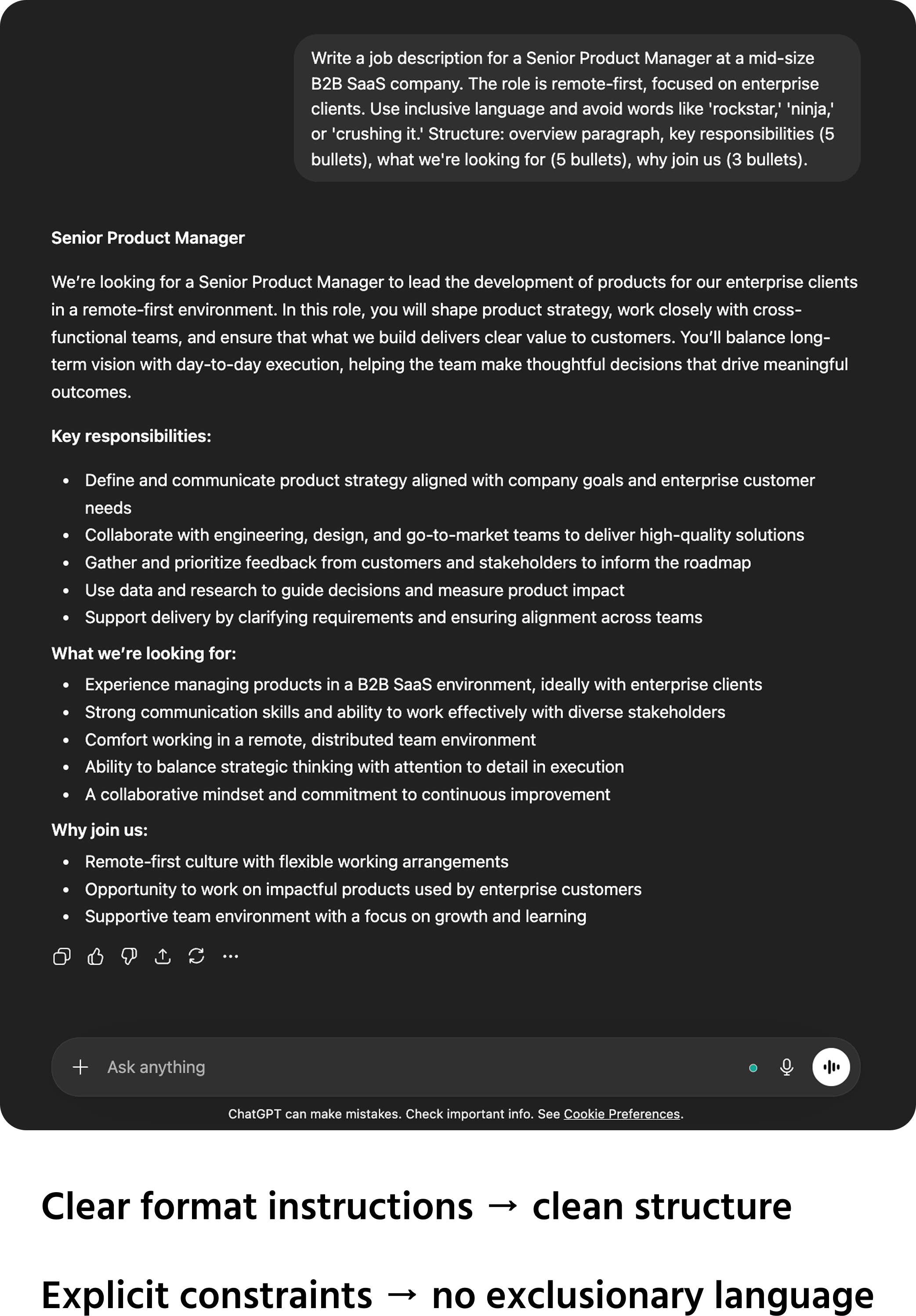
- Writing and refining job descriptions — drafting from a brief, checking for exclusionary language, adapting for different seniority levels;
- Preparing interview question sets — generating role-specific behavioral and situational questions aligned to competencies;
- Summarizing feedback — synthesizing responses from multiple reviewers into a coherent narrative for performance discussions;
- Drafting onboarding content — welcome messages, FAQ documents, process guides, and role-specific orientation materials;
- Policy drafts — producing first drafts of internal policies based on a description of the requirement and context.
A Critical Warning: People Data and AI
HR professionals handle data that is highly sensitive by nature — performance records, compensation information, disciplinary history, health accommodations, personal circumstances shared in confidence.
None of this should be entered into a consumer AI tool.
Even anonymized data requires care. A description like "a 52-year-old employee in the London office who has been underperforming since their return from medical leave" may be identifiable to anyone who knows the organization.
The rule for HR and AI: use AI to handle the writing structure and language — never to process real employee data. Describe the type of situation, not the actual people involved.
AI and Hiring Decisions: A Specific Caution
AI can help write interview questions and structure evaluation criteria. It should not be used to score, rank, or make decisions about candidates.
Reasons to keep hiring decisions human:
- Legal exposure — algorithmic decision-making in hiring is subject to increasing regulation in many jurisdictions;
- Bias risk — AI trained on historical hiring data can replicate and amplify patterns of past discrimination;
- Accountability — hiring decisions affect people's livelihoods and require human judgment and responsibility.
Use AI to prepare and structure the process. Keep the decision itself firmly with a person.
Thanks for your feedback!
Ask AI

Ask AI

Ask anything or try one of the suggested questions to begin our chat
AI for HR and People Operations
HR work involves a significant amount of writing — job descriptions, interview guides, feedback summaries, policy documents, onboarding materials. Much of this writing follows predictable structures, which makes it well-suited to AI assistance.
At the same time, HR deals with sensitive people data and decisions that carry real consequences. The principles from Section 3 apply here more directly than in almost any other function.
Where AI Adds the Most Value in HR
- Writing and refining job descriptions — drafting from a brief, checking for exclusionary language, adapting for different seniority levels;
- Preparing interview question sets — generating role-specific behavioral and situational questions aligned to competencies;
- Summarizing feedback — synthesizing responses from multiple reviewers into a coherent narrative for performance discussions;
- Drafting onboarding content — welcome messages, FAQ documents, process guides, and role-specific orientation materials;
- Policy drafts — producing first drafts of internal policies based on a description of the requirement and context.
A Critical Warning: People Data and AI
HR professionals handle data that is highly sensitive by nature — performance records, compensation information, disciplinary history, health accommodations, personal circumstances shared in confidence.
None of this should be entered into a consumer AI tool.
Even anonymized data requires care. A description like "a 52-year-old employee in the London office who has been underperforming since their return from medical leave" may be identifiable to anyone who knows the organization.
The rule for HR and AI: use AI to handle the writing structure and language — never to process real employee data. Describe the type of situation, not the actual people involved.
AI and Hiring Decisions: A Specific Caution
AI can help write interview questions and structure evaluation criteria. It should not be used to score, rank, or make decisions about candidates.
Reasons to keep hiring decisions human:
- Legal exposure — algorithmic decision-making in hiring is subject to increasing regulation in many jurisdictions;
- Bias risk — AI trained on historical hiring data can replicate and amplify patterns of past discrimination;
- Accountability — hiring decisions affect people's livelihoods and require human judgment and responsibility.
Use AI to prepare and structure the process. Keep the decision itself firmly with a person.
Thanks for your feedback!
