Bias, Copyright and Ethical Use
Swipe to show menu
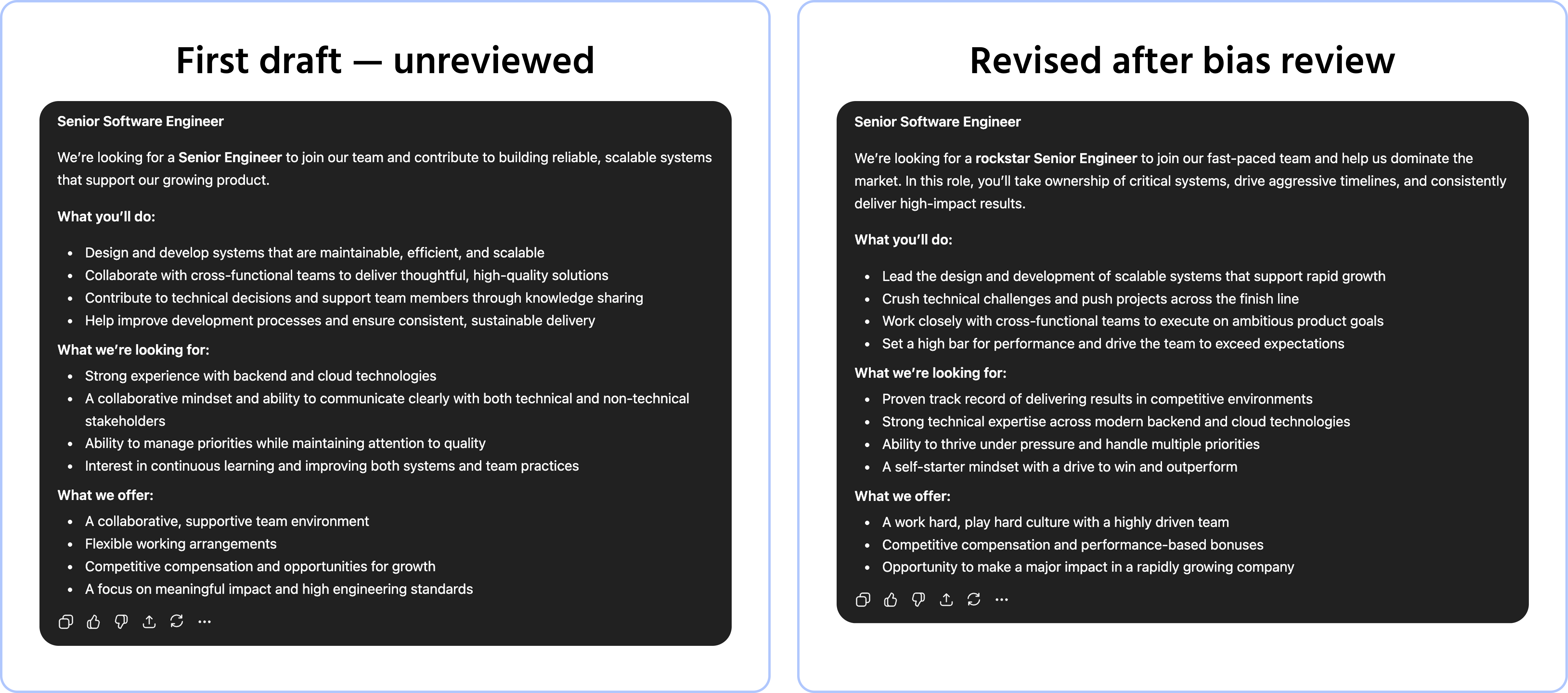
Using AI responsibly at work goes beyond protecting data. AI systems carry biases inherited from their training data, raise unresolved questions about intellectual property, and shift moral responsibility in ways that aren't always obvious.
This chapter isn't about discouraging AI use. It's about helping you use it in a way you can stand behind.
Where AI Bias Comes From
AI models are trained on enormous amounts of text produced by humans. That text reflects the perspectives, assumptions, and blind spots of the people and cultures that produced it.
As a result, AI systems can reproduce and amplify bias in subtle ways:
- Job descriptions generated by AI may use language that skews toward certain demographics;
- AI-generated images of "a professional" or "a leader" may default to stereotyped representations;
- Summaries of complex social topics may reflect the dominant perspectives in the training data rather than a balanced view;
- AI tools may perform differently across languages and cultural contexts, with stronger results for content that resembles their training data.
Bias is not always visible or obvious. The output will sound neutral — even when it isn't.
Copyright and AI-Generated Content
When AI generates text, code, or images, questions about ownership and intellectual property are not fully resolved — legally or practically.
Key things to be aware of:
- AI-generated content is trained on existing work, including copyrighted material. The extent to which this affects the output is contested;
- In most jurisdictions as of 2026, purely AI-generated content cannot be copyrighted — copyright requires human authorship;
- Content that closely resembles or reproduces existing copyrighted work may create legal exposure for the organization using it;
- Some industries (legal, publishing, journalism) have specific and evolving norms around disclosure of AI use.
The practical implication: for important, public-facing, or legally sensitive content, always have a human meaningfully involved in the creation — not just as a final reader, but as an active author.
Who Is Responsible for AI Output?
When something goes wrong with AI-generated content — a factual error in a client report, biased language in a job posting, a privacy breach from a poorly crafted prompt — the AI is not accountable.
You are.
AI does not bear legal, professional, or ethical responsibility for what it produces. The person who uses the output, approves it, and sends it into the world carries that responsibility.
This is not a reason to avoid AI. It is a reason to stay in the loop — to review what AI produces before it represents you, your team, or your organization.
1. Which of the following are ways that AI systems can reproduce or amplify bias?
2. Which statements about responsibility for AI output and copyright are accurate according to the chapter?
Thanks for your feedback!
Ask AI

Ask AI

Ask anything or try one of the suggested questions to begin our chat
