Principles of a Responsible AI User at Work
Swipe to show menu
The previous chapters covered specific risks. This final chapter in Section 3 brings it together into a clear set of principles — a practical code for using AI responsibly in a professional context.
These aren't rules handed down from above. They're habits that protect you, your colleagues, and the people your work affects.
Principle 1 — Verify Before You Use
AI output is a starting point, not a finished product. Anything that will be shared, published, or acted upon should pass through a human review — with particular attention to facts, figures, and claims.
In practice this means:
- Reading AI output critically, not just scanning it;
- Checking specific claims against reliable sources;
- Asking yourself: "Would I be comfortable defending every sentence in this?"
Principle 2 — Be Transparent About AI Use
There is no universal rule about when to disclose that content was AI-assisted — but there are clear situations where transparency matters:
- When a client or stakeholder expects human-authored work and would object to AI involvement;
- When submitting work for evaluation or assessment;
- When AI generated a significant portion of content being presented as your own analysis or opinion;
- When your organization or industry has specific disclosure requirements.
When in doubt, disclose. It protects you and builds trust.
Principle 3 — Keep Human Judgment in the Loop
AI is particularly good at generating options, drafts, and analysis. It is not good at judgment — weighing competing values, understanding organizational context, or making decisions that affect people.
Tasks where human judgment should always remain primary:
- Hiring and performance decisions;
- Client-facing advice or recommendations;
- Any decision with significant impact on individuals or groups;
- Sensitive communications where tone and relationship matter.
Use AI to inform your judgment. Don't outsource it.
Principle 4 — Protect Data by Default
Until you know with certainty that a tool meets your organization's data protection requirements — treat every AI tool as a public space.
Anonymize sensitive content before prompting. Describe situations without identifiable details. When in doubt, leave it out.
Principle 5 — Stay Skeptical and Stay Curious
AI tools are improving rapidly. What is true about their capabilities and limitations today will be different in six months. The responsible AI user is not someone who learns the rules once and stops there.
Stay skeptical:
- Question outputs that seem too perfect or too convenient;
- Maintain the habit of verification even as AI becomes more accurate;
- Watch for bias and one-sidedness in generated content.
Stay curious:
- Experiment with new tools and features as they emerge;
- Share what you learn with your team;
- Revisit your assumptions about what AI can and cannot do.
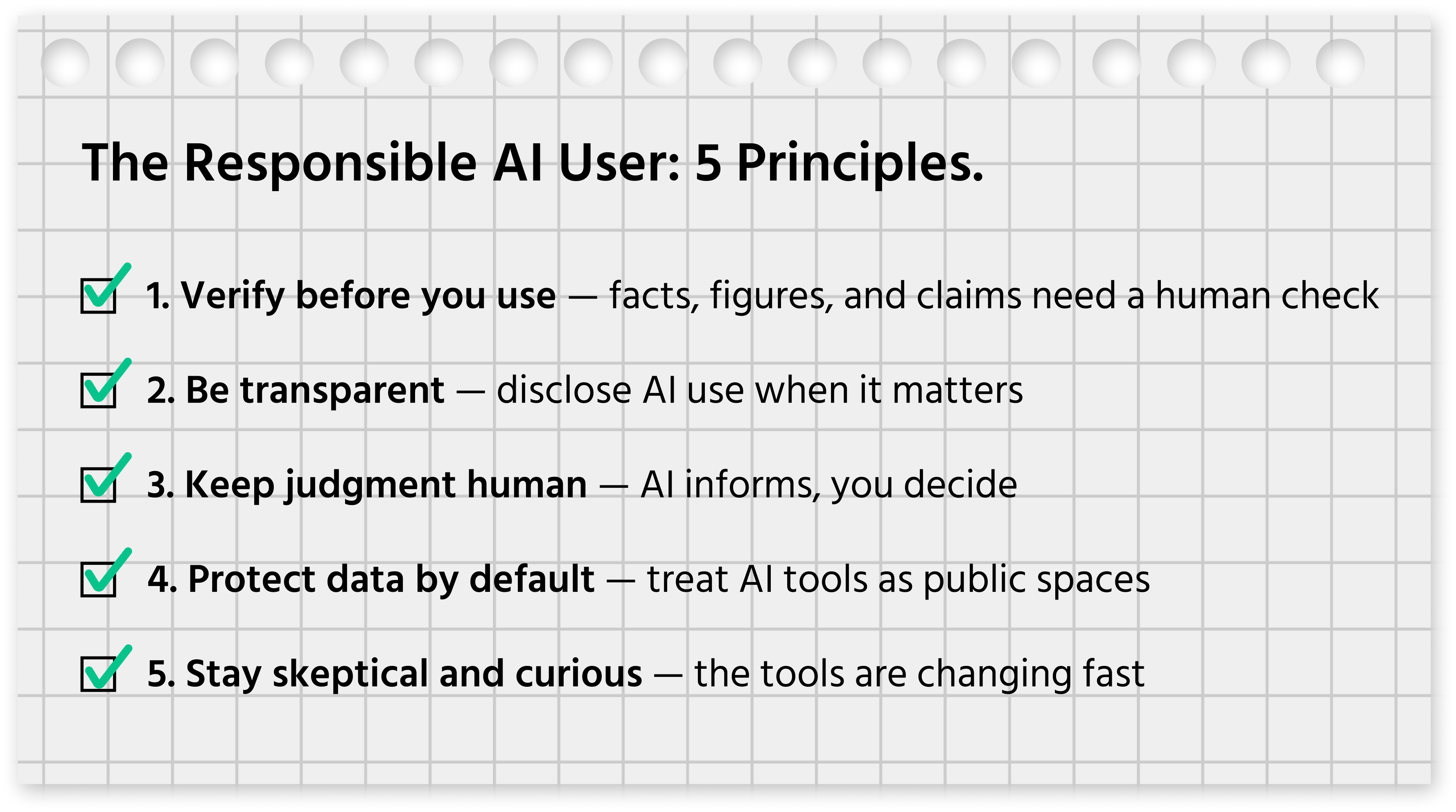
Section 3 has covered the risks — hallucinations, privacy, bias, accountability, and responsible use. You now have both the skills to get results from AI and the judgment to use it safely.
In Section 4, we bring everything together with a focus on your specific role — showing exactly how AI is being applied in marketing, HR, analytics, development, and operations, with practical examples you can adapt immediately.
1. What is the most important action to take before using AI-generated content in a professional setting according to Principle 1?
2. Which approach best follows Principle 3 — Keep Human Judgment in the Loop when making important workplace decisions?
3. What is the core message of Principle 5 — Stay Skeptical and Stay Curious, for responsible AI use at work?
Thanks for your feedback!
Ask AI

Ask AI

Ask anything or try one of the suggested questions to begin our chat
Principles of a Responsible AI User at Work
The previous chapters covered specific risks. This final chapter in Section 3 brings it together into a clear set of principles — a practical code for using AI responsibly in a professional context.
These aren't rules handed down from above. They're habits that protect you, your colleagues, and the people your work affects.
Principle 1 — Verify Before You Use
AI output is a starting point, not a finished product. Anything that will be shared, published, or acted upon should pass through a human review — with particular attention to facts, figures, and claims.
In practice this means:
- Reading AI output critically, not just scanning it;
- Checking specific claims against reliable sources;
- Asking yourself: "Would I be comfortable defending every sentence in this?"
Principle 2 — Be Transparent About AI Use
There is no universal rule about when to disclose that content was AI-assisted — but there are clear situations where transparency matters:
- When a client or stakeholder expects human-authored work and would object to AI involvement;
- When submitting work for evaluation or assessment;
- When AI generated a significant portion of content being presented as your own analysis or opinion;
- When your organization or industry has specific disclosure requirements.
When in doubt, disclose. It protects you and builds trust.
Principle 3 — Keep Human Judgment in the Loop
AI is particularly good at generating options, drafts, and analysis. It is not good at judgment — weighing competing values, understanding organizational context, or making decisions that affect people.
Tasks where human judgment should always remain primary:
- Hiring and performance decisions;
- Client-facing advice or recommendations;
- Any decision with significant impact on individuals or groups;
- Sensitive communications where tone and relationship matter.
Use AI to inform your judgment. Don't outsource it.
Principle 4 — Protect Data by Default
Until you know with certainty that a tool meets your organization's data protection requirements — treat every AI tool as a public space.
Anonymize sensitive content before prompting. Describe situations without identifiable details. When in doubt, leave it out.
Principle 5 — Stay Skeptical and Stay Curious
AI tools are improving rapidly. What is true about their capabilities and limitations today will be different in six months. The responsible AI user is not someone who learns the rules once and stops there.
Stay skeptical:
- Question outputs that seem too perfect or too convenient;
- Maintain the habit of verification even as AI becomes more accurate;
- Watch for bias and one-sidedness in generated content.
Stay curious:
- Experiment with new tools and features as they emerge;
- Share what you learn with your team;
- Revisit your assumptions about what AI can and cannot do.
Section 3 has covered the risks — hallucinations, privacy, bias, accountability, and responsible use. You now have both the skills to get results from AI and the judgment to use it safely.
In Section 4, we bring everything together with a focus on your specific role — showing exactly how AI is being applied in marketing, HR, analytics, development, and operations, with practical examples you can adapt immediately.
Thanks for your feedback!
