How to Evaluate AI Output
Swipe to show menu
Knowing that AI can hallucinate is useful. Knowing how to check its output is what makes you an effective and safe AI user.
This chapter gives you a practical framework for evaluating what AI produces — so you can catch problems before they become real ones.
Not Everything Needs the Same Level of Scrutiny
Before reaching for a fact-checking checklist, it helps to calibrate how much verification a given output actually needs.
Low-scrutiny tasks — where hallucinations matter little:
- Brainstorming ideas (you're choosing from them, not citing them);
- Drafting the structure of a document (you'll review and rewrite);
- Generating first-draft text that you'll edit heavily;
- Rephrasing something you already know to be correct.
High-scrutiny tasks — where errors have real consequences:
- Any output containing specific facts, statistics, or data;
- Legal, medical, financial, or compliance-related content;
- Content that will be published or sent to clients without review;
- Summaries of documents where accuracy is critical.
The rule of thumb: the higher the stakes, and the more specific the claim, the more carefully you verify.
A Practical Verification Checklist
Run through this before using any AI output in a professional context:
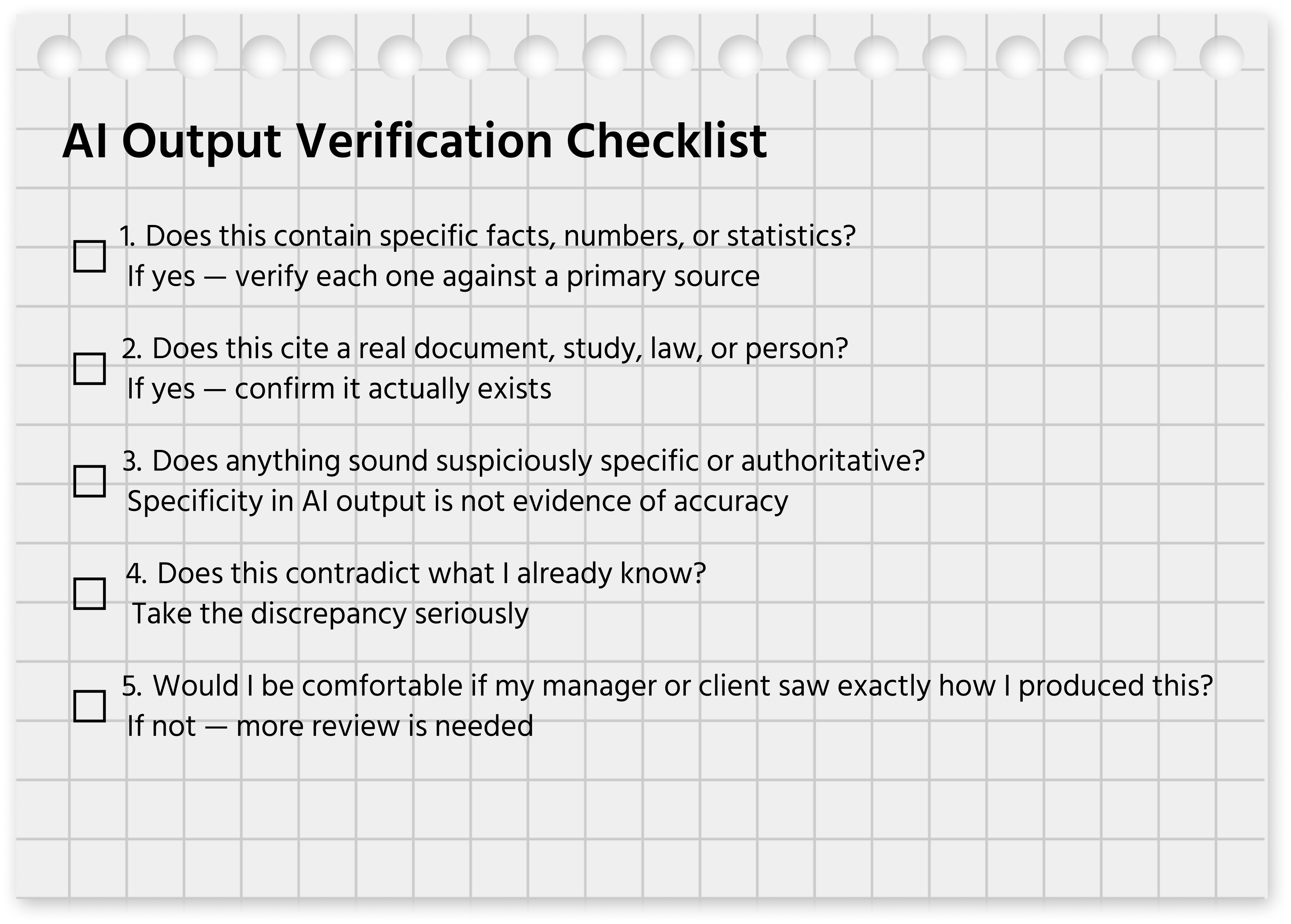
- Does this contain specific facts, numbers, or statistics? If yes — verify each one against a primary source;
- Does this cite a real document, study, law, or person? If yes — confirm it actually exists;
- Does anything sound suspiciously specific or authoritative? Specificity in AI output is not evidence of accuracy;
- Does this contradict what I already know? Take the discrepancy seriously;
- Would I be comfortable if my manager or client saw exactly how I produced this? If not — more review is needed.
How to Verify Efficiently
You don't need to fact-check every sentence. Focus your effort on:
- Named sources (people, organizations, reports) — search for them directly;
- Statistics and percentages — find the original source, not another AI-generated summary of it;
- Legal or regulatory references — check official government or institutional sources;
- Dates and timelines — easy to verify, easy for AI to get wrong.
For general content that doesn't rely on specific facts, a careful read-through by someone with domain knowledge is usually sufficient.
Practice: Check a Real AI Response
Take any response you've received from an AI tool recently — or generate one now by asking about a topic you know well.
Read through it critically:
- Identify every specific claim — a fact, a name, a statistic, a recommendation;
- Mark anything you cannot personally verify from memory;
- Check at least two of those items against a reliable source;
- Note whether the AI's output was accurate, partially accurate, or wrong.
Most of the time the output will be largely correct. Occasionally you will catch something important. The goal is to build the habit of critical reading — not paranoia about every sentence.
1. Which of the following tasks requires high scrutiny when evaluating AI output?
2. What is a practical step to verify AI output efficiently?
Thanks for your feedback!
Ask AI

Ask AI

Ask anything or try one of the suggested questions to begin our chat
How to Evaluate AI Output
Knowing that AI can hallucinate is useful. Knowing how to check its output is what makes you an effective and safe AI user.
This chapter gives you a practical framework for evaluating what AI produces — so you can catch problems before they become real ones.
Not Everything Needs the Same Level of Scrutiny
Before reaching for a fact-checking checklist, it helps to calibrate how much verification a given output actually needs.
Low-scrutiny tasks — where hallucinations matter little:
- Brainstorming ideas (you're choosing from them, not citing them);
- Drafting the structure of a document (you'll review and rewrite);
- Generating first-draft text that you'll edit heavily;
- Rephrasing something you already know to be correct.
High-scrutiny tasks — where errors have real consequences:
- Any output containing specific facts, statistics, or data;
- Legal, medical, financial, or compliance-related content;
- Content that will be published or sent to clients without review;
- Summaries of documents where accuracy is critical.
The rule of thumb: the higher the stakes, and the more specific the claim, the more carefully you verify.
A Practical Verification Checklist
Run through this before using any AI output in a professional context:
- Does this contain specific facts, numbers, or statistics? If yes — verify each one against a primary source;
- Does this cite a real document, study, law, or person? If yes — confirm it actually exists;
- Does anything sound suspiciously specific or authoritative? Specificity in AI output is not evidence of accuracy;
- Does this contradict what I already know? Take the discrepancy seriously;
- Would I be comfortable if my manager or client saw exactly how I produced this? If not — more review is needed.
How to Verify Efficiently
You don't need to fact-check every sentence. Focus your effort on:
- Named sources (people, organizations, reports) — search for them directly;
- Statistics and percentages — find the original source, not another AI-generated summary of it;
- Legal or regulatory references — check official government or institutional sources;
- Dates and timelines — easy to verify, easy for AI to get wrong.
For general content that doesn't rely on specific facts, a careful read-through by someone with domain knowledge is usually sufficient.
Practice: Check a Real AI Response
Take any response you've received from an AI tool recently — or generate one now by asking about a topic you know well.
Read through it critically:
- Identify every specific claim — a fact, a name, a statistic, a recommendation;
- Mark anything you cannot personally verify from memory;
- Check at least two of those items against a reliable source;
- Note whether the AI's output was accurate, partially accurate, or wrong.
Most of the time the output will be largely correct. Occasionally you will catch something important. The goal is to build the habit of critical reading — not paranoia about every sentence.
Thanks for your feedback!
