The S&P 500 Explained
Swipe to show menu
Most people treat the S&P 500 as "the market." That's not quite right – but it's close enough to be useful.
The S&P 500 is an index of 500 large U.S. companies, selected by a committee at S&P Global based on size, liquidity, and financial viability. It covers approximately 80% of total U.S. stock market capitalization, which is why it's used as the default benchmark for almost everything in American investing.
It is not the 500 biggest companies by revenue. It is not equally weighted. It is a market-cap-weighted index – meaning larger companies have a bigger impact on the index's movement than smaller ones.
How It Has Actually Performed
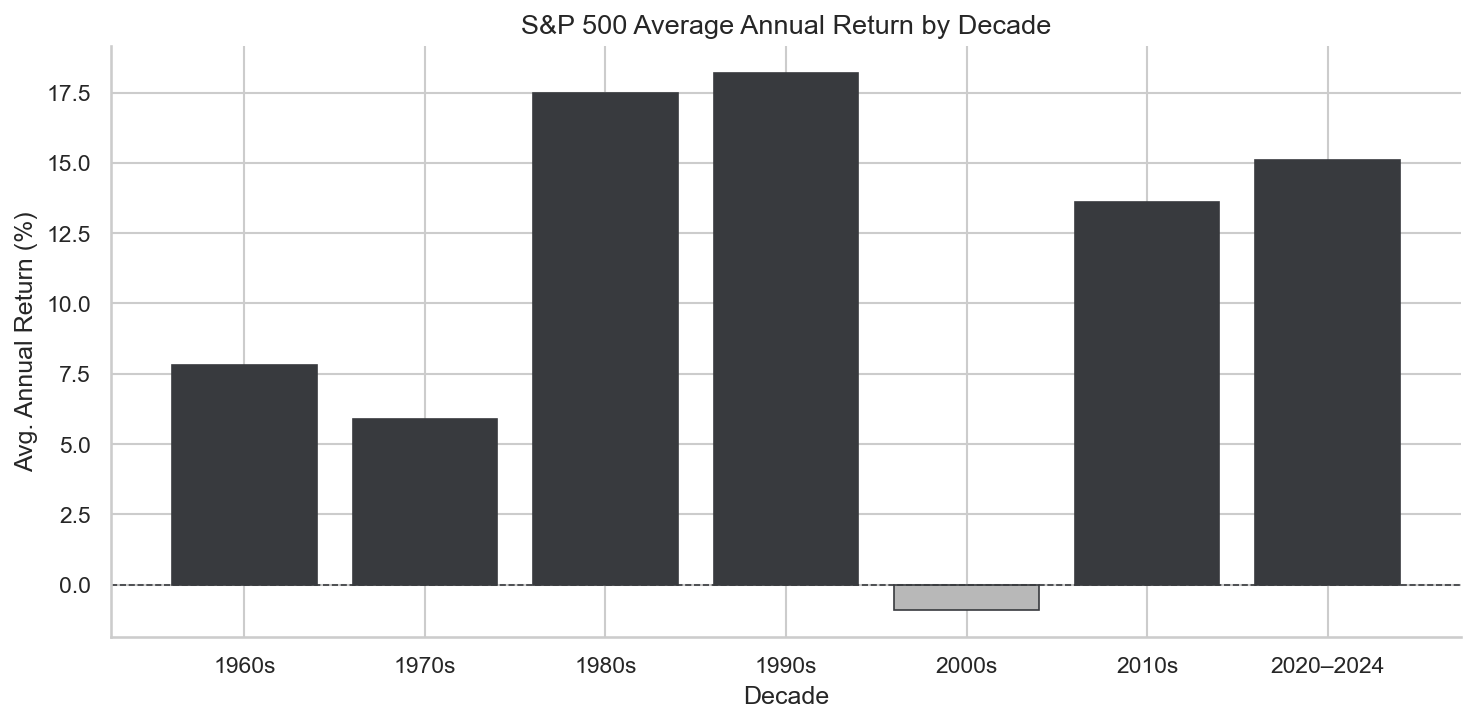
Since its modern form was established in 1957, the S&P 500 has returned approximately 10% per year on average – or about 7% after inflation. That number hides enormous year-to-year variation.
The 2000s produced a negative decade. Someone who invested in 2000 and sold in 2009 lost money. Someone who held through 2019 turned that same investment into a strong gain. Time horizon is everything.

A market-cap-weighted index tracking 500 large U.S. companies across all major sectors. It is the most widely used benchmark for U.S. equity performance and serves as the default definition of "the market" in American finance.

The S&P 500 survivorship bias is real – only successful companies stay in the index. Companies that fail or shrink get removed and replaced. This makes the long-term return look cleaner than the actual experience of picking individual stocks, most of which underperform or fail entirely.
1. The S&P 500 is a market-cap-weighted index. What does this mean in practice?
2. An investor put money into an S&P 500 index fund in January 2000 and sold in December 2009. What does the historical data suggest about this outcome?
Thanks for your feedback!
Ask AI

Ask AI

Ask anything or try one of the suggested questions to begin our chat
