The Real Cost of Missing the 10 Best Days
Swipe to show menu
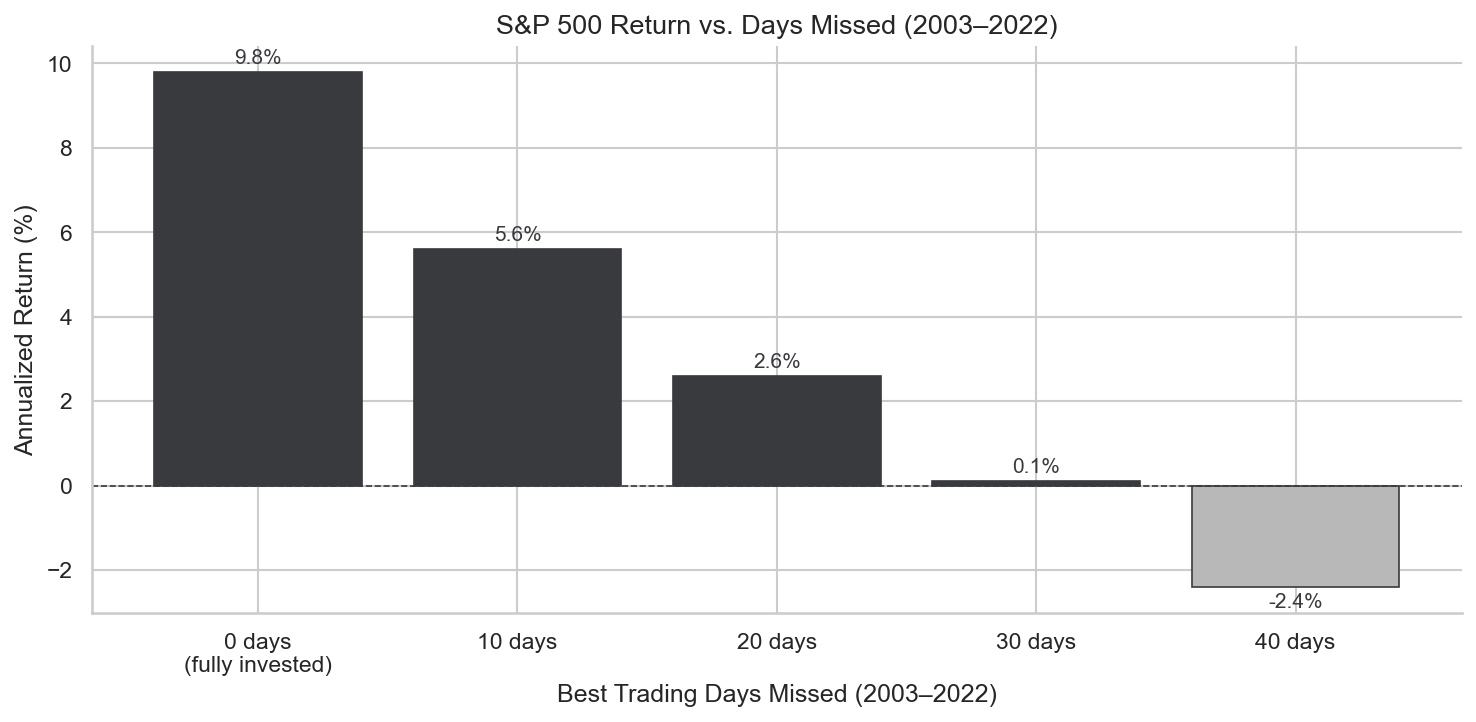
Between 2003 and 2022, the S&P 500 returned approximately 9.8% per year to an investor who stayed fully invested. Miss the 10 best trading days over those 20 years – just 10 days out of roughly 5,000 – and that return drops to 5.6%. Miss the 20 best days and it falls to 2.6%.
A fully invested portfolio turning $10,000 into ~$64,000 over 20 years becomes ~$30,000 if you miss just 10 days. The math is brutal – and it gets worse when you look at when those best days actually occur.
When the Best Days Happen
The best trading days don't happen during calm, confident bull markets. They happen during the most volatile, frightening periods – right in the middle of or immediately after bear markets.
Six of the ten best days in the 2003–2022 period occurred during bear markets. The three best single days in S&P 500 history all occurred during the 2008–2009 financial crisis. Investors who sold to "wait out" the downturn missed the exact days that drove long-term returns.
This creates an unavoidable problem for market timers:
- To avoid the worst days, you have to exit the market during downturns;
- Exiting during downturns means missing the best days, which cluster in the same periods;
- Missing the best days destroys long-term returns far more than riding through the worst days would have.

Missing the 10 best days and missing the 10 worst days produce surprisingly similar outcomes over long periods – the asymmetry in this analysis runs both ways. The real point isn't that you must never sell. It's that trying to time the market consistently enough to avoid the bad days without missing the good ones is practically impossible – the two tend to cluster together.

J.P. Morgan Asset Management publishes an annual "Guide to the Markets" that includes an updated version of this analysis. It is one of the most widely cited data points in the case for passive, long-term investing and is updated with each calendar year.
1. An investor exits the S&P 500 during a bear market to "wait for things to stabilize" and re-enters three months later. What risk does this behavior most directly create?
2. A fully invested S&P 500 investor earned 9.8% annually over 20 years. A market-timing investor missed the 20 best days over the same period and earned 2.6% annually. On an initial $10,000 investment, approximately how does this difference play out?
Thanks for your feedback!
Ask AI

Ask AI

Ask anything or try one of the suggested questions to begin our chat
The Real Cost of Missing the 10 Best Days
Between 2003 and 2022, the S&P 500 returned approximately 9.8% per year to an investor who stayed fully invested. Miss the 10 best trading days over those 20 years – just 10 days out of roughly 5,000 – and that return drops to 5.6%. Miss the 20 best days and it falls to 2.6%.
A fully invested portfolio turning $10,000 into ~$64,000 over 20 years becomes ~$30,000 if you miss just 10 days. The math is brutal – and it gets worse when you look at when those best days actually occur.
When the Best Days Happen
The best trading days don't happen during calm, confident bull markets. They happen during the most volatile, frightening periods – right in the middle of or immediately after bear markets.
Six of the ten best days in the 2003–2022 period occurred during bear markets. The three best single days in S&P 500 history all occurred during the 2008–2009 financial crisis. Investors who sold to "wait out" the downturn missed the exact days that drove long-term returns.
This creates an unavoidable problem for market timers:
- To avoid the worst days, you have to exit the market during downturns;
- Exiting during downturns means missing the best days, which cluster in the same periods;
- Missing the best days destroys long-term returns far more than riding through the worst days would have.
Missing the 10 best days and missing the 10 worst days produce surprisingly similar outcomes over long periods – the asymmetry in this analysis runs both ways. The real point isn't that you must never sell. It's that trying to time the market consistently enough to avoid the bad days without missing the good ones is practically impossible – the two tend to cluster together.
J.P. Morgan Asset Management publishes an annual "Guide to the Markets" that includes an updated version of this analysis. It is one of the most widely cited data points in the case for passive, long-term investing and is updated with each calendar year.
Thanks for your feedback!
