The Efficient Frontier
Swipe to show menu
You now know how to measure return, risk, and the variance of a combined portfolio. The efficient frontier is what happens when you run those calculations across every possible combination of assets and weights – and plot the results.
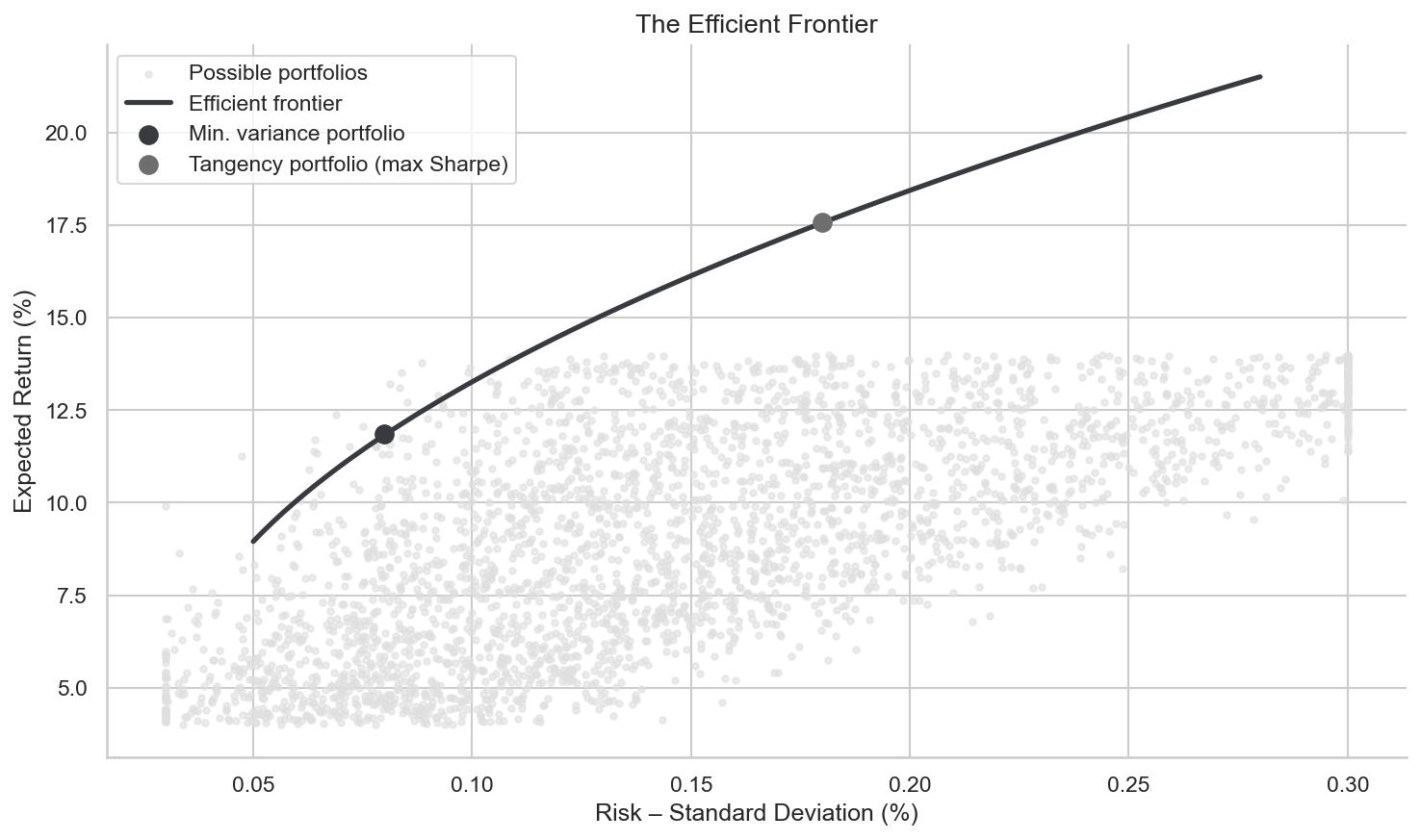
Each dot on the chart below represents a portfolio with a specific expected return and standard deviation. The curved line connecting the best portfolios – the ones that offer the highest return for each level of risk – is the efficient frontier.
Any portfolio sitting on the frontier is efficient: you can't get more return without accepting more risk, and you can't reduce risk without sacrificing return. Any portfolio sitting below the frontier is inefficient: a better option exists at the same risk level.
What the Frontier Tells You
The efficient frontier doesn't tell you which portfolio to pick. It tells you which portfolios are worth considering at all – and eliminates every option that is dominated by a better one.
Where you sit on the frontier depends on your risk tolerance:
- Left end of the curve: minimum variance portfolio – lowest possible risk, lower expected return;
- Right end of the curve: maximum return portfolio – highest expected return, highest volatility;
- Your optimal point: the highest Sharpe ratio portfolio – the point where the line from the risk-free rate is tangent to the frontier.
The tangency point is called the market portfolio in Modern Portfolio Theory. It represents the best possible risk-adjusted return available from the given set of assets.
- Below the frontier: inefficient – a better portfolio exists at the same risk level;
- On the frontier: efficient – no improvement is possible without a tradeoff;
- Above the frontier: impossible – no portfolio can exist there given the available assets.

The set of optimal portfolios that offer the highest expected return for each level of risk, or the lowest risk for each level of expected return. Portfolios on the frontier are efficient; portfolios below it are suboptimal.

The efficient frontier is built from historical data and assumed correlations – both of which change over time. A frontier calculated in 2019 looked very different from one calculated in 2023. The concept is a powerful framework for thinking about portfolio construction, but it shouldn't be treated as a precise engineering tool.

The efficient frontier was introduced by Harry Markowitz in his 1952 paper "Portfolio Selection" – the same work that formalized the role of correlation in diversification. The concept became the foundation of Modern Portfolio Theory and directly influenced how institutional portfolios are constructed today.
1. An investor's current portfolio has an expected return of 8% and a standard deviation of 14%. A different portfolio exists with an expected return of 9% and a standard deviation of 14%. What can you conclude?
2. An investor wants the best possible risk-adjusted return from a given set of assets. Which point on the efficient frontier should they target?
Thanks for your feedback!
Ask AI

Ask AI

Ask anything or try one of the suggested questions to begin our chat
The Efficient Frontier
You now know how to measure return, risk, and the variance of a combined portfolio. The efficient frontier is what happens when you run those calculations across every possible combination of assets and weights – and plot the results.
Each dot on the chart below represents a portfolio with a specific expected return and standard deviation. The curved line connecting the best portfolios – the ones that offer the highest return for each level of risk – is the efficient frontier.
Any portfolio sitting on the frontier is efficient: you can't get more return without accepting more risk, and you can't reduce risk without sacrificing return. Any portfolio sitting below the frontier is inefficient: a better option exists at the same risk level.
What the Frontier Tells You
The efficient frontier doesn't tell you which portfolio to pick. It tells you which portfolios are worth considering at all – and eliminates every option that is dominated by a better one.
Where you sit on the frontier depends on your risk tolerance:
- Left end of the curve: minimum variance portfolio – lowest possible risk, lower expected return;
- Right end of the curve: maximum return portfolio – highest expected return, highest volatility;
- Your optimal point: the highest Sharpe ratio portfolio – the point where the line from the risk-free rate is tangent to the frontier.
The tangency point is called the market portfolio in Modern Portfolio Theory. It represents the best possible risk-adjusted return available from the given set of assets.
- Below the frontier: inefficient – a better portfolio exists at the same risk level;
- On the frontier: efficient – no improvement is possible without a tradeoff;
- Above the frontier: impossible – no portfolio can exist there given the available assets.
The set of optimal portfolios that offer the highest expected return for each level of risk, or the lowest risk for each level of expected return. Portfolios on the frontier are efficient; portfolios below it are suboptimal.
The efficient frontier is built from historical data and assumed correlations – both of which change over time. A frontier calculated in 2019 looked very different from one calculated in 2023. The concept is a powerful framework for thinking about portfolio construction, but it shouldn't be treated as a precise engineering tool.
The efficient frontier was introduced by Harry Markowitz in his 1952 paper "Portfolio Selection" – the same work that formalized the role of correlation in diversification. The concept became the foundation of Modern Portfolio Theory and directly influenced how institutional portfolios are constructed today.
Thanks for your feedback!
